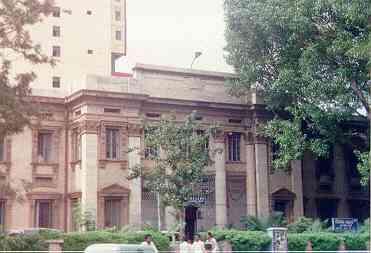
Bangalore around the late 1920's ...
YOUR COMMENTS PLEASE
Until 15th August 1947, the City of Bangalore comprised of two separate
areas, Bangalore City (Petta) proper which was administered by the Maharaja
of Mysore, the other area was known as a Civil and Military Station (Cantonment),
administered by the British Government through the Resident. (Click
on the Blue coloured 'hyper-text' below paragraphs
for photographs) If one were to go back to the late 1920's
it's geography consisted of Shoolay, The
Parade (later Parade Grounds) , Northern Suburbs (St.
John's Hill, Fraser Town, Cleveland Town,
Benson Town, Cox Town and Richard's Town),
Eastern Suburbs (Ulsoor, Knoxpet and Agram),
Southern Suburbs (Richmond Town, Langford Town
and Austin Town). Even today these Suburbs still exist except
perhaps Knoxpet which was converted into Murphy Town. The residences of
the "Elite" of Bangalore were situated in an area known as "High
Grounds", and were not within the Cantonment limits which adjoined
them on the Eastern side. It was for a visitor a very difficult question
to decide which was the best Suburb in the City of Bangalore to reside
in. Much depended on the "purse" and "tastes" of the
individual. Russell Market and Blackpully was part of the
Northern Suburb of the Cantonment.
The outskirts of the City were open, healthy, and the houses prettily
built, well suited for people who desired to lead quiet and retired lives.
It was however a disadvantage being far from places that matter. There
was much gaiety in the areas closer to the main Schools and Colleges, Clubs,
Institutes, Theaters, Shopping Centres, as this was the "Social"
make up of the City. Because of the cool weather, people used to take drives
in open carriages through the City, enjoying the scenes of beautifully
laid out gardens. Parks were found in a number of places, some of them
had Bandstands, where the Armed Forces Band played every week.
Noted shopping centres in the 1920's were Commercial Street, South Parade
( now referred to as M.G. Road ), St.Mark's Road (the shopping block was
what is now India Garage), and Brigade Road, all near each other. Commercial
has still kept it's remarkable business for all classes of people, and
one could get practically anything at these places. One could find the
European shops on South Parade, a few on St. Mark's Road and Brigade Road.
There was an Evening Bazaar and a Gooj where one could pick up all kinds
of commodities like used clothes, cameras, and almost any imaginable article,
some almost new and at about one-tenth of it's original price. The Gooj
even today, is still a very interesting place to visit, but one has to
keep an eye on one's purse and also not be tricked into buying some real
junk.
Photographers were situated around South Parade, like Bangalore Photo
Stores at No.4, South Parade, Picture House, No. 2, Brigade Road. Some
of the cameras were the Amateur Cine-Kodaks and Cine-Codoscopes for taking
Home Movie pictures. Many a visitor needed their services to take back
some of the memories of Bangalore, and some of the photos taken in those
days are still hanging on many a wall in silent testimony of the good workmanship
and products.
Let's take an amble starting from Shoolay, which is perhaps the most
central of all the Suburbs. The northern area contained several prominent
buildings, and palatial residences of Europeans and Anglo-Indians. Some
called it the "Chowringhee" (this is a reference to a prominent
place in Calcutta) of Bangalore. Some of the landmarks were St. Patrick's
Cathedral (redesignated as "Church"), which was situated on Residency
Road. The Cathedral was built in the form of a Latin Cross and the main
portion seats 800 and the two wings around 200 people. Relics of the True
Cross and St. Justin the Martyr are kept here. The building has a very
imposing facade over which are the words "Hoec Est Domus Domini"
which means " The House of the Lord". The Fourteen Stations and
Altars were of exquisite beauty and workmanship. Although today the interior
architecture has changed considerably and the beautiful Main Altar replaced,
some of the old Side Altars still maintains some of their original beauty.
The Cathedral was erected in 1844. The Church was redesigned and consecrated
on 12 November 1899.
Attached to St. Patrick's Cathedral is the St. Patrick's Orphanage (
also known as St.
Patrick's Boys Home) and School. This Institution was meant for the
children of European and Anglo-Indian parents who were in destitute circumstances.
It was opened in 1893. There was accommodation for 150 boys and was the
largest in Bangalore. The boys were lodged, fed, clothed and educated free
up to the Middle School Standard. Poorer boys of the locality also attended
the Day School and even received free mid-day meal and clothes from the
funds. The Boys were given a good all-round education. Rev. Fr. Antoine
Marie Tabard, was very much involved in the building and collection
of funds for it's construction. To the south of Shoolay one would find
the Church of the Sacred Heart with it's very
old cemetery for Priests, Soldiers and Europeans. The Priests of the Paris
Foreign Mission were buried in this cemetery. Today, sad and unfortunately,
only the Priests' Cemetery remains. The old Cemetery was leveled out and
some of the old grave stones can be seen in parts of the steps around the
Church.
The Parade (or Maidan) as it was called, is nearly three miles in perimeter.
The roads from the West of the Parade branches off through Cubbon Park
called the "Pears' Ride" another branch was called the "Rotten
Row". The military authorities have taken pains to keep the Parade
in fine condition. Turfed slopes, paths for pedestrians, shady trees, stone
seats, a garden opposite St. Mark's Church (Gandhi Park today), gave great
joy to the residents of this area and outsiders. The troops paraded here
for Reviews, Inspections and on other ceremonial occasions when the Resident,
the Government Officials, the "Sahibs" and their wives turned
out to witness the maneuvers and hear the pipers and bands.
On the Northern side of the Parade is Cubbon Road, and the B.R.V. Theater,
Brigade Staff Offices, St. Andrew's Chruch, Baird
Barracks, and at the East end of it is the Wesleyan Church (East Parade
Church) and the Soldiers Home, and further East one comes to the Holy Trinity
Church. The Southern side of the Parade one finds the South Parade (M.G.
Road) . The South Parade was an area where business was conducted in Bangalore.
A few buildings that existed in the 1920's were Whiteaways', Funnells'
Restaurant (now the premises of the Deccan Herald), Empire Theatre*, Higginbothams*,
Wrenn, Bennett & Co. Ltd (the best ladies garments and millinery
displayed here), Baccalas' Restaurant. Near the Mayo Hall is a cross
road called the Commissariat Road, where one can find the Ebenezer Chapel,
belonging to the Bangalore Free Communion Baptist Church. (The Church was
formed on 26th November 1854 and the building Opened on 18th August 1867.
It was formed by the late Rev. T.C. Page of Madras. On 30th March 1856,
Mr. Marsden, became its next Pastor. Besides watching over this Christian
Community, Mr. Marsden devoted a considerable portion of his time to evangelistic
visitation amoung the residents of Bangalore, particularly the Military,
of whom there was always a very large number at the Station). At the Parade's
Western end were "The Shaftesbury", Oriental Buildings*, Bible
and Tract Society*, and at the Eastern end, Bangalore Library, Mayo
Hall*, Public
Offices*, and Gymkhana Pavillion* (now become the RSI Officers Mess)
(* - Buildings that are Still existing).
There were six European Schools and two European Colleges in Bangalore,
for the education of the Anglo-Indian and European boys and girls. Three
were for girls and three for boys. There were also a few private Mission
Schools , and quite a lot of schools for the European Community.
St. Joseph's College on Residency was the
prime First Grade College under the University of Madras, and was housed
in a three storied building. The ground floor was occupied by Chemistry
and Language Departments. Rooms were also reserved for B.A. English and
History Departments. On the first floor was the Principal's Office ( earlier
known as Residence), the Library, the College Offices, the Intermediate
English lecture rooms, and the Physics lecture rooms and Laboratory. On
the second floor were the Professors' Room, the Mathematics and Intermediate
History lecture rooms, and the College Hall which was used for examinations
and composition work. A Reading and Common Room for students was provided
in the vicinity of the Library. The College Hostel on Residency Road, just
a few minutes' walk from the College, provided accommodation for European
and Local students. The Principal of the College was the Warden of the
Hostel also. Apart from English, in the 1920's the College offered instruction
in the following languages and subjects - for the Intermediate Course
and B.A. (Honors) Degree Course - French, Sanskrit, Tamil, Telugu,
Kanarese; Mathematics, Physics, Chemistry, Economics, Ancient History,
Modern History and Logic. The Physics and Chemistry Laboratories were well
equipped with water, gas and electricity. The Library contained over 4000
volumes. Ample provision was made for games of which the Physical Director
of the College, held a Diploma in Physical Education was the Superintendent.
The College was under the management of the Roman Catholic Mission of Mysore
- The French Foreign Mission, and was open to students of all communities
without distinction. In 1929, there were 280 students in the Intermediate
and B.A. classes of whom 18 were ladies. In 1939, the College was handed
over to the Jesuits.
There were two schools attached to this College, the European Section
( originally called St.
Joseph's European High School, today it is known as St.
Joseph's Boys High School) built in the form of the letter H. It prepared
students for High School and Cambridge examinations. It accommodated 300
boarders in the upper dormitories. It had a beautiful Chapel. The School
was founded in 1865. It was said that great care was taken to impart to
the pupils a sound moral training, to improve their minds, and hearts,
to inculcate in them gentlemanly manners and habits of regularity and cleanliness.
In short to prepare them for the duties of after school. Two large and
open play-grounds afford ample space for cricket, football, hockey, tennis,
badminton and other games and exercises. One was situated on the School
premises. The other, a much larger field called "New Field"
near the United Breweries. Great attention was paid to physical training
and games apart from studies. The School possessed a Cadet Platoon and
a Boy Scouts' Troop (some of the photographs are available at the School's
Old Boys' Office).
The other school was the Indian Section ( St. Joseph's Indian High School)
and was in the 1920's a three storied building on Museum Road. It educated
Indian boys irrespective of caste or creed up to the school final course
of the Madras University and had accommodation of upto a 100 students.
Attached to this school was the St. Louis' Boarding House, which housed
for a small sum the boys from this school. It had a playground of six acres
in the bed of Old Shoolay Tank ( today this is the St. Joseph's Commerce
College premises). The School has moved to the New Field Grounds new Cubbon
Park.
The College and the Schools were managed by the Society of French Foreign
Missions of which the Superior was the famous Abbe' Dubois. For History
click on St. Joseph's
Colleges and Schools, and the Jesuits.
All Saints' Church and Institute
This Church is situated on Hosur (Hoosur) Road in Richmond Town . The
Church was built in 1870. An English built Pipe Organ was erected in August
1905. A Parsonage was also attached to it. The Institute is located on
the junction of Alexander Street and Wellington Street. It was originally
a grant from the military authorities for the use of pensioners as Reading
Room. When that was given up, the building was used as Armoury for Volunteers
who vacated on constructing their own building. In 1901 the All Saints'
Incumbent, Canon Foley was given the same by the then Resident, Mr. Robertson
and it was used as the Church Institute for young people and a place of
meeting for parishioners. In 1908 under Rev. Walsh a Reading Room and Library
was organised by the men's society and in 1911 it was handed over to the
Church Committee who manage the affairs of the Institute and it is now
in a very flourishing condition. In 1912 the building was enlarged and
electric lights installed. There is a stage and for a small fee it is let
out for concerts and other entertainment. The Building in all respects
fulfills the intention of the donors because the Civil and Military pensioners
freely use the Institute; besides being the favourite resort of the young
for games, meetings and concerts. The Institute was also known as the Richmond
Institute, and today Frank Anthony Junior School runs on the premises,
and also extends to the next plot which belonged to Mr. Moore. All
Saint's Church in the midst of trees, and a
stately profile. A little walk down Hosur Road will take you past the
Bangalore Military School, Johnson Market, and Baldwin Boys' School.
Baldwin Boys' High School
The School is on Hosur Road, Richmond Town. It is a Boarding School
belonging to the Methodist Episcopal Mission. The chief features are a
laboratory, large dormitory and two big halls. Students are prepared for
High School and Cambridge Examinations. The School was established in 1880
by Bishop Oldham. The buildings were erected by liberal donations from
Mr. Baldwin of U.S.A. The Institution is managed by a Board of Governors.
A brief History. The School has now opened a Junior
College section a few years ago.
Home For The Aged
This remarkable institution stands on Hosur Road. It is maintained by
voluntary subscriptions and is managed by the Roman Catholic Order of Nuns
known as "Little Sisters of the Poor ". It is a home for
the destitute, aged, poor and infirm who are over 60 years of age and who
seek its shelter. All persons irrespective of caste and creed are admitted
to the Home. The inmates number about 140 in the late 1920's. Today the
numbers have grown, and a new block is under construction on the North
side along the wall of Baldwin Boys' High School. History.
Similar Institutions could be found on Glory.
Richmond Town Park
The Park is situated to the South -West of Richmond Town along Kingston
Road. It provided and still provides a necessary recreation ground for
the young and old of the locality. There was a Bandstand and a band
occasionally played at the Park. There are paths neatly laid out and had
pretty flower beds. It is certainly a credit to the Municipality that what
was once a tank has now been converted into a beautiful park. Today the
Park is used very much by the local residents for morning exercise, and
in the evenings for children to play. The garden has always been well maintained
with pretty flower beds neatly arranged. A fountain was later constructed
in the centre of the Park, and a new stage towards the North-West section
was built. It is used quite frequently for dramas and musical evenings.
Baldwin Girls' High School
The School is on Richmond Road at it's Western end. The School was established
in 1879 and was managed by the same Board which controlled the Boys' School.
It was attached to the Methodist Episcopal Church on Myrtle Lane. It has
commodious premises, large class-rooms and upstair dormitories. In the
1920's there was accommodation for 100 Boarders and 100 Day scholars. The
girls were prepared from Kindergarten to High School and Cambridge Examinations.
Special attention was paid to music, drawing, dress-making, ample scope
for tennis, badminton, and basket-ball. Attention was paid to the intellectual,
physical and moral training of the girls and in every way it provided a
thorough education for European and Anglo-Indian children. History.
Hosur Cemeteries
The Cemeteries are to the South of Richmond Town on the Hosur (or Hosoor)
Road. Protestant and Catholic Cemeteries are side by side. In the centre
of the Old Protestant Cemetery stands a tall monument erected
to the officers and men of 16th Queen's Lancers who died in India. In the
1920's, the walks and gardens were well kept. Today this Old Cemetery is
neglected and full of bushes and snakes, and the graves cannot be reached
for fear of being bitten. In the Cemetery a portion was assigned to each
denomination. The New Protestant Cemetery on the opposite side of
the road facing the Catholic and Old Protestant Cemeteries is very large
and is very well maintained. The South section of the Old Cemetery is said
to be still used.
In the Roman Catholic Cemetery are some fine and handsome tombstones,
some leading back to 1877. The Cemetery is maintained by St. Patrick's
Church. The present Supervisor is Mr. Adams, and Members of the Cemetery
Committee are Sydney Mendens (Incharge), Major Cherian and Ronnie Johnson,
besides the Parish Priest. Graves
& more graves.
Request is made to families having deceased relations buried in the
cemetery to pay Rs.100/- per year towards the Cemetery & Grave maintenance.
Municipal Model Houses
Encouraged by Mr. Austin, the Collector and Municipal President, the
Municipality had built in the 1920's a number of small cottages in Austin
Town for the benefit of the poorer classes. These cottages with two
and three rooms were rented for nominal sums. They were in great demand
by poor Anglo-Indians and Indians. Compared to the regular private houses
these could be called "Huts". The adjacent locality was mainly
the abode of servants who were working in Shoolay. The neighbouring areas
were Neelasandra, Agram and Vannarpet. These houses are still occupied
by descendants of the original occupants.
Some of the Recommendations for
a Visitor to Bangalore in the 1920's
...
Some of the Other Sites recommended to a visitor to Bangalore Civil
and Military Station in the 1920's .
In the North-West Sector - The Mysore Maharaja's Palace,
Palace Orchard, Palace Race Course, Palace Polo Ground, Mysore Transport
Lines, Mysore Lancers' Lines, Kaiser-i-Hind Mills, Hebbal Experimental
Farm, Kempe Gowda Tower, Sandalwood Oil Factory, Jewel Fitters, Hebbal
Rifle Range and the world famous Tata's Indian Institute of Science.
In the West Sector - The Golf Course, Race Course (opposite
the West End Hotel), Central Jail (opposite the Race Course), Central College,
Meteorological Observatory, Health Institute, Mythic Society ( a new block
has been built behind Daly Hall), Cubbon Park Band Stand, Sir Mark Cubbon's
statue, Mysore Public Offices (now Karnataka Government Offices, High Court
known as the Attara Kacheri), Sheshadri Iyer Memorial Hall and Public Library
(a circular red building in Cubbon Park) , Mysore Government Museum (on
Kasturba Road), Cenotaph (Not to be seen), St. Martha's Hospital, Municipal
Offices, Daly Memorial Hall.
In the South-West Sector - The Fort and Tippu's Palace,
Victoria Hospital, Minto Ophthalmic Hospital, Vani Vilas Hospital, Lal
Bagh, Kempe Gowda Tower, Tata's Silk Farm
In the East Sector - Whitefield
, also further East about 70 miles is the Kolar Gold
Mines generally referred to as K.G.F., said to be one of the deepest
mines in the world.
On South Parade, Brigade Road,
St. Mark's Road and Commercial Street, back in
the early 1920's "Where You could Buy What!!"
One of the biggest shopping complex on Brigade Road
in the 1920's was the "Campbell Building" at No. 7, Brigade Road.
This building house quite a number of Shops and Establishments. To start
with, there was Campbell & Sons (Estd. 1895), Electricians (by Appointment
to His Excellency the Rt. Hon. The baron Hardrige of Penshurst), Tile
and Stone Merchants, dealing with Mangalore pattern tiles, roofing, flooring,
ceiling tiles manufactured by the famous Basel Mission at Mangalore, Hardwood
Door Handles, famous House & Commission Agents with the motto "Build,
Buy, Sell, Let, Repair, Improve or Electric-Light a Bungalow!",
Campbell also was able to supply you with a "private' Telephone connection
at home besides doing Printing jobs. Brigade Road also had the pick of
shops dealing with vehicles, one could pick up from F.T. Peters & Co.,
automobile parts or get carriages built (those days a Rickshaw with
rubber tyres cost Rs.250/- while one with Iron tyres cost Rs.200/- !).
and get the tyres fixed by a then new process of vulcanizing called the
"Harvey Frost" process. Here one could pick up the speedy "Velocette"
motorcycle. Being decked up with top-hats and high collars, and ladies
with their plumed hats and fancy millinery, a quick nip into Dalley's Studio
at 7A Campbell Building for a soft-edged portrait in amber bromides, those
visiting from K.G.F. patronised this popular photographer.
Gentle & Co. at 7C Campbell Building had a specialist French engineer
L.Duchamp who was an expert on automobile lighting and "magneto-electricity"!.
The Brigade Stores also was in the same Building, and sold wines, cigars
and cigarettes. Ali Mohamed & Brother, a General Merchant and Dress
Maker has a shop at No.7, and deals in Millinery, Haberdashery, Draperies,
and Hosiery items. The Bangalore Pharmaceutical Company, was the Chemist,
Druggist and Optometrist at Campbell Building. Furniture, new and hired
could be got at The Victory Furnishing House at No.111 Brigade Road. If
you wanted a custom carriage or a special designed wrought iron gate or
a garden bench, you could get it at G. Swasbrook at No. 12. Looking for
a cold beer and a round of billiards you could step into 'Ye Olde Bulle
& Bushe'. Turning off Brigade Road, one can divert into a quiet section
of this Town and find R.A. Thompson, B.A., Law and House Agent, Conveyaner,
at No.5, 'Mango Dell', Rest House Road, if one wanted some Legal
work done for Sales, Mortgages and Loans. Back on Brigade Road, one can
get a carriage built at The Coronation Carriage Works under M. Aga &
Co., at Nos. 103-105 Brigade Road. It is possible that 'New
King' built in 1901, was a garage for a carriage, because of it's appearance
and shape, also being at the corner of Castle Street and Brigade Road.
If your were to go further down the road, you would know surely you were
heading in the wrong direction when you came to the Elgin Electric Flour
Mills, a beautiful red building, alas, it's gone today, and a set of flats
are coming up on the site. Another Genneral Merchant was B.V. Venkataswamy
Naidu & Sons under Rao Sahib at No.10. For a more sobering thought,
one could go down to No.14, Brigade Road, and order a coffin or a stone
from Snaize Brothers (Estd. 1870), further down the road on Langford Road
was Stableton a stone sculpturer. The Snaize Family, are the only old undertakers
of the City still in business, , others have succumbed to the business
itself.
On South Parade, at No.1, to
be more precise, one could pick up a good "Oliver" typewriter
or a "Burroughs Adding & Calculating Machine" for one's Office
or to be impressive and send off to England "Official" letters.
In those days, people did concentrate on "Cursive" handwriting,
when the "quill" gave way to the "dip-pen". The lettering
was very rounded with curls and twists. A busy place was Hill's News Agency
and Music Depot at No.2, South Parade. Attached was a Reading Room, Book
Club, Billiard Room, all within the premises. The entrance to the Billiard
Room was from Museum Road, giving us a location of the building. If one
wanted to buy silks, carpets and other hosiery items, A. Lavender &
Co. at Prince of Wales Building was just the place. (Mr. Lavender who
owned the enterprise also was in the hotel business, and had a beautiful
hotel on Cubbon Road. Today it is totally annihilated by the road that
connects Raj Bhavan Road with Infantry Road at the junction of Capitol
Hotel, Coffee Board, & Visveswaraya Centre, New GPO Building.)
The officers got their personal vehicles serviced at the Military Garage
at No.37 South Parade, which also sold tyres and tubes and did vulcanizing
work, while their cars or bikes were being serviced, they could go next
door to the Bangalore Photo Stores at No.36, and pick up film or leave
film for processing, or get components for Kodak cameras, this was situated
negr the Wesleyan Soldiers Home ( close to the Mayo Hall end of the road).
Down towards Agram through Brunton or Primrose Roads, one came across M/s.
George Hall, Army Merchants and this concern was adjacent to Cornwallis,
More House & Pekin Barracks. A couple of names crop up one S.Shamsuddeen
& Co. Army Contractors, dealers in Mineral Waters, Bread, Pastry, Italian
& French Confectioners; then there was Marlam & Co well known as
watchmakers and jewelers; L.A. Pourwal & Co., General Merchants and
Wholesale dealers in piece goods of the Buckingham, Carnatic, Bangalore
Wollen Cotton and Silk Mills (Binny's). The Royal Dispensary under Shrieves
& Co. (Estd. 1886) were well known dispensing Chemists and druggists.
Off South Parade and parallel to St. Mark's Road one finds Jules Phaure,
the oldest Land (House Estate) and Commission Agent in Bangalore, at No.11,
Museum Road. If you wanted to buy something or sell something, the best
place you could go to was Abraham & Co. the pioneer Auctioneers of
the "Station" at No.1 South Parade, Furnature could be hired
or sold, Trollies and Hackney Carriages hired, House & Estate Agency
also thrown in, and if you were going out of the Station for some time,
they would store your personal effects, one is not too sure how 'personal'
the effects could be, for many a Tommy never returned to collect
his 'effects'! Spencers & Co. Ltd., close to the Crystal Palace Theater,
dealt with cars like the Chandler car, Saxon, Brical, Maxwell, and also
Michelin Tyres. They also stocked grease and lubricants under the trade
name of 'Gargoyle'!, and sold the famous 'Coventry' Eagle cycles. A big
shop for the ladies was the Indian Silk Depot, under the management of
V.K. Chandumal, which stocked Indian, Chinese, Japanese, Burmese silks,
and C(K)ashmiri Shawls, and Curios to match the silks. With the amount
of activity on South Parade, and the headbanging at Funnells, there was
ample scope of a number of chemists, one could step into J.B. Forester
& Co. (not to be mixed up with the Bold & Beautiful!) for
some relief.
At one end of South Parade, is St.
Mark's Road, which had a large shopping complex at the now "India
Garage" Building. At the corner of South parade and St. Mark's Road
stands a gaunt looking stone building belonging to the Oriental Life Assurance
Company Limited. which had it's H.O. at Bombay (Mumbai), the Chief was
R. Patterson Brown and the Bangalore Branch was run by P.V. Subramonier.
Opposite to Bowring Institute and a little to the left as you come out
of the main gate, you could come to Addison & Co., where one
could get Bicycles (brands like Triumph, BSA, Humber, Sunbeam, Kynoch,
Invicta, Popular, Lenton, Royalty and Cadby, also Lucas accessories),
Cars (brands like Overland, Buick, Crossley, Humber, Sizaire, Berwick
and Recitroen, Peugeot and Standard), Motorcycles (brands like Triumph,
BSA, P&M, Sunbeam, Douglas, Harley Davidson, ABC, Invicta and Revere),
and other Business like Stationery, Printing, sale of Watches, Typewriters,
cyclostyles and letterpress, the Office is still existing today, but the
business may be different. Close to this was A.P. Butler & Co. who
sold Boots and Shoes. There were two types of 'boots' Army Surplus and
Riding or fancy boots. There were also many schools and grounds for riding
in those days, and even to ride a 'hackney', one required one as part of
the dress code. The long shopping arcade of the now India Garage building,
was called the 'Cash Bazaar', and one could pick up a hackney carriage
from The Cash Bazaar Carriage Works, on the Madras Bank Road which joins
Museum Road and St. Mark's Road., perhaps this Enterprise moved up from
Carriages to Motor vehicles, or one could even get a decent suit tailored
at Ahmed & Co in the same building.
Further up and over the hump past the Parade Grounds, into Blackpully,
one came into the areas of Russel Market and Commercial Street.
If one needed to get in touch with the wholesale merchants, this was the
area, cheaper then Brigade Road and St. Mark's Road shopping areas. One
could pick up watches, clocks, jewelry, inks, get electroplating work done
at Saliah's Warehouse , 155 Commercial Street. Even in those days, there
were many shops in this area. One of the old time General and Wine Merchants
was C.V. Pyneandy Chetty & Son at No.6 . Sports goods could be had
at The Best House at No.11, which sold cricket bats, hockey sticks, imported
Duke & Son (of Penshurst) cricket and hockey balls. The factory was
located at Sialkot City and they had a branch at Colombo, Ceylon (today
known as Sri Lanka). The Firm of B. Sreeramulu Chetty & Sons at
'City Hall', No.4, Commercial Street, was said to be one of the oldest
in the City, and were dedicated Wine Merchants. The English Emporium at
'Mysore Hall' opposite Commercial Street sold hosiery, shoes, postcards
of Bangalore and surrounding areas, ideal for the visitor. If one needed
a Monocle, or a pair of spectacles or even Musical Instruments, one could
step into V.M. Jaganath & Brothers, Consulting Opticians, at No.13,
Commercial Street.
Shopping or getting things done in other places other
than the above favorite areas, one could get a car repaired at The Bangalore
Automobiles, at No.8, St. John's Road; or maybe after having had some problem
with the car and your clothes got all greasy, there was still hope at T.G.
Bailey & Co., who were Proprietor of the 'Poineer' Steam Dye Works
at No.4, St. John's Road, where Flannels, lace, 'Ostrich' feathers, Boas,
fans, and delicate items of ladies could be repaired and cleaned, a special
offer - 'goods for mourning promptly executed!'; or if one needed
to get a piano repaired or tuned, go to N.W. Jones, late of Misquith &
Co., at No.5, Wellington Street. Looking after the needs of St. John's
Road and Cantonment Railway Station areas, was Hitchcock & Co., a Despensing
Chemist at No.3, Cockburn Road, who had specialties like Household Balm,
Household 'Embrocation', 'Neurette' Tablets, 'Cold' Tablets, Throat Pastilles,
hair Cream, Paraffin for hair, besides the Chemists line, they were Sole
Agents for the tea from the Carolina Tea Estate. Closer into 'Town'
on 25A, Cubbon Road, one could get tasty confectioneries and food from
J.W. Smith.
If You were to visit Bangalore
in the "Good Old Days" ... Around
the end of the 1920's ... Where
Would You Stay?
If You were to visit Bangalore
in the "Good Old Days" ... Around the end of the 1920's
... What Would You See?
'The Works' of Bangalore walla!
Return to Home Page : India Hello,
Bangalore Walla, Namaskara!
Thought for the Day: "Be still, and know I am God;
I will be exalted amoung the nations, I will be exalted in the earth! Psalms:46:10,
Holy Bible.
YOUR COMMENTS PLEASE
This Page Hosted by  Get Your Own Free Home Page
Ron's New e-mail:ronniejohnson@hotmail.com"
|