
The Life Story of
Major Henry Lee
Higginson
Part
III: Life in the Business
World and among Friends
Page 4
The
Culmination of a Life's Work
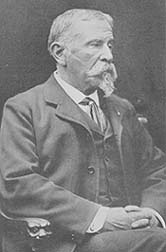 Photo of Higginson by Notham, 1905, from Bliss Perry's book. Image courtesy of Brian Pohanka.
|
|
At the outbreak
of World War I in 1914, Higginson's concerns about the
firm and the orchestra escalated. Many friends and
members of the orchestra were of various European
nationalities, and their fate in the United States and in
their homelands abroad was uncertain. In a letter to J.P.
Morgan, the younger, Henry wrote on August 5:
Horrible as the destruction of property will be, and
destruction of life, and almost worse, the maiming of
many men and women, is the terrible temper which has been
aroused....
Though Higginson
understood the devastation of war, he was realistic in
his assessment of America's position and did not wish to
add more fuel to the fire. The Boston Herald
published Henry's comments in their August 7 edition:
We have good crops and quiet homes, and we have the
great barrier of the Atlantic Ocean between us and this
terrible war. As men, we cannot forget the passions and
sufferings of the fighting nations, but we can go on
quietly. Nothing helps more in life than cheerfulness,
and we Americans have the right and the duty to be
cheerful.
|
As the war progressed,
Higginson's thoughts grew sober. He was concerned about
the "waste of the armies of all those nations"
and the "burden that comes on the poor people."
Though he tried to remain calm in the face of the storm,
he became a focal point of controversy as the war reached
its climax. Henry's nationalism was questioned by a
number of the orchestra's faithful subscribers because
the conductor was a German-born citizen and supported his
homeland. In a letter to a close friend, Judge Frederick
P. Cabot, Henry confided on February 25, 1918:
...My present plan is to keep absolute silence
until the end of the last concert, and then to state my
case from the stage: that the conductor [Dr. Carl Muck]
has been so harassed that he can only go; and that I quit
also. This plan involves a considerable statement, which
can be made then and there. Any earlier statement would
injure the concerts and make much trouble all around.
Tell me if you approve of this plan.
Now as to the future, if you have time to consider it
and take action: We have reached a time, through
circumstances, when I can drop this task without comment
as to my motives, because the Orchestra and conductor
have been attacked, and I also, as a man who employs
Germans and, therefore, whose loyalty can well be doubted.
As you know, various decent people here and in other
cities have joined in this attack; so the moment seems
opportune....
In March, Dr. Muck was arrested for being an "alien enemy" and was
later replaced by another conductor. In his reminiscences,
Henry stated:
At the end of the season, at the last concert of
Saturday evening, May 4, 1918, I went on to the stage,
stated the original purposes of the Orchestra, and said
that I was done with the work, added a few words to the
men of the Orchestra, and came away; and that was the
finish of my connection with that enterprise. Various
friends had already been moving and had resolved to carry
on the Orchestra, and I stated that fact at the last
concert....
As summer approached, Higginson was urged by his physicians to get some rest.
He was now approaching his 84th birthday when his niece,
Mrs. George R. Agassiz, suggested in July that he write
his reminiscences. To this request, Henry replied:
...As to your suggestion about reminiscences, those
about you and various other pleasant people are
delightful, but many of my reminiscences are anything but
pleasant. I have made so many mistakes, and done so many
foolish things, and thrown away so many good chances that
I cannot take any particular joy in my life. As to what
has been done, that was all in the day's work. I have
received more credit in my lifetime than I ever deserved.
Did I ever tell you that, if I had not been married, I
proposed staying in the army, and, by this time, would
have been a retired old veteran, growling at everything.
I enjoyed my army life, and, on the whole, did it better
than anything else—that is, I was a good regimental
officer, but could not have gone above the command of a
thousand men. I 've not been a good business man, but
have come through somehow or other. Yes, I can remember
many things within my European life which were
interesting to me, and some of them are so still, but
they would do nobody any good, and I think they would
entertain nobody....
Henry set to work writing his reminiscences and was feeling better now that his
obligations in maintaining the details of the Orchestra
had ceased. He was pleased by the hundreds of letters he
received at his bedside, expressing appreciation of him
and his work. In a letter written on August 2 to Sir Hugh
Levick, a partner at the London house firm, he reflected
on earlier days, wondering if he should have regarded the
firm with more consideration:
...I certainly have been treated with great kindness [at
the firm]. But I do think that for most people the place
of second fiddle is preferable to first fiddle. If only a
man will consider the success of the work of the firm, of
the government, of the country, rather than of himself,
he will probably reach the same conclusion. If I were X,
I should not care whether I was first or fifth in the
firm, so I was kindly treated and got my share of what
was going.... Certain qualities I have, and they may have
helped to the success of the firm; but, after all, it was
founded by George Lee's grandfather,—who was a very
noble old man,—and my dad,—who was honest, tolerably
keen, full of common sense, and irascible at times and
pleasant at times,—and also by Mr. Henry Lee, whose
character was as spotless as that of the others. To them
must be added old George Lee, who was a sunbeam, faithful
to the last degree, and a man whom nobody ever doubted
for a quarter of a second. It was they who made the firm,
and I have merely followed in their path. I am not
thinking of my own value. I have thought too much of my
duties and wishes outside and too little of the firm. If,
instead of spending all the money that has been spent
outside, I had kept it, I should have five or six
millions to-day, and very likely more. But it is all in
the day's work....
A week before Henry's 84th
birthday, Armistice Day arrived, bringing peace to the
world at last. Early in 1919 Henry was hospitalized, but
felt better by the end of spring. That summer, he
addressed the school of bond-salesmen organized by Lee,
Higginson and Co. on the philosophy of the firm:
...The house has always tried to do its work well and
to have and keep a high character, and I think it has
succeeded in those points. Character is the foundation-stone
of such a business, and once lost, is not easily regained....
Now, for yourselves: Do not lose a day; use your time
well, remembering that that day never comes again; know
your business, and tell the story just as it is; find out
the truth about the bonds and shares; if a bond is pretty
good, say so; if it is first-class, say that; if it is
attractive from a speculator's point of view, say that.
Put the "cards on the table" every time, and do
not bore buyers. If you are roughly treated, never mind.
Good men are not infrequently out of temper or very busy,
and do not care to see you. Remember this about truth:
you must know your subject in order to speak truly; and
although making a mistake is not the same thing as
deceiving, still you are responsible for the facts, and,
therefore, for the truth. Do not waste your time. Keep
your temper. Play the game decently, and be faithful.
In October, Henry was hospitalized again but returned to work in early November.
A week later on November 14 he underwent surgery and
never regained consciousness. On the day before what
would have been Henry's 85th birthday, services were held
for him at Appleton Chapel. From there he was borne to
Mount Auburn and laid to rest.
Following his death, many
friends and colleagues remembered Henry with the kindest
thoughts and words. He would have been touched to have
read and heard them. For his many contributions to the
world, Henry Lee Higginson remains a great inspiration to
all, and one of the greatest friends of humankind.
Among Higginson's final
words were those written to a friend just before his 85th
birthday:
I've had only too many kind words of
praise for doing my duty, and only my duty, as my eyes
and those of dear, dead friends saw it. The simple tale—that
he tried to fill up gaps and sought to bring sunshine
into the lives of his fellow men and women, that he
usually kept his word, given and implied, and that he
worshipped his country and had the very best and most far-seeing of friends—is the whole story.
Sources Used in Writing this Section of the Essay
Book:
Life and Letters of Henry Lee
Higginson, by Bliss Perry, The
Atlantic Monthly Press, Boston, MA, 1921.
Periodical:
A Great Private Citizen, by M.A. DeWolfe Howe, Atlantic Monthly, March 1920, pp. 329-339.
Web Pages:
Ancestry.com, copyright 2001, http://www.ancestry.com (accessed August 2001).
Boston Museum of Fine Arts, copyright 2001, http://www.mfa.org (accessed August 2001).
Boston Symphony Orchestra, copyright 2000,
http://www.bso.org/participate/bso_annual.cfm (accessed February 2001).
The College Pump: Sticking to the Union, Harvard Magazine, March – April 1997, http://www.harvard-magazine.com/issues/ma97/pump.html (accessed February 2001).
Harvard University Athletics: History (Timeline), Harvard University, copyright 1999,
http://www.fas.harvard.edu/~athletic/history.html (accessed February 2001).
Harvard’s Womanless History: Completing the University’s Self-Portrait, by Laurel Thatcher Ulrich, Harvard Magazine, November – December 1999, http://www.harvard-magazine.com/issues/nd99/womanless.html (accessed August 2000).
The Library of Congress: America’s Story from America’s Library, copyright 2001, http://www.americaslibrary.gov/pages/jb_0914_harvard_1.html (accessed August 2001).
Middlesex School, copyright 2001, http://www.middlesex.edu (accessed August 2001).
Morristown Beard School, copyright 2001, http://www.morristown-beard.com (accessed February 2000).
Nineteenth Century South End Hotel Turned Into Condos, by Marilyn Jackson, CNC Boston Homes, copyright 2000, http://195.7.48.75/release/new/needham/community/bostonhomes/p1s2m.htm (accessed August 2001).
The Oldest in Town: A Treasure Hunt of Boston's Firsts, by Michael Kenney, Boston Globe Online, copyright 1999, Globe Newspaper Company, http://www.boston.com/globe/calendar/features/oldboston/printable.shtml (accessed August 2000).
Radcliffe Institute for Advanced Study at Harvard University, copyright 2001, http://www.radcliffe.edu/ (accessed February 2001).
Significant Dates in Radcliffe’s History: Radcliffe and Harvard Announce Proposed Merger, Radcliffe Quarterly - Summer 1999, http://www.radcliffe.edu/quarterly/199902/rad_har-5.html (accessed February 2001).
The Silver Panic, The Liberty Haven Foundation, copyright 2001, http://libertyhaven.com (accessed August 2001).
Soldiers Field, by Helen Hannon, Town Online, copyright 2000, http://www.townonline.com/cambridge/news/topstories/general/
0-9285_0_soldiers_071400_1b3ff8199b.html (accessed August 2000).
Thoreau Institute, copyright 2001, http://www.walden.org (accessed August 2001).
Williams School, copyright 2001, http://wlu.edu/description/history.htm (accessed August 2001).

Index
to Higginson's Pages
Back | Home
Copyright © 2005 1st
Dragoon's Civil War Site. All rights
reserved.
|

