Sir Charles
Wheatstone Uses Paper Tape to Store Data
In 1837, the American
inventor Samuel Morse developed the first American electric
telegraph, which was based on simple patterns of "dots"
and "dashes" called Morse Code being transmitted over a
single wire.
The telegraph quickly
proliferated thanks to the relative simplicity of Morse's system.
However, a problem soon arose in that operators could only
transmit around ten words a minute, which meant that they
couldn't keep up with the public's seemingly insatiable desire to
send messages to each other. This was a classic example of a
communications bottleneck.
Thus,
in 1857, only twenty years after the invention of the telegraph, Sir Charles Wheatstone
introduced the first application of paper tapes as a medium for
the preparation, storage, and transmission of data.
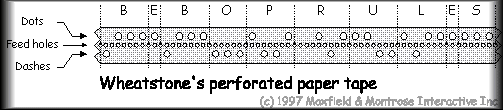
Sir Charles' paper tape
used two rows of holes to represent Morse's dots and dashes.
Outgoing messages could be prepared off-line on paper tape and
transmitted later. By 1858, a Morse paper tape transmitter could
operate at 100 words a minute. Unsuspectingly, Sir Charles had
also provided the American public with a way to honor their
heroes and generally have a jolly good time, because used paper
tapes were to eventually become a key feature of so-called
ticker-tape parades.
In a similar manner to
Sir Charles' telegraph tape, the designers of the early computers
realized that they could record their data on a paper tape by
punching rows of holes across the width of the tape. The pattern
of the holes in each data row represented a single data value or
character. The individual hole positions forming the data rows
were referred to as "channels"
or "tracks,"
and the number of different characters that could be represented
by each row depended on the number of channels forming the rows.

Copyright Maxfield
& Montrose Interactive Inc., 1996, 1997. All rights reserved.
|
