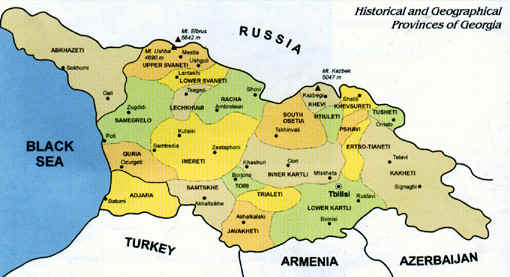
Georgia is a small patch of land to the south of the Greater Caucasus Range. It
occupies the isthmus between the Black and Caspian Seas. Bordering in the north on Russia,
in the east - on the republic of Azerbaijan, in the south - on the republic of Armenia and
in the south-west - on Turkey.
Due to its relatively small size, (occupying the area of 69,700 sq./km,) you can cross
Georgia by car in a single day meeting on your way steppes, semideserts, subtropical
forests and glaciers which are looked down by peaks up to 5000m high.
The Caucasus Great Range serves as Georgia’s natural border with Russia. The nature
of Georgia is quite varied; the country is characterized by rough terrain, almost two
thirds of it being mountains. Highest Peaks: Mt.Shkhara 5068m, Mt.Kazbek 5047m.
The nature of Georgia is quite varied; the country is characterized by rough terrain,
almost two thirds of it being mountains. Western Georgia has a humid subtropical climate,
while in Eastern Georgia it is dry or moderately humid. The country’s natural resources
include coal, oil, manganese, non-ferrous metals and some non-metallic ores. Georgia’s
rivers are extensively used for generating electricity and for irrigation.
The Republic of Georgia comprises the Abkhazian Autonomous Republic and the Acharan
Autonomous Republic and is subdivided into 65 districts and rural areas, controlled by
rural councils; it has 13 cities and many towns, viz.: Tbilisi,
Kutaisi, Gori, Chiatura, Rustavi, Poti, Tqibuli, Zugdidi, Tsqaltubo, Sukhumi, Tqvarcheli,
Gagra, Batumi and 37 minor towns, 61 rural settlements and 450 villages.
3.8 million Georgians, living in a country of 5.5 million people call themselves
Kartveli and their country Sakartvelo, i.e. the Georgians’ place. The latter appellation
had not been in use until the 11th century when ethnically and linguistically related
countries united to form one nation.
Christian Orthodox. Christianity, the state religion since the fourth century, has
played a major part in Georgian history and culture.
In geographic terms Georgia belongs to neither Europe nor Asia; in cultural terms it is
neither West nor East. It has a distinct language, customs and traditions.
“Situated in a strategically valued location between East and West, Georgia was
frequently invaded by foreign armies, its lands devastated, and its people subjugated to
foreign rule and quarreling native feudatories. Together with local unrests, epidemics,
and droughts, the invasions disrupted the social system, depleted the population, and
inflicted upon the Georgians accepted foreign rule and culture. Yet, even as Georgians
adopted features of other cultures, they maintained their own. Their ethnic community was
like a balloon: squeezed at one place, it popped out at another, always outliving its
enemies”.
The Georgian language belongs to the south Caucasian language group which has very
little, if anything, in common with any other family of languages. The prototype of
contemporary Georgian spawned a number of related languages, such as the language of the
mountainous province of Svaneti - Svanuri, the language of Samegrelo - Megruli, and some
others, which together with the most widespread of them, contemporary Georgian, make up
the Caucasian family of languages. Westeners say the Georgian language is extremely
difficult.