Colonial Beginnings
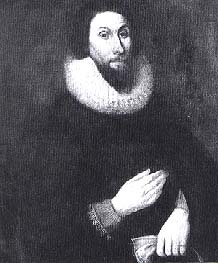
John Winthrop, Puritan leader of Massachusetts Bay Colony
I. Causes for English Colonizing in America
A. Fall of Spanish Armada in 1588 opened North Atlantic to English expansion
-. England infused with a spirit of self-confidence and enthusiasm for adventure.
B. Changes in English economy.
1. Rise of merchant class to provide business leadership and wealth for colonial investment.
2. Joint-stock company allowed for pooling of capital with limited risk.
3. Surplus population in cities as farmers were pushed off lands converted to sheep herding
C. Protestant Reformation
1. Priesthood of all believers inspired religious dissidents
2. Anti-"Popish" believers (Puritans) felt that the Church of England was not Protestant enough in its beliefs and practices.
3. Persecution of Puritans, Catholics, and Quakers led to conflict with religious and political authorities
4. America was seen as a desirable haven for these groups.
II. Jamestown and Virginia
A. Virginia Company received charter (guaranteeing settlers the same rights as Englishmen at home) from King James I for settlement in America (1607). Goals:
1. Gold and wealth
2. Convert Indians to Christianity
3. Find a passage to the Indies
B. Early group suffered from laziness, starvation, malaria, and unfriendly Native Americans. Saved by leadership of John Smith and enterprise of tobacco planter John Rolfe.
1. Perfected methods of raising and curing tobacco
2. Brought capital and workers to Virginia
3. Problems with tobacco farming
C. Contributions of early Virginia
1. Provided model for further economic investment in America
2. First representative self-government (House of Burgesses--1619)
3. Demand for slaves (1st Africans sold by Dutch to settlers in 1619 as indentured servants)
III. New England Colonies
A. Separatists (Pilgrims) arrived at Plymouth in 1620 on Mayflower after initial settlement in Holland.
1. Mayflower Compact--first document of self-government in America.
2. After difficult first winter (44 out of 102 survived), Pilgrims survived under the leadership of Governor William Bradford. And with the help of friendly Native Americans (like Squanto)
B. Puritans settled Massachusetts Bay in 1630 for economic and religious reasons.
American Puritanism
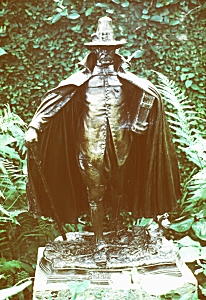
The Puritan by Augustus Saint-Gaudens (1887)
Brookgreen Gardens, South Carolina
I. Puritan Beliefs and Values
A. Predestination--all events are foreknown and foreordained
by God
B. Value of education
1. Publicly supported schools needed to oppose Satan by teaching all to read the Bible
2. Harvard founded in 1636 to train ministers
3. Probably 70% of New England literate in 1770
C. Uniformity is necessary for success
1. Persecution and expulsion of Anne Hutchinson (1638)
2. Roger Williams expelled for "new and dangerous opinions"
((1638)
a) Preached complete separation of church and state--the state
should have no influence over a person's conscience
b) Indians should be paid for lands.
c) Settled Rhode Island and established complete freedom of
religion (including Jews, Catholics, and Quakers)
II. Puritan Political Life
A. Voting restricted to church members
B. Blurring of political and religious authority–theocracy,
not democracy
III. Salem Witchcraft Crisis (1692)
IV. Puritan Contributions
A. Self-government and community responsibility
1. Democracy in church rule led to democracy in town meeting
2. All community members responsible for conduct of citizens
B. Education critical for individual and community success
C. Hard work and thrift demanded of all
D. High standards of moral excellence and conscience (John
Winthrop--"City Upon a Hill")
Slavery in the American Colonies
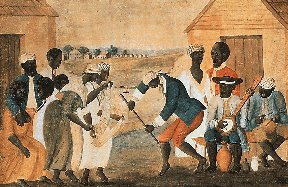
The Old Plantation
Abby Aldrich Rockefeller Folk Art Center,
Williamsburg, Virginia
I. Slavery's Early Presence
A. First African-Americans that arrived in Jamestown in 1619
were brought as indentured servants, not slaves, so they would be set free after 7 years.
B. Very small numbers of slaves in the Southern colonies in the early
years. By 1650, only 300 blacks lived in Virginia
II. Slavery, Race & Economics
A. Slavery, though originally adopted for economic reasons,
eventually was justified by Southern whites on the basis of race.
1. Whites concluded that extermination of Indians and enslavement
of Africans was logical in that whites were civilized and others were barbaric.
2. Language used to describe blacks and Native Americans was similar: "brutes,
heathen, naked, etc." It also was how educated Englishmen described poor
members of society.
III. Plantation Culture
A. Some plantations were enormous (40,000 acres, hundreds of
slaves), but most were small, self-contained communities.
B. Family relationships
- Slaves attempted to construct strong families, though any member
could be sold at any time
C. Work patterns
1.Most slaves (men and women) worked as field hands
2. House servants lived in better circumstances, but were isolated from
other slaves on the plantation.
3. On larger plantations slaves learned trades and crafts--blacksmithing,
carpentry, shoemaking, midwifery
18th Century American Colonies

Ben Franklin, America's 18th Century Renaissance Man
I. Common Characteristics of Colonists
A. Most of the colonial population was of British stock and English speaking (In 1790 only 17% of white population was non-British)
B. Colonial America was overwhelmingly Protestant. Dominant groups: Puritanism in New England, Dutch Reformed and Presbyterian in Middle Colonies, Anglican in South
C. Most came with similar economic and social backgrounds. Lower and middle class stock usually from rural areas of England.
II. Four Major Regions (Plantation South, Middle Colonies, New England, and Frontier)
A. Plantation South
1. Tidewater region featured wide coastal plain, wide rivers, and rich soil particularly well-suited to tobacco farming.
a. Large plantations became economically more successful as soil was exhausted, leading to self-sufficing economic units.
b. As indentured servants became harder to obtain (and retain), demand for slaves increased (400,000) in colonies by 1776.
2. Only children of planters were educated and higher education was only for those who could afford it .
3. Plantation owners became the leading economic, political, and social forces of the South. Democracy limited to wealthy landowners.
B. Middle Colonies-- farming, manufacturing center
1. Three large rivers (Hudson, Delaware, and Susquehanna) flowed north to south and served as trade paths .
2. Large numbers of immigrants (known as “the melting pot”)
a. Dutch in Hudson Valley (New York)
b. Germans in Pennsylvania
c. Scotch-Irish in Pennsylvania
C. New England--rapid rivers and rocky soil
1. New England town meeting as center of power at first.
2. Occupations included farming (scarce labor, tough conditions), fishing, and commerce
a. Shipbuilding became major supplement to fishing and trade
b. Slavery, rum and the triangular trade with West Indies and Africa brought economic wealth to New England
D. Backcountry/Frontier--continually moving region: "The West."
1. Large families, exhausted soil encouraged westward movement
2. Religious dissenters, immigrants, and criminals all found "refuge" in the West.
3. Vigorous spirit of democracy and emphasis on individual freedom
III. 18th Century Politics
IV. Economics
A. Mercantilism
1. Exclusive navigation
2. Trade must pass through home country, England
3. Create a self-sufficient economy
B. Navigation Acts
C. Triangular Trade
-trade routes connecting the colonies, England, Africa, and West Indies
V. Religion
A. Population overwhelmingly Protestant
B. Anglican Church weak in colonies
C. Great Awakening--1730s and 1740s.
1. Reaction against cold, emotionless appeal of Puritan brand of Calvinism.
2. George Whitefield--emotionally intense, dynamic preacher
3. Educational revival--Dartmouth, Princeton, Brown all formed to supply New Light preachers
VI. Wars with France (King Wiliiams's, Queen Anne's, King George's Wars)
1. Issues in America
2. French & Indian War
3. Results of the French & Indian War
a) France loses Canada and all land west of Mississippi River
b) Spain loses Florida
c) Britain's national debt doubled
d) Cost of governing colonies multiplied
e) Increased trouble with Indian tribes
f) Series of restrictive laws to control colonists and raise revenues
Prologue to Revolution

Hanging of John Huske (Stamp Act supporter) in Effigy--Paul Revere
I. The New Imperial Policy (1763-1770)
A. Reasons for inaugurating the policy
B. Early tax measures (1763-1766)
1. Grenville taxation program.
a) More serious prosecution of smugglers
b) Sugar Act threatened triangular trade
c) Currency Act forbade the issue of paper money
d) Stamp Act (1765) sought to raise funds for defense of America.
2. Colonial opposition to new program
a) Postwar depression left Americans short on cash
a) Stamp Act Congress met to call for boycott of British goods and state that Parliament had no right to tax colonies without consent.
b) Sons of Liberty (led by Samuel Adams) used mob violence to force all stamp agents to resign.
3. Parliament repealed Stamp Act but asserted its rights (with Declaratory Act) to regulate colonies "in all ways whatsoever."
II. The Move Toward Independence (1770-1776)
American Revolution
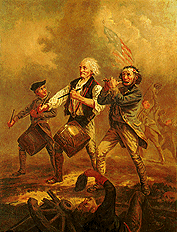
The Spirit of '76 by Archibald McNeal Willard
U.S. State Department, Washington, D.C.
I. Strengths and Weaknesses of Opposing Sides
B. American
1. Strengths
a) Outstanding leadership
i) Military–Washington
ii) Diplomatic–Franklin
b) Colonists fighting defensively
c) Colonists were better marksmen (Americans accurate at 200 yds.)
d) Personal motivation: Americans fighting for their own freedom
e)Fighting on own land
2. Weaknesses
a) Colonies were badly organized, disunited for war.
b) Economic difficulties
i) Little currency (money) available
ii) Fearful of taxation, Congress issued worthless currency
iii) Inflation led to increased prices, desertions from army.
c) Limited military supplies
- At Valley Forge, 2800 men barefooted
II. American Secession
A. Second Continental Congress (May 1775) called Washington to lead
colonial army.
B. Following Bunker Hill (costly victory for British), King George III sent more troops.
C. Thomas Paine published Common Sense, a pamphlet selling 120,000
copies.
- Appealed to natural law ("an island should not rule a continent")
D. Second Continental Congress declared independence July 2, 1776.
1. Jefferson headed the committee drafting the written statement. Arguments:
a) All people have natural rights ("Life, liberty, and the pursuit
of happiness")
b) When a government abuses rights, the people have a right to "alter
or abolish" it
c) King George has acted tyrannically. Long list of wrongs done by King
to colonists.
d) The colonies are independent.
2. Declaration gave a clear position for rebellious colonists, forcing
others to choose rebellion or declare as Loyalists.
III. The War's Major Battles (1776-1781)
A.Fight begins at Lexington and Concord (“the Shot Heard around the World”).
B. England loses at Battle of Saratoga, which becomes turning-point battle for war.
- French become convinced that America now has a chance to win and
offers navy, money, and international support with a treaty of alliance.
C. Battle of Yorktown: British General Cornwallis surrenders to American General Washington on October 19, 1781 .
IV. Treaty of Paris (1783)
Articles of Confederation ("The Rope of Sand")
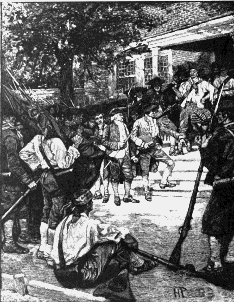
Shays' Rebellion--Western Massachusetts, 1786
I. New Social Fabrics
A. Pro-democracy efforts gained.
B. Religious Change
- Strong statement of separation of church and state written
by Jefferson
II. Economic Stresses
A. Doing Business with Britain almost completely halted.
B.War left a huge debt
C) Economic causes of war had led to distate for taxes, further
weakening Congress' ability to collect taxes.
III. Articles of Confederation
A. Congress was the dominant force (no executive or federal courts),
but it was restrained by rules:
1. All bills required 2/3 vote for passage
2. Any amendment to the Articles required a unanimous vote
3. Each state had 1 vote.
4. No power to regulate commerce (business between states)
5. No tax power (states paid taxes voluntarily).
C. Land Ordinance of 1785
D. Northwest Ordinance of 1787
IV. Foreign and Domestic Problems
A. The U.S. had difficulty commanding respect from allies or enemies
1. Britain refused to send an ambassador, to make a commercial treaty,
or repeal the Navigation Laws. Trading posts along Canadian border source
of trouble with Indians.
2. Spain seized lands granted to the U.S. by Britain and harassed
trade on the Mississippi River.
3. France demanded repayment of loans made during the Revolution.
B. Domestic disputes arose over economic and political weakness
1. Some states refused to pay any taxes, while interest on the public
debt grew and the nation's credit dwindled.
2. States began levying duties on each other's products and quarreling
over boundaries.
3. Shays' Rebellion (1786) broke out in western Massachusetts
with frustrated farmers losing their farms due to mortgage foreclosures
and tax delinquencies.
V. The Call for Reform of the Articles
A. Annapolis Convention, called to deal with interstate commerce squabbling,
instead requested a convention to meet in Philadelphia to deal with reforming
the Articles.
B. 55 representatives from 12 states (Rhode Island boycotted)
assembled in Philadelphia in May 1787 to "make a more perfect union."
Miracle at Philadelphia: The Constitutional Convention
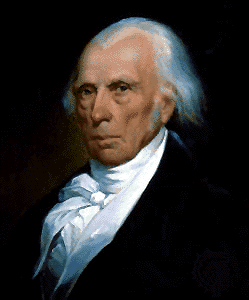
James Madison, Father of the Constitution
I. The Setting of the Philadelphia Convention
A) Early decision to re-write, rather than tinker with the Articles
of Confederation
B) Intent of the Convention
1) Economic –protect property rights and make America
safe from democracy.
2) Idealistic--make a perfect Union
3) Pragmatic--dealing with the question of sovereignty. Placing common
interests over regional or personal concerns.
II. The Participants
A. 55 delegates from 12 states
1) Young (average age 42), professional (over half were lawyers), men
of economic substance
2) Many were Revolutionary War veterans
3) Absent: Thomas Jefferson, Patrick Henry, other Revolutionary War
heroes.
B. Key Participants
1) Washington--president of the convention
2) Madison--researched every previous republic
a) Large republic is not only possible, it's preferred
b) Popularly elected officials with sovereignty in the hands of the
people, not the states
3) Franklin--81 years old. The steadying influence
III. ***The Compromises***
A. Great Compromise (bicameral legislature representing both people
and states)
1. Virginia Plan or Large States Plan(Edmund Randolph) = House of Representatives
2. New Jersey Plan or Small State Plan (William Patterson) = Senate
a) Congress with each state having l vote
b) separate executive and judicial branches
c) increased powers of Congress
3. Great Compromise
B. Three-Fifths Compromise (3/5 of slaves counted for representation and
taxation; no Congressional interference with slavery for 20 years)
1. Non-slavery states wanted slaves counted for taxation, but not representation
and wanted an end to importation of slaves
2. Slave states wanted slaves counted for representation, but not taxation
and no interference with slave trade by the federal government
C. Commerce Compromise (no tax on exports)
1. Cotton and tobacco producing states wanted restriction of taxes
on exports
2. Northern industrial states wanted federal tariffs to keep up out
cheaper European products and raise revenues for the government.
IV. Ratification
A. Because of fear of opposition from states, only 9 of the 13 were
needed for the Constitution to pass
B. Federalists vs. Antifederalists
1) Most Federalists were wealthy and well-educated and wanted a more powerful central government
2) Most Antifederalists were farmers who wanted states rights: the state (not national) governments had the most power
C. Federalist Papers--most influential political literature of the time
- Argued that it was safe for Anti-federalists to agree to Constitution because limitations on governmental power were built into the Constitution
D. Promise of Bill of Rights added to the Constitution helped persuade
opponents to ratify it.
The Federalist Era (1789-1800)
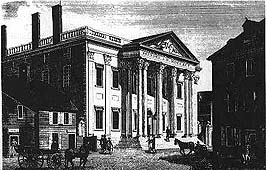
National Bank of the U.S.
I. Hamiltonians vs. Jeffersonians
A. Hamilton's views--Man is irrational, corrupt, and guided
by corrupt instincts.
1) A strong central government insensitive to the popular will
2) Government's function is maintain order in a chaotic society. It needs to be remote and secure from the people's emotional uprisings.
B. Jefferson's views--man is rational, capable of self-improvement.
1) Government exists to protect man's natural rights to life,
liberty, and happiness.
2) A government needs to be limited in its powers and completely responsive
to the needs and desires of the people.
3) State governments should have greater power because they
are less likely to be oppressive.
II. Hamilton's Financial Plan
A. Protective tariff to stimulate industry
B. National government pays debts of states
C. Willingness to assume Confederation's debts
D. Establishment of a national bank.
E. Whiskey Excise Tax--burden fell on western farmers
1) Whiskey Rebellion (1794)--2000 armed men
2) Washington leads militia to put down revolt, which shows America is going to stay united
III. Jeffersonian Opposition to Hamilton's Plans
A. Strict constructionist view--creation of U.S. Bank exceeded
Congressional authority
B. 10th Amendment forbids the national government exercising
powers not delegated to it.
C. Commercial and manufacturing favored over farming.
IV. Foreign Problems
A. French Revolution
1) Democrat-Republicans were strongly pro-French and formed
Republican clubs advocating war with England and Spain
2) Federalists do business with England, so they don’t want to help France, England’s enemy.
B. Jay Treaty (1794)
1) Trouble with Great Britain arose over fur trading posts
in the Northwest and interference with American shipping
2) Jay negotiated with British who agreed to:
C. Pinckney Treaty (1795) gave Americans the right to navigate
freely on the Mississippi River.
D. XYZ Affair--French demands for a bribe before negotiating
with Americans so angered citizens that they called for war.
Congress armed privateers, commissioned an army, and ordered
new ships built
1) Naval war with France raged for two years, with 90 French
ships captured.
2) France agreed to American terms in the Convention of 1800.
V. Fall of the Federalists
A. Alien & Sedition Acts (1798) sought to lessen criticism
of the Federalists
1) Alien Acts made it difficult to become a citizen,
provided for detention of aliens in time of war, and allowed
the president to deport any alien
2) Sedition Act outlawed criticism of the government or the
president
3) Jefferson and Madison wrote the Kentucky & Virginia
Resolutions which stated right of states to disobey Congress
if laws exceeded Constitutional authority. First statement of
nullification.
B. Jefferson's election in 1800 ended the reign of the Federalists.
1) Jefferson and Burr ended up with 73 electoral votes each
2) Hamilton cast his support to Jefferson, ending the tie
3) 12th Amendment allows for president and vice-president
to run on the same ticket.
Jeffersonian Era
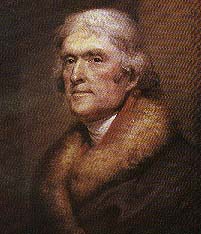 Portrait of Thomas Jefferson by Rembrandt Peale
I. Jeffersonian Democracy
II. Domestic Problems
A. Midnight judges & judicial review
1. Marbury and 15 other Federalist judges were appointed as Adams'
term expired.
2. John Marshall rejected their claim, contending that the Judiciary
Act of 1789 was unconstitutional.
- Victory for Federalists--greatly expanded power of Supreme Court
by establishing precedent of court ruling laws unconstitutional.
B. Aaron Burr kills Hamilton in duel
III. Foreign Problems
A. Louisiana Purchase (1803)
1. France acquires Louisiana from Spain in 1800.
2. Jefferson sent agents in Paris to purchase New Orleans.
3. Napolean offers entire territory for $15 million
4. Jefferson violated his belief in strict construction of Constitution
by using necessary and proper clause.
5. Two expeditions sent out to explore new land:
B. Conflict over neutral rights
1. British and French ships seized American cargoes and sailors (impressment)
2. Jefferson responded with Embargo Act which prohibited all American
trade with foreign countries
3. Non-intercourse Act replaced Embargo Act
- Reopened trade with all nations except England and France
C. Western War-Hawks demands for war
The Legacy of the Marshall Court (1801-1835)
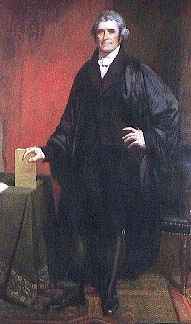
Chief Justice John Marshall (Boston Athenaeum)
I. Major Goals of Marshall
II. Strengthening the National Government
A. Cases expanding the authority of the Supreme Court
- Marbury v. Madison (1803) gave the Court the power of judicial review.
B. Cases expanding the powers of Congress
1. McCullough v. Maryland (1819) upheld the right of Congress to charter a national bank, thus putting into national law the doctrine of implied powers.
2. Gibbons v. Ogden (1824) gave the national government undisputed control over interstate commerce by ruling invalid a steamboat monopoly chartered by New York state. This freed internal transportation from state restraint.
War of 1812

Constitution and Guerriere, 1812
I. Breakdown of Peaceful Coercion
A. America dropped its embargo with France.
B. British support of Shawnee Confederation led by Tecumseh and the Prophet proved at battle of Tippecanoe (1811).
C. War Hawks call for war. Issues:
D. Despite pleas from New England to remain calm, Madison asked Congress for a war declaration on June 18, 1812.
II. Military Campaigns of 1812-13
A. Three-pronged attack of Canada failed due to American incompetence.
B. US burn York (now Toronto), leading to later British burning of Washington, D.C.
C. British navy overwhelmed US ships and blockaded coast from New England to Georgia.
III. War's Conclusion
A. Attack on Washington--4000 British troops burn White House, other buildings.
B. At Treaty of Ghent, American and British negotiators agree to end fighting on December 24, 1814
C. British invade New Orleans, only to be defeated by American troops under Andrew Jackson's command in January 1815, making Jackson a national hero
Sectionalism & National Growth
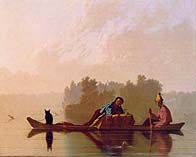
Furtraders Descending the Missouri by George Caleb Bingham
I. Sectional Specialization
A. Industrialization of the Northeast
1) Factory system expanded quickly after Embargo Act and War of 1812 cut off competition from England. Factors assisting expansion:
a) Water power from streams and rivers
b) Plentiful labor supply from immigrants
c) Poor agricultural conditions
d) Lowell system brought girls to factories for a few years
2) New England became center of textile mills, while Pennsylvania led in production of iron.
3) Samuel Slater "steals" a spinning mill (1790)
4) Eli Whitney
5) Supports protective tarriffs
B. Plantation agriculture of South
1) Cotton gin's invention increased productivity (in 10 years production increased 800%)
2) Removal of Indians from Southeastern US allowed expansion
3) Success of cotton led to one-crop economy
4) Oppose protective tariffs
C. Diversified farming in the West
1) Small farms slowly gave way to specialized farms:
2) Improved transportation allowed for marketing of surpluses
II. Improvements in Transportation
A. Demands created for better roads and canals:
1) Northeast needed Southern cotton and Western food
2) South and West needed manufactured goods from North
3) South needed food from the West
B. Many turnpikes (toll roads) built by private companies from 1800-1825. Most famous: Cumberland Road which allowed wagon traffic from the Atlantic Ocean and the Ohio River.
C. Canal Era(1825-35)--need for cheaper, faster freight transportation
D. Steamboat traffic along the Hudson, Mississippi and Ohio Rivers became extensive in the 1820s and 30s.
III. Missouri Compromise (1820)
A. Missouri, populated mainly by Southerners, applied for statehood in 1819.
B. Northern states opposed adding a new slave state to the Union, which would upset the balance of 11 free and 11 slaves in the Senate
C. Compromise reached which stated
1) Missouri would enter Union as slave state
2) Maine would enter as free state
3) Line drawn at 36o30Õ with slavery banned in the portion of the Louisiana Purchase north of that line.
IV. Monroe Doctrine (1823)
A. Statement of foreign policy, not a treaty or law
B. Problems leading to development of doctrine
1) Recognition of Latin American republics
2) European interference
C. Elements of doctrine
D. Impact of doctrine not immediate, but it signalled America was now a power strong enough to keep Europe from messing with the western hemisphere.
Jacksonian Era & The Rise of the Common Man
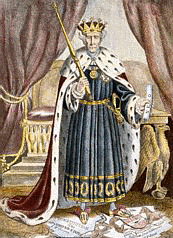
Andrew Jackson portrayed by his enemies as
a monarch, trampling on the Constitution
and abusing the veto power
(Bettman Archives)
I. Era of Good Feelings: Election of 1824
A. Temporary end of political parties
B. End of caucus system of selecting candidates
C. Jackson receives more electoral and popular votes than Adams, Clay,
and Crawford, but not a majority
D. House chooses Adams because of Clay's support
II. Jacksonian Democracy
A. Jackson's election in 1828 signaled rise of common man
B. Jackson viewed himself as the spokesman of the people
C. Indian policy
- Trail of Tears--Cherokees and other Indian tribes in Southeast U.S.
forced to march 1200 miles to Oklahoma territory
D. Nullification Crisis–South Carolina 1832
1) South Carolina stated its opposition to tariff (Tariff of Abominations)
2) Jackson appealed to people of South Carolina to obey national law,
obtained authority from Congress (Force Act) to enforce laws any way necessary,
and worked out a compromise tariff
III. War Over the U.S. Bank
A. Jackson opposed re-charter of the National Bank because banks
B.Panic of 1837 resulted when
1) English bankers called in loans to states and investors
2) Gold supplies were depleted, preventing banks from making payments
and forcing failures
Reform Movements in 19th Century America

Girls' School, 1840 (Anonymous)
I. Religious Sources of Reform
A. Second Great Awakening--religious revivals among Protestants.
B. New religious groups formed as instruments of reform
1. Utopian societies created in reaction to urban growth and industrialization.
Emphasis on community and withdrawal from society(Brook Farm)
2. Shakers--socially radical. Abolished families, practiced celibacy,
full equality between sexes.
3. Mormons--Organized by Joseph Smith in 1830 as a cooperative theocracy
with himself as the Prophet. Because of persecution, Smith and his followers
moved from New York to Ohio to Missouri to Illinois, where he was murdered.
Succeeded by Brigham Young, who led migration to Utah.
II. Other Areas of Early Social Reform
A. Temperance--Movement fight for total abstinence from alcohol. Led by women.
B. Education--compulsory education in every state by 1860. Led by Horace
Mann, who secularized the curriculum
C. Women's Rights--women were considered so inferior to men that they
were not allowed to obtain higher education, vote, or control their own
property
1. Grimke sisters (1838) began with abolitionism, then turned to attacking
the subordinate position of women. Similarities to position of slaves noted.
2. Seneca Falls Statement (1848)--statement of women's mistreatment
by men – modeled after Declaration of Independence .
3. Improvement made possible by:
a) Industrial revolution demonstrated to women that they could work the same jobs as men
b) Reform movements, where women could crusade equally with men.
D. Abolitionism
E. Humane Treatment of Individuals: Dorothea Dix
- investigated and reported treatment of insane and led
to creation of humane institutions (mental hospitals, poor houses, & better conditions in jail)
Expansionism & Manifest Destiny
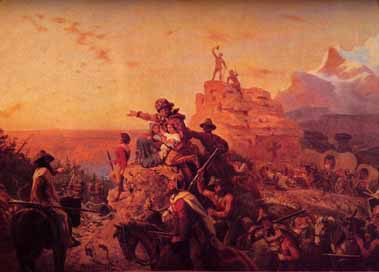
Emmanuel Leutze, "Westward the Course of Empire"(1861).
I. Background of U.S. Foreign Policy
A. Washington's Proclamation of Neutrality and Farewell Address ("avoid entangling alliances")
B. Jefferson's frustrations with the Tripolitan pirates (1801-1804)
C. Monroe Doctrine (1823) signaling America's power that was strong enough to prevent European meddling in western hemisphere's affairs
II. Causes of American Expansion in 1830s and 1840s
A. Economic factors
B. Psychological factors–manifest destiny: it’s God’s destiny for America to spread from ocean to ocean)
C. Attractive regions of fertil land --east Texas, California, Oregon
D. Advertising the West
III. Texas
A. American colonization began in the 1820s under Austin.
B. Mexican independence led to restrictions (slavery prohibited)
C. Texans remained loyal to US but became increasingly frustrated by Mexican rule
D. Santa Anna abolished local rule and set up himself as dictator (1835)
1) Texans responded by declaring independence and establishing own government (March 1836)
2) Alamo--defeat of Texan forces
3) San Jacinto--Mexicans defeated, Santa Anna captured, Texas independence recognized by Mexico
E. Jackson refused to annex Texas
F. Texas admitted to Union in 1845 – which will lead to war
IV. Oregon Territory
V. Mexican-American War
The Peculiar Institution of American Slavery
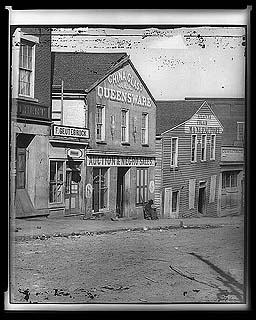
Antebellum Slavetrading Storefront
The whole commerce between master and slave is a perpetual exercise of the most unremitting despotism on the one part, and degrading submission on the other. Indeed I tremble for my country when I reflect that God is just; that his justice cannot sleep forever. Thomas Jefferson, 1782
I. Slavery's Economic Base
A. Whitney's cotton gin (1793) allowed cotton to become the main Southern crop, more important economically than tobacco, rice, and sugar
B. Both the North and the South profited from the prosperity of cotton
1. Cotton's huge profitability caused planters to buy more slaves and more land to take advantage of the economic potential
a) 1800 18 million lbs. of cotton exported ($5,000,000 value), 7% of total exports
b) In 1860, 1,700 million lbs. of cotton exported ($191,000,000 value), 57% of total exports
2. 80% of the world's cotton came from the South in 1860. Most went to factories in England
II. Slavery's Social Base
A. While a small number of whites owned slaves (only 1750 families owned over 100 slaves in 1850), they exerted enormous political and social power in the South
B. Dominance by the aristocracy was basically undemocratic
1. It widened the gap between rich and poor
2. It hampered state-supported public education
3. It attempted to preserve the "cavalier" tradition--courteous, hospitable, and chivalrous
C. Beneath the plantation slave owner were poor whites with less status
1.Poor whites--suffering from malnutrition and intense poverty
2. Mountain whites--lived in semi-isolation in Appalachian Mountains. Independent small farmers resenting both planters and slaves.
D. Beneath the poor whites were 250,000 free blacks of the South. Free blacks were resented by Southern whites as examples of emancipation and many Northern whites because of their competition for work
E. Bottom of social pyramid: 4,000,000 slaves.
1. Legal importation of slaves ended in 1808.
2. Slaves mostly concentrated in "black belt" of the Deep South
3. Slaves were bought or sold at auctions
4. Slavery was degrading to the dignity of victims and to the humanity of the whites
III. Abolitionist Responses to Slavery
A. Abolitionists differed from early antislavery movements in their emphasis on racial equality and were divided into two main camps:
1.Gradualists (Theodore Weld) who favored a gradual erasure of slavery by Southern legislatures
2. Militants (William Lloyd Garrison) who argued that no compromise with the evil of slavery was possible
a) Demanded immediate emancipation without compensation
b) Opposed the Constitution as a "covenant with death and an agreement with hell."
c) Garrison published a powerful newspaper entitled The Liberator which attacked slavery and the government's collusion with the institution
3. Organized abolitionists
a) Set up an Underground Railroad that smuggled 2000 slaves a year to Canada and freedom
b) Barraged Congress with antislavery petitions despite a "gag rule" designed to prevent the discussion of slavery
c) Entered politics directly by establishing the Liberty Party
B. While abolitionists always remained small in number, their constant single-issue approach to slavery as a political and moral issue kept it in the public's eye
IV. Southern Defenses of Slavery
A. Slavery was ordained by God, mentioned in the Bible ("Slaves, obey your masters")
B. Essential to the southern economy
C. Preferable to the "wage slavery" of the North
D. Beneficial to the blacks who became Christians after being brought to America
1850s: Decade of Controversy
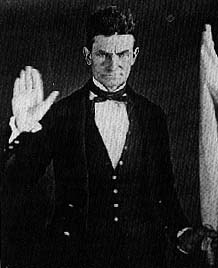
John Brown in 1846
I. Economic Prosperity of 1850s
A. Railroad building expanded tremendously
1. Mileage increased from 9000 to 36,600 miles in 1860
2. Most expansion concentrated in Northeast section of nation
3. By 1860 Northeast and Northwest sections linked by lines. Southern railroads formed a distinct unit with few links to northern rail lines.
B. Northern industrial growth
1. Market expansion for northeast manufacturers
2. California gold rush added capital
3. Expansion of labor supply
C. Spread of Southern plantation system. Slavery seen as absolutely necessary for South's ability to do well.
- Expansion of cotton production
- U.S. produced 7/8 of world cotton supply by 1860
D. Western agriculture expanded as a result of railroad growth and opening of European markets. Results:
1. Westerners became aware of world hostility to slavery
2. Westerners became convinced of importance of Northeast to their prosperity rather than the South which purchased a much smaller share of their produce
II. Persistence of the Slavery Controversy
A. Compromise of 1850 angered extremists on both sides
1. Admission of California as a free state
2. Remaining western territories organized with no restriction on slavery
3. End of all slave trade in Washington DC
4. Strict federal fugitive slave law
B. Harriet Beecher Stowe's Uncle Tom's Cabin (1852) convinced many northerners of the evil of slavery and angered many Southerners because of its biased portrayal
III. Kansas-Nebraska Act (1854)
IV. Dred Scott Case (1857)
V. Illinois Senate Election of 1858
VI. John Brown's Raid--1859
A. Brown and his followers planned a slave insurrection to begin in western Virginia.
B. Seized federal arsenal at Harper's Ferry, but was quickly captured, tried, and hanged.
C. Impact of Brown
1. Northern abolitionists (Emerson and Thoreau) viewed him as a martyr, taking action against the evil of slavery
2. Southerners generally viewed Brown as a madman, symbolizing the fanatical hatred of the North
3. Moderates (Lincoln) condemned Brown's action, while admiring his commitment to countering slavery
VII. Election of 1860
A. Democrats split into northern and southern factions and nominated two candidates (Douglas and Breckenridge)
B. Former Whigs nominated Bell in an attempt to preserve Union with Constitutional Union Party. Strong only in Virginia and upper South
C. Republicans nominated Lincoln as a moderate compromise candidate.
D. Results:
1) Bell wins three states (Virgina, Kentucky, Tennessee)
2) Breckenridge carried the South
3) Lincoln carried the Northern states and won the
electoral vote, though earning less than 40% of all votes cast
4) On December 20, 1860, South Carolina seceded from the Union
|