Part II: The Civil War Years
When Henry returned home to Boston, he spent the winter confined to his father's
house on Chauncy Street with a sprained foot, patiently
seeking employment opportunities as the outlook grew
increasingly dismal. All the while tension steadily
mounted between various groups of citizens, culminating
in the firing upon Fort Sumter on April 12, 1861. Ten
days later, Henry wrote about the outbreak of war in a
letter to his brother Jim who still remained overseas in
Europe:
...Everything excepting the war is forgotten, business
is suspended, the streets are filled with people,
drilling is seen on all sides and at all times. Our
Massachusetts troops were poured into Boston within 12 to
24 hours after the command was issued from here,
and were the first to go on and the first to shed
blood....
|
...I tell you, Jim, no more
heartfelt enthusiasm or devotion was to be found
in '76 than now. Everyone is longing to
go.... I have been laid up all winter with a
sprained foot, which is still weak, but I'll go
if I can march possibly. I've committed myself to
a regiment of volunteers to be raised and drilled
in our harbor before going. It is the best way,
if they are not wanted immediately, for then a
disciplined body of active troops will be opposed
to the enemy, instead of raw recruits. Jim Savage will go in this regiment
as an officer. This foot has been a great
nuisance to me for months, and now may prevent my
going, for a lame man will not be accepted. And
now, Jim, you must decide for yourself whether
you'll return [from Europe] just yet or not; you
might wait a few months to advantage. There will
be little business in any way for beginners until
the war is over, I suppose: the first quota is
gone and the second will be off also before you
can reach here. Then will come much drilling and
preparation for the future: the war will, I
fancy, be very severe, but of short
duration....
|
|
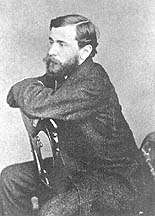 Photo of Henry as a
civilian prior to his enlistment in the 2nd
Massachusetts Regiment. Image of Carte de visite
courtesy of Brian Pohanka.
|
Lieutenant of the
2nd Massachusetts Infantry, Company D
On May 11, 1861
Henry Higginson was mustered in Colonel George H. Gordon's
2nd Massachusetts Regiment, as second lieutenant of
Company D. Jim Savage already had been appointed captain,
and other friends of Henry's who had enlisted in this
regiment were: Greely Curtis (Captain of Company B),
Charles F. Morse (First Lieutenant), Henry S. Russell
(First Lieutenant), William D. Sedgwick (First
Lieutenant), Robert Gould Shaw (Second Lieutenant in Company F),
Richard Cary (Captain of Company G), and Stephen Perkins (Second Lieutenant).
The men of Company D were
drilled at Brook Farm (renamed Camp Andrew for Governor
John A. Andrew), and officers recited their lessons daily
to the lieutenant colonel. Higginson described this
ritual subsequent to the war:
We were usually so tired that we could not recite, and
we had really no time to study, but somehow or other we
learned what we had to do. He [Lieutenant Colonel George
L. Andrews] used to catechize us about all sorts of
points, give instruction about the drill and about the
control of the men, the feeding of the men, and many
other smaller points. Men were taught to stand up when
they were spoken to, to stand in the presence of
officers, to wash themselves properly, and, in short,
were disciplined. Presently, our drill became so
attractive that people used to come and see us, and the
parades which were given every evening were visited by a
large concourse of people—friends and neighbors.
On July 8 Higginson was commissioned first lieutenant, and on that same day the
regiment headed to Boston. From Boston the 2nd
Massachusetts moved on to New York and finally reached
their destination of Hagerstown, Maryland. Three days
later, the troops crossed the Potomac and started for
Winchester, Virginia to face General Joseph E. Johnston's
men. However, on the event of the Battle of First
Manassas (Bull Run) on the 21st, the 2nd Massachusetts
was ordered to hold the nearby town of Harpers Ferry.
Though the Union army suffered a great defeat at
Manassas, Lieutenant Higginson philosophically believed
that the eventual outcome would be good for the men.
Idealistic as he was about the nature of humankind,
Higginson had been disappointed in the behavior of some
of the soldiers in the ranks. He wrote after the battle:
That night I was on guard. As I had not been to sleep
the night before, the task was not easy. I sat on a
fence-rail, and whenever I began to fall, I waked up. I
walked up and down and did everything to keep myself
alive, and certainly went to sleep part of the time while
I was walking.... Seventeen regiments of three-months men
have crossed the river for home, and we are thankful for
it. Such a set of untamed and undisciplined wild-cats you
never saw. They steal, they get drunk. We have four
companies in the town guarding the houses and stores
against these robbers.... Talk to the men as we will,
they will not take care of themselves. Jim [Savage] is
under the weather just now and will have to be off duty a
day or two. [Bill] Sedgwick stands it well so far.
Stephen [Perkins] has been starving considerably, as
indeed we all have.... I am well and strong and shall
bear more work than most of the men. The want of good
officers is surprising.... I am glad of the defeat at
Bull Run, and believe it will be productive of good to
us.
The Battle of Ball's Bluff
On October 21, 1861, the 2nd Massachusetts was spared the defeat the Union army faced at the Battle of Ball's Bluff, but Higginson and his comrades witnessed the aftermath of this disaster for their friends of 20th Massachusetts Infantry, better known as the "Harvard Regiment."
Higginson relates this experience in his memoirs:
One evening, just after drill, we were ordered to march. We heard that there had been a severe fight on the river, and we were to go as fast as we could. We marched all night, going right through a considerable stream, and presently it began to rain, and toward morning, as we were pegging along, we came across various men coming back, who said that we had had a terrible beating. This was the battle of Ball's Bluff. We reached the bank of the river, and there were various men in the houses thereabouts, and troops lying pretty near to the point we reached; and we then learned how our men had gone across the river, had been attacked and driven back, and how much harm had been done. All this time it was raining as hard as it well could, and we were wet through. I heard that a canal boat was going down the river, and that various men whom I knew were on board. I ran down and found Caspar Crowninshield on the stern of the canal boat in a pair of drawers and an overcoat. He gave me a hand, and I got up on the boat, heard his story, saw Willy Putnam [cousin of Charles Lowell] and various others lying down below. Willy Putnam had been shot in the stomach and could hardly speak, and there were various other men badly wounded.
William Lowell Putnam died of his wound, but fortunately others who also were wounded—Putnam's cousin Lieutenant James Jackson Lowell (younger brother of Charles Lowell), and their friend Lieutenant Oliver Wendell Holmes, Jr.—survived.
Captain of the 1st Massachusetts
Cavalry, Company A
With Putnam's death, Higginson experienced his first great loss in the war. William had been a friend—he and Henry had traveled abroad in Europe in happier times. Now the reality of war set in, and the trials of daily life weighed heavily upon Henry. As a result of his
dissatisfaction with various aspects of the 2nd
Massachusetts Infantry, Higginson requested a transfer.
On October 31, 1861 he and Greely Curtis received
commissions in the 1st Massachusetts Cavalry as a
captain and major, respectively. They resigned from the
infantry and departed for Boston to enlist with the new
regiment that was to be mustered in. But Higginson would
not become an active member of the unit any time soon,
much to his disappointment. Having contracted typhoid
fever, Higginson was not able to join his new comrades in
camp at Readville until December. When he arrived in
camp, as senior captain he was responsible for the care
and discipline of the men in Company A:
They were a remarkably tough set of men of all sorts
of occupations, among them prize-fighters, barkeepers and
the like, and also some very good men. They had had as
their first captain a barkeeper, who could do nothing
with them, and he was dismissed and I was put in
charge.... I had to ride and look after my men, do the
regular guard-duty, drill, etc., and I knew nothing about
it and had to learn as I went.
On Christmas Day, the First Battalion (comprised of Companies A, B, C, and D)
under Major Curtis departed for Annapolis, Maryland,
expecting to join General Ambrose Burnside's expedition
to North Carolina. After drilling here for a few weeks,
however, they were instead ordered to join the troops
under the command of General David Hunter on Beaufort
Island off the coast of South Carolina. While stationed
on the island, Higginson wrote to his father in March
1862 about life as a cavalryman and caring for the
regiment's horses:
I was ignorant as a baby of horses when I joined the
regiment at Readville, and yet I knew that I must take
great care of my company horses as my means of making my
men efficient. Now I know very little of horses, but I
have succeeded in making my men work at them in every way
until they look tolerably well.... I find great and
continual pleasure in this occupation, and foresee the
same for a long time. Infantry drill once learned is
monotonous, but riding is a lasting excitement and
delight.
Promotion to Major of the 1st Massachusetts Cavalry
Higginson was commissioned
major on March 26, 1862, a deserved promotion that he did
not expect. In a cheerful letter to his sister Mary
("Molly"), he described camp life with his horses, and—with tongue-in-cheek—wrote about his new status as major:
Beaufort, S.C., May 20, 1862.
Dear little Molly: —
What do you want to know about our camp? One camp is very like another, the difference being that with us
cavalry folks a long rope is stretched down the company
street, to which the horses are tied. We keep very tidy
and clean, strike (that is take down) the tents three
times a week, send the men to bathe as often, take all
the bedding, etc., out of the tents every fair day, and
in short do everything we can to keep healthy....
...My new horse came to me Saturday, and is a
beauty.... This new horse and my other (taken from the
regiment) canter and gallop well and trot also if I like;
they are quiet-tempered and yet full of life. You see,
Molly, there is quite enough to do even on drill without
having a horse wild with excitement to bother one; and
when we come to actual service, it will be essential to
have one's horse well in hand.... If we ever get home
with our nags, you shall have the jolliest ride in the
world on him. My big horse, popularly known as
"Rats-in-a-barrel," and called for short
"Rats," is an excellent work-horse, handy,
light, strong and ugly; he can run fast for a short
distance. Saturday we are going to have a very short
race, all of us officers here: I'll tell you who wins, if
the steamer does not go till then; but I hope to be in
first, for "Rats" starts very quickly indeed.
You can't imagine how big I feel now that I've a camp
under me. A year ago this time I was learning guard-duty
and squad-drill on foot; now I ride around on a big
horse, have two rows of brass buttons on my coat
(you should have seen the men look last night at parade,
as I wore the new coat for the first time), preside at
parade, go to see the general commanding our brigade, and
am generally just as big as I can swell. There is one
thing about it: I don't swear so much as when I had to do
directly with the men. I 've a real pretty cap and
beautiful boots and spurs, and so, with my new coat, it
is quite a pity that my picture should n't be
taken....
Give my love to father and the other children; [our
brother] Jim will be at home [from Europe] one of these
days, but not in time enough for the war. I'm afraid that
our regiment will never see a fight. Where are you going
this summer? We've had bushels of blackberries etc for
several weeks, and to-day have very hot weather: we do
nothing from 9 o'clk A.M. to 3 P.M.; our mounted
drill-hour is from 6 to 8 A.M. Good-bye, little girl: be
good and you'll be happy. — H.

Henry's Civil War story continues:
Page 1 | Page 2 | Page 3 | Page 4

Index
to Higginson's Pages
Back | Home
Copyright © 2005 1st
Dragoon's Civil War Site. All rights
reserved.
|