
The Life Story of
Major Henry Lee Higginson
Part II: The Civil War Years
Page 3
Sketches from Henry's War Diary
Henry kept a war
diary during a month's period from April to May
1863, recording the regiment's activities prior
to and during the days on which the Battle of
Chancellorsville was fought. The following
excerpts from three passages document the
movements of their troops:
April 29. ...We went on a mile or two thro' the woods, passed the scene of
the Kellysville fight, a beautiful field. Just as
we got there firing began, first carbines, then a
few shells. We formed, and got thro' another belt
of woods, then formed line on a huge field, where
also the former fight took place. It was just
dark, and in ten minutes we returned to the edge
of the woods, dismounted, and kept the squadrons
formed all night. We made very small fires
indeed, fed horses, and slept thro' a hard rain
all night....
May 2. Aroused early and
ordered to march in 3/4 of an hour. Marched and
waited and marched thro' a beautiful country to
Stevensburg, and then to Ely's Ford. Heard bad
and good reports of a big battle; had a long
discussion with G. [Lieutenant Colonel Greely
Curtis] and concluded it to be a drawn battle.
Encamped about 8 o'clk. From 4 to 8 we heard very
heavy firing indeed toward Chancellorsville,
where the forces are. Aroused about 12 o'clk
by a volley fired into the 2d brigade by someone
unknown. Turned out all hands. I went with the
carbineers into a wood on foot to hold it. Great
confusion in the arrangement of our brigade. Col.
S. [Horace Binney Sargent] knew nothing of his
regiment or of the ground. Genl. A. [William W.
Averell] decided that it was a mistake of our
own infantry. Left a small picket on foot, and
got to sleep about 1-1/2 o'clk in a wood.
May 3. Wakened with orders for
moving. Sent out with our whole regiment to
picket the road from Culpeper, etc., and returned
about 3 o'clk. Nothing to be seen. Heard various
reports of the battle, but nothing authentic.
...several of our men rode to our lines as escort
and took some prisoners. Learned that the volley
of the night before was fired by the rebels....
Crossed with our brigade alone at Ely's Ford, and
rode to our fortification, about two miles. Went
inside some two or three miles and encamped in a
field near the United States Ford. Saw the
wounded—which is horrid. Everything in
excellent order—1st, 3rd, 5th, 11th
and 12th corps are here.... We are well
entrenched. We had very heavy fighting this
morning, but little this afternoon here. The
heights of Fredericksburg were taken by [General
John] Sedgwick to-day. Genl. [Hiram] Berry was
killed on our right. Slept here—without a
picket or a guard.
On May 7,
Higginson relayed pleasant news in a letter to
his father:
I received a letter from Bob Shaw, speaking of his wedding [(marriage to Annie Haggerty)], this
afternoon.... Charley (Lowell) should be married
too [to Shaw's sister, Josephine
("Effie")]; it is much better, for his
wife might go to him while in winter quarters....
[Cousin] William Channing [of London] was here
this afternoon, he having been on duty with the
Sanitary [Commission] people here. [Brother] Jim
is very well and happy; he has been in
charge of a company for some three or four
weeks.... Bob Shaw wrote to me about [our brother]
Frank [who is now first lieutenant in Shaw's 54th
Massachusetts regiment], speaking very well of
him; he will get promoted faster there than in
the 2d Cavalry....
The Battle of Aldie
The following month, on June 17, 1863, the 1st Massachusetts
Cavalry engaged in a fierce combat with the
soldiers of General John Ewell Brown (JEB) Stuart
and General FitzHugh Lee's cavalry at Aldie Gap. Higginson told his account of the Battle of Aldie in his reminiscences:
It had been a hot, tiresome ride. The men came along in pretty good order, although one of the
regiments belonging to another brigade galloped
about to get water, and acted in a foolish way.
Just as we came to the town of Aldie, we heard a
little firing, and were ordered to the front. As
we rode through the town, we saw a little
fighting going on in front of us—a little
charge by some men of another regiment. We turned
to the right, went up by a little wood, and our
regiment was put into a field close by a
farmhouse and close by the road. There, Colonel
Curtis, in command, left me with two squadrons,
and went to attend to something else. I rode up
to this farmhouse, and saw one or two soldiers'
jackets hanging at the door, and was looking
about, when I saw a regiment coming down at full
tilt on the road towards us. I immediately
ordered one squadron into the road and we charged
these men. They turned straight around and ran
away. We came very near their rear, but could not
reach them. They went down a hill and at the top
I ordered a halt. Captain [Lucius M.] Sargent,
with two or three men, rode straight on down into
a valley after a few of the troopers we had been
pursuing, and began fighting them. I yelled to
him to come back, but he would not do so, and
fearing that he would get into trouble, I rode
down to give him the order, when right behind us
came a whole regiment of Confederate cavalry at
full speed. I shouted to Sargent and the two or
three men with him to ride for their lives, and
we galloped up a hill in front of us, where we
lost one man through the balking of his horse. We
reached the top of the hill, and the Confederates
had stopped, as we were not worth pursuing.
Sargent turned around in his saddle and made
faces at them with his fingers, whereat they
pursued us, and we rode down another very steep
hill, and at the bottom they caught us, and we
had a little shindy. Sargent was knocked from his
horse and shot, as he thought, just above the
heart. One of our men was killed, and one
lieutenant was shot through the side. In striking
a man opposite to me, who was using improper
language, I was knocked from my horse, and found
myself in the road. Over me was standing a man
whom I had unhorsed, and who struck at my head.
He then proposed to take me prisoner, but I told
him I should die in a few minutes, for I put my
hand and found a hole in my backbone. He took
what he could get of my goods, and rode off,
leaving my horse, which had been shot with four
bullets. (See Higginson Reminisces on the
Aftermath of the Battle for the rest of the major's
account.)
On
June 30, Major Higginson was granted a
60-day leave of absence for his injuries
(three saber cuts and two pistol wounds),
and returned to the house on Chauncy
Street where he was tended by his father.
Days later, his old regiments fought at
Gettysburg and Henry regretted that he
could not be among them. Higginson
learned about the Union's victory from
Greely Curtis who was soon out of action
himself, stricken with malaria. Curtis
wrote again on July 18, telling of the
regiment's confidence in General George
Gordon Meade after the success of
Gettysburg. Meanwhile, on that same day,
Robert Gould Shaw was killed in the 54th
Massachusetts Infantry's assault on Fort
Wagner. Higginson learned of this great
personal loss long after the event.
Fortunately,
Higginson's brother Frank did not
participate in the assault, having been
assigned fatigue detail. As for his
brother Jim—who
had been captured by the enemy at the
Battle of Aldie—Henry
received good natured letters from him at
Libby Prison, indicating that he was
surviving successfully despite "a
few scurvy sores." Jim expressed
surprise regarding Henry's wounds; he had
no knowledge of what happened to him in
the chaos of that battle.
|
|
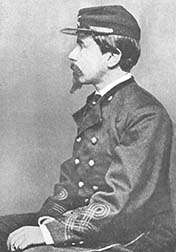 Photo of Major Higginson after the Battle of Aldie. Image courtesy of Brian Pohanka, from the Bliss Perry
book.
|
The
Major and Mrs. Higginson
Little did
Higginson or his doctors know, but his injuries
were far more critical than they realized. In
late August 1863 he appeared to be on the mend,
but by the end of October the bullet wound in his
back became abscessed. However, by mid-November,
the doctors reported that Higginson began to make
a rapid recovery. Perhaps his improved health was
the result of the comfort and cheer he received
from Ida Agassiz to whom he proposed marriage
that autumn. If not for Ida's affection and
companionship, Henry's condition might have
worsened.
Henry felt blessed
with good fortune to have Ida Agassiz as his
fiancée. The daughter of Harvard zoology professor Louis Agassiz, Ida was his ideal woman—gracious,
charming, cultured and refined, and an old friend
from the neighborhood. Upon learning of their
engagement in September, Charles Lowell—who
would marry "Effie" Shaw on October
31—wrote to Higginson in jest: "You've
been a great deal of trouble to me for the last
25 years, Henry, a great deal of trouble. Still I
should have been very willing to continue to take
care of you. Life has been made such a very light
burden to me lately, that I feel as if I could
carry you along without much trouble. Still, old
fellow, I am very, very glad, to turn you over to
so much better hands. It has been a pleasant
thing always to have two such good friends, and
it will be a pleasanter thing to know of you now
helping one another along in these uncomfortable
times."
Henry and Ida were
married on December 5, 1863 in a "quiet,
simple, and sacred" wedding. The couple
spent Christmas at her father and stepmother's
home, then went to the Agassiz cottage at Nahant
for spring.
The major served
with the recruiting service that winter and had
hoped to soon rejoin his regiment. But he was not
well enough to resume his duties, as he could not
sit in the saddle without enduring severe pain.
Meanwhile, his post had been filled by officer
Samuel E. Chamberlain, and Henry received letters
from commander Charles Adams, telling of
the demoralization of the troops. It was not
until June 1864 that Higginson was allowed to
return to service with his unit, just as the
Campaign of the Wilderness opened. However, he
was unable to partake in any action for the
remainder of his career with the 1st
Massachusetts Cavalry.

Henry's Civil War
story continues:
Page 1 | Page 2 | Page 3 | Page 4

Index
to Higginson's Pages
Back | Home
Copyright © 2005 1st
Dragoon's Civil War Site. All rights
reserved.
|

