 |
(Some) Computer History in a Timeline |
|
|
(Some) Computer History in a Timeline |
 |
With a little preparation, turns out not to be the end of the world after all.It was speculated that computer programs could stop working or produce erroneous results because they stored years with only two digits and that the year 2000 would be represented by 00 and would be interpreted by software as the year 1900. This would cause date comparisons to produce incorrect results. It was also thought that embedded systems, making use of similar date logic, might fail and cause utilities and other crucial infrastructure to fail. Special committees were set up by governments to monitor remedial work and contingency planning, particularly by crucial infrastructures such as telecommunications, utilities and the like, to ensure that the most critical services had fixed their own problems and were prepared for problems with others. It was only the safe passing of the main "event horizon" itself, January 1, 2000, that fully quelled public fears. |
 |
The last version of the "Classic" OS, which was tightly integrated into proprietary chips running the Motorola 68000 series of processors. Although development on the Amiga continues, it begins to radically change after this OS release. |
 |
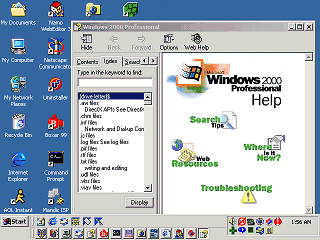 |
(NT 5.0) Microsoft continues to improve the NT line.Windows 2000 comes in four versions: Professional, Server, Advanced Server, and Datacenter Server. Windows 2000 is classified as a hybrid-kernel operating system, and its architecture is divided into two modes: user mode and kernel mode. The kernel mode provides unrestricted access to system resources and facilitates the user mode, which is heavily restricted and designed for most applications. All versions of the operating system support the Windows NT filesystem, NTFS 5, the Encrypted File System (EFS), as well as basic and dynamic disk storage. Dynamic disk storage allows different types of volumes to be used. The Windows 2000 Server family has enhanced functionality, including the ability to provide Active Directory services (a hierarchical framework of resources), Distributed File System (a file system that supports sharing of files) and fault-redundant storage volumes. |
 | Milenium Edition, Microsoft's last OS following the Win95 based kernel. It provided Internet Explorer 5.5, Windows Media Player 7, and the new Movie Maker software, which provided basic video editing and was designed to be easy for home users. Windows Me is an MS-DOS based version just like Windows 95 and Windows 98 but with access to real mode MS-DOS restricted for faster system boot time. This was one of the most publicized changes in Windows Me because applications that needed real mode DOS to run (such as older disk utilities) would not run under the Windows Me operating system. |
 |
Transmeta Corporation introduced Crusoe, low power microprocessors designed to create a new category of Mobile Internet Computers. Crusoe performs in software some of the functionality traditionally implemented in hardware, resulting in simpler hardware with fewer transistors. The relative simplicity of the hardware means that Crusoe consumes less power (and therefore generates less heat) than other x86-compatible microprocessors running at the same frequency. |
 | Don Ferguson invents the Java 2 Enterprise Edition application server at IBM. J2EE includes several API specifications, such as JDBC, RMI, e-mail, JMS, web services, XML, etc, and defines how to coordinate them. Java EE also features some specifications unique to Java EE for components. This allows the developer to create an enterprise application that is portable between platforms and scalable, while integrating with legacy technologies. J2EE can handle the transactions, security, scalability, concurrency and management of the components that are deployed to it, allowing the developers to concentrate more on the business logic of the components rather than the lower level maintenance tasks. |
 | Anders Hejlsberg is the chief architect of C#, the first component-oriented programming language in the C and C++ family to combine the power of those languages with the functional ease of modern, rapid application development tools. Anders Hejlsberg also played a pivotal role in the development and design of Visual J++ and the Windows Foundation Classes. In 2003, J++ support was dropped in favor of J#, which has been included into the MS .NET platform. |
 | AMD released the first 1GHz microprocessor a month before Intel. Athlon is the brand name applied to a series of different x86 processors designed and manufactured by AMD. The original Athlon, or Athlon Classic, was the first seventh-generation x86 processor and, in a first, retained the initial performance lead it had over Intel's competing processors for a significant period of time. AMD has continued the Athlon name with the Athlon 64, an eighth-generation processor featuring AMD64 technology. |
 | The Pentium 4 is a seventh-generation x86 architecture microprocessor produced by Intel and is their first all-new CPU design, called the NetBurst architecture, since the Pentium Pro of 1995. Unlike the Pentium II, Pentium III, and various Celerons, the architecture owed little to the Pentium Pro/P6 design, and was new from the ground up. The microarchitecture of Netburst featured a very deep instruction pipeline, with the intention of scaling to very high frequencies. It also introduced the SSE2 instruction set for faster SIMD integer, and 64-bit floating-point computation. |

|

|
Steve Jobs is back with Apple and together they release a new phase for Macintosh, this time based on FreeBSD UNIX, OS X delivers the NeXT dream. Mac OS X (officially pronounced "Mac OS Ten") is a line of proprietary, graphical operating systems developed, sold, and marketed by Apple Computer, the latest of which is included with all currently shipping Apple Macintosh computers. Mac OS X is the successor to the original Mac OS, which had been Apple's primary operating system since 1984. Unlike its predecessor, Mac OS X is a multi-user, pre-emptively multitasking, Unix-like operating system built on technology that had been developed at NeXT through the second half of the 1980's and up until Apple Computer purchased the company in early 1997. Mac OS X is based on the Mach kernel and the BSD implementation of Unix, which were incorporated into NEXTSTEP, the object-oriented operating system developed by Steve Jobs' NeXT company after he left Apple in 1985. |
 | ACM Turing Award Winner in recognition of his fundamental contributions to the theory of computation, including the complexity-based theory of pseudorandom number generation, cryptography, and communication complexity. |
 | Sony releases the PlayStation2, a 64-bit, CD ROM based video game console. The PS2 is part of the sixth generation era, and has become the fastest selling gaming console in history, with over 100 million units shipped by November 2005, beating the previous record holder, the PlayStation, by three years and nine months. When it was released, the PS2 had many advanced features that were not present in other contemporary video game consoles, including DVD-playback functionality, USB support, and IEEE 1394 expansion ports. |
 | Shawn Fanning developes internet file sharing software service that enrages the recording industry. Napster was the first widely-used peer-to-peer (or P2P) music sharing service. |
 | A flash memory card is a solid-state electronic flash memory data storage device used with digital cameras, handheld and laptop computers, telephones, music players, video game consoles, and other electronics. They offer high re-recordability, power-free storage, small form factor, and rugged environmental specifications. |

Floating Gate Transistor  |
USB flash drives are NAND-type flash memory data storage devices integrated with a USB interface. They are typically small, lightweight, removable and rewritable. As of November 2006, memory capacities for USB Flash Drives currently are sold from 32 megabytes up to 64 gigabytes.
USB flash drives offer potential advantages over other portable storage devices, particularly the floppy disk. They are more compact, generally faster, hold more data, and may be more reliable (due to their lack of moving parts) than floppy disks. IBM was the first North American seller of a USB flash drive, and marketed an 8 MB version of the product in 2001 under the "Memory Key" moniker. Lexar can also lay claim to a pioneering USB flash drive product. In 2000 they introduced a Compact Flash (CF) card having an internal USB function. But the technology behind devices like Flash Memory cards and USB Flash Drives come from Flash Memory, which was invented by Dr. Fujio Masuoka while working for Toshiba in 1984. According to Toshiba, the name 'Flash' was suggested by Dr. Masuoka's colleague, Mr. Shoji Ariizumi, because the erasure process of the memory contents reminded him of a flash of a camera. There are two types of Flash memory, NOR and NAND. NAND is the common form found in devices like memory cards, USB Flash drives, audio players, digital cameras, video games, PDAs and mobile Phones. In a computer, working memory is placed in RAM, which allows the information to be randomly accessed, but will lose the information without a steady flow of electricity, so changes are saved into long term memory storage, which is usually on a hard drive or CD. Flash memory has the ability to allow random access like RAM, yet is a form of non-volatile storage, meaning it does not require a steady stream of electricity. Flash memory stores information in an array of floating gate transistors, called "cells", each of which traditionally stores one bit of information. Newer flash memory devices, sometimes referred to as multi-level cell devices, can store more than 1 bit per cell, by using more than two levels of electrical charge, placed on the floating gate of a cell. In a Floating Gate Transistor, oxide surrounds the floating gate entirely, so an electrical charge trapped on the floating gate remains there. The charge stored on the floating gate can be modified by applying voltages to the source, drain, and control gate terminals. This is what keeps the memory state when the power is off. Standard computer RAM is currently much faster than Flash, or any other ROM, but work is in place to create Flash memory that is as fast as RAM. ROM technology like Flash goes back many years, but 2000 is definately the year that USB Flash Drives began popping up all over the place. |
 |
OpenOffice.org is based on StarOffice, an office suite developed by StarDivision and acquired by Sun Microsystems in August 1999. The source code of the suite was released in July 2000 with the aim of reducing the dominant market share of Microsoft Office by providing a free, open and high-quality alternative. OpenOffice.org is free software, available under the GNU Lesser General Public License (LGPL).
The project and software are informally referred to as OpenOffice, but this term is a trademark held by another party, requiring the project to adopt OpenOffice.org as its formal name. The components available include: Writer - a word processor. Calc - a spreadsheet. Impress - a presentation program. Base - a database program (not introduced until version 2.0) Draw - a vector graphics editor Math - for creating and editing mathematical formulae. OOoBasic - a programming language that can be used to enhance the above components. |
 | Exchange 6.0 raised the maximum sizes of databases and increased the number of servers in a cluster from two to four, and integrated with Active Directory in Windows 2000 server to set accounts and access rights. |
 |
The Linux kernel is an assortment of modular components and subsystems including device drivers, protocols, and other component types. APIs, programming interfaces that provide a standard method by which the Linux kernel can be expanded, glues these to the core of the Linux kernel. Linux 2.4 is the first release of the Linux kernel that will include a full-featured resource management subsystem. First, Linux 2.4 can handle many more simultaneous processes. Second, the scheduler has been to be more efficient on systems with a larger number of concurrent processes. Third, kernel 2.4 can now handle an amazing number of users and groups-- about 4.2 billion. (And that's a lot of users!) In addition, support for more powerful hardware is provided which now supports up to 64GB of RAM on Intel hardware, 16 Ethernet cards, 10 IDE controllers, multiple IO-APICs, and other pointless abuses of good hardware. The 2-gigabyte file size restriction has also been lifted, and much more. |
 | The Itanium is an IA-64 microprocessor developed jointly by Hewlett-Packard and Intel. It uses Explicitly Parallel Instruction Computing (EPIC), where the compiler would line up instructions for parallel execution, replacing Reduced Instruction Set Computing (RISC) architecture. Features were added to ensure compatibility with both Intel x86 and HP UNIX applications. It was expected to dominate servers, workstations, and perhaps even desktops, however it expensively failed to do so, giving it the nickname Itanic, in reference to the sinking Titanic ship. |
 |
(NT 5.1) Microsoft continues to improve the NT line. It presents a redesigned GUI. New software management capabilities were introduced to avoid the "DLL hell" that plagued older consumer versions of Windows. It is also the first version of Windows to use product activation to combat software piracy, a restriction that did not sit well with some users and privacy advocates. Windows XP has also been criticized by some users for security vulnerabilities, tight integration of applications such as Internet Explorer and Windows Media Player, and for aspects of its user interface. The two major editions are Windows XP Home Edition, designed for home users, and Windows XP Professional, designed for business and power-users.Windows XP Professional offers a number of features unavailable in the Home Edition, including: the ability to become part of a Windows Server domain, Remote Desktop server, offline Files and Folders, Encrypting File System, Group Policies, Automatic Software Installation and Maintenance, Roaming User Profiles, Remote Installation Service (RIS), and multiple processors for symmetric multiprocessing, allowing the PC to divide work between multiple processors (CPUs). |
 | Just prior to its acquisition by HP, Compaq announced the port of OpenVMS to the Intel Itanium 64-bit EPIC architecture. This port was accomplished using the OpenVMS Alpha source code pool and libraries. The OpenVMS Alpha pool was used as the basis of the port as it was significantly more portable than the original OpenVMS VAX source code and because the code was fully 64-bit capable. |
 |
Wikipedia is an international Web-based free-content encyclopedia project. It exists as a wiki, a website that allows visitors to edit its content; the word Wikipedia itself is a portmanteau of the words wiki and encyclopedia. Wikipedia is written collaboratively by volunteers, allowing articles to be changed by anyone with access to the website. Wikipedia's main servers are in Tampa, Florida, with additional servers in Amsterdam and Seoul. The project began January 2001 as a complement to the expert-written (and now defunct) Nupedia, and is now operated by the non-profit Wikimedia Foundation. Midway through 2006, Wikipedia had more than 4,600,000 articles in many languages, including more than 1,200,000 in the English-language version. There were more than 200 language editions of Wikipedia, fifteen of which had more than 50,000 articles each. |
 | Created by Bram Cohen, BitTorrent is a Python based file sharing utility that shares files between all clients currently getting the file and continue to share the file on their computer. What makes bittorrent so successful is that it shares the files between all users, which means if the file is popular the bandwidth is likely to increase and will not overload or stop the download because so many users trying to get the file at the same time. |
 | The Xbox was the first console to incorporate a hard disk drive, used primarily for storing game saves compressed in zip archives and content downloaded from Xbox Live. An Xbox owner can rip music from standard audio CDs to the hard drive so players can play their custom soundtrack, in addition to the original soundtrack of Xbox games that support such a feature. The Xbox is based on commodity PC hardware and runs a stripped-down version of the Windows 2000 kernel using APIs based largely on DirectX 8.1. It also features built in fast ethernet. |
 | ACM Turing Award Winners for ideas fundamental to the emergence of object oriented programming, through their design of the programming languages Simula I and Simula 67. |
 |
IBM released the POWER4, the first multicore chip, which contains two PowerPC cores in a single die. It also was the first to implement a Multi-Chip-Module(MCM) containing four POWER4 Microprocessors in a single package.
It is besed on the 64-bit PowerPC instruction set architecture, replacing the previous POWER3 chip design. POWER is a reduced instruction set computer (RISC) instruction set architecture designed by IBM. The name is a backronym for Performance Optimization With Enhanced RISC. The POWER architecture was used to develop the PowerPC architecture, used in later Apple Macintosh computers, some IBM workstations, as well as a number of embedded applications. |
 | A Pocket PC is a handheld-sized computer that runs the Windows CE operating system. It has many of the capabilities of modern desktop PCs. Currently there are thousands of applications for Pocket PC, many of which are freeware. Pocket PCs can also be used with many add-ons like GPS receivers, barcode readers, RFID readers, and cameras. |
 | Microsoft Windows XP 64-bit Edition was a version of Microsoft's Windows XP operating system designed to run on Intel Itanium family of microprocessors in their native 64-bit mode. Microsoft later released Windows XP Professional x64 Edition, which is designed for x86 processors supporting the x64 extensions. |
 | The iPod is a brand of portable media players by Apple Computer. The full-sized model stores media on a built-in hard drive, while the smaller iPod shuffle and iPod nano use flash memory. Like many digital audio players, iPods can serve as external data storage devices when connected to a computer. Originally offered with 5GB of storage, newer models boast 60GB of storage, color screens, and video players. |
 | In 2001, a new company called AOL Time Warner was created when AOL purchased Time Warner. AOL CEO Steve Case became executive chairman of the new company, while Time Warner CEO Gerald Levin retained the CEO title. The deal has since become a symbol of the Dot com bubble and is widely regarded as a disaster, with a $2.4 billion shareholder settlement and a $5 billion price boosting share buyback program. The value of the America Online division dropped significantly. This forced a goodwill write down, causing AOL Time Warner to report a loss of $99 billion in 2002 - at the time, the largest loss ever reported by a company. In response to the huge loss in 2002, the company dropped the "AOL" from its name, and removed Steve Case as executive chairman in favour of Richard Parsons. Case resigned from the Time Warner board on October 31, 2005. |
|
| The RIAA uses the US Digital Millenium Copyright Act to shut down Napster. After a $2.4 million takeover offer by the Private Media Group, Napster's brand and logos were acquired at bankruptcy auction by the company Roxio, Inc. which used them to rebrand the pressplay music service as Napster 2.0. As of 2005, this new service has met with moderate success. |
 | The Game Boy Advance is much smaller and lighter than the origial Game Boy at 3.2" Height by 5.69 " Wide and 0.97" Deep. It features a 2.9" Reflective thin-film transistor color LCD of up to 240 x 160 pixels capable of displaying 511 simultaneous colors in character mode and 32,768 simultaneous colors in bitmap mode. Weighing only 5 ounces, it is powered by two AA batteries that last around 15 hours. The CPU is a 16.8 MHz 32-bit ARM7TDMI with 96kb embedded memory and 256 kb WRAM. Backward compatibility for Game Boy and Gameboy Color games is provided by a 8.4 MHz Z80 co-processor, while a link port at the top of the unit allows it to be connected to other devices via use of a Nintendo Game Link cable or GameCube cable. |
 | The Hammer processor architecture is designed to provide unparalleled PC performance on 32-bit applications while allowing a migration path to 64-bit applications. The “Hammer” family of microprocessors features a high-performance integrated memory controller and a high-speed scalable system bus using HyperTransport technology. |
 | Intel &HP release an improved IA-64 Itanium processor. Although faster, Itanium had yet to produce the types of speed that would allow it to domainate the market. The following companies announced a new "Itanium Alliance" in September 2005 to promote hardware and software development for the chip: Hewlett-Packard, Hitachi, Fujitsu, NEC, Unisys, Bull, Silicon Graphics, Microsoft, Oracle, Red Hat, Novell, BEA Systems, SAP, SAS, and Intel. |
 | ACM Turing Award Winners for seminal contributions to the Theory and Practical Applications of Public Key Crytography. |
 |
Microsoft releases .NET web services development platform.Programs written for the .NET framework execute in a software environment that manages the program's runtime requirements. This runtime environment, which is also a part of the .NET framework, is known as the Common Language Runtime (CLR). The CLR provides the appearance of an application virtual machine, so that programmers need not consider the capabilities of the specific CPU that will execute the program. The CLR also provides other important services such as security guarantees, memory management, and exception handling. The class library and the CLR together comprise the .NET framework. The framework is intended to make it easier to develop computer applications and to reduce the vulnerability of applications and computers to security threats. First released in 2002, it is included with current versions of Microsoft Windows, and can be installed on most older versions. |
 |
Microsoft released Visual Studio .NET in 2002 (the beta version was released on the Microsoft developer network in 2001). The biggest change was the introduction of a managed code development environment using the .NET Framework. Programs developed using .NET are not compiled to machine language (like C++ is, for example) but instead to a format called MSIL or CIL. When an MSIL application is executed, it is compiled while being executed into the appropriate machine language for the platform it is being executed on, thereby making code portable across multiple platforms. Programs compiled into MSIL can be executed only on platforms which have an implementation of Common Language Infrastructure. It is possible to run MSIL programs in Linux or Mac OS X using non-Microsoft .NET implementations like Mono and DotGNU. Microsoft introduced C#, a new programming language, that targets .NET. It also introduced the successor to Visual J++ called Visual J#. Visual J# programs use Java's language syntax. However, unlike Visual J++ programs, Visual J# programs can only target the .NET Framework, not the Java Virtual Machine that all other Java tools target. Visual Basic was drastically changed to fit the new framework, and the new version was called Visual Basic .NET. Microsoft also added extensions to C++, called Managed Extensions for C++, so that C++ programmers could create .NET programs. Visual Studio .NET can be used to make applications targeting Windows (using Windows Forms, part of the .NET Framework), Web (using ASP.NET and Web Services) and, with an add-in, portable devices (using the .NET Compact Framework). |
 | In 2001, Compaq engaged in a merger with Hewlett-Packard. Numerous large HP shareholders, including Walter Hewlett, publicly opposed the deal, which resulted in a nasty proxy battle between those for and against the deal. The merger was approved only after the narrowest of margins, and allegations of vote buying (primarily involving an alleged last-second back-room deal with Bank of America) haunted the new company. Some Compaq products were re-branded with the HP nameplate, while the Compaq brand remained on other products, notably PC, PDA, and server lines. |
 | Specified by IEEE as 802.3-2005 standard, it was released as 10GbE over fiber only. A twisted pair implementation is expected sometime in 2006. |
 |
Public Wireless services begin to appear at various stores in the US. Most are commercial, however, many hotspots are open and free for use, either set up by the public or by a commercial enterprise hoping to use it to attract customers. A "poisoned hotspot" refers to a free public hotspot set up by identity thieves or other malicious individuals for the purpose of "sniffing" the information being sent by the user. |
 | Handspring ships the Treo, the first PDA + Cell phone including wireless internet services such as email and the Web. |
 | Palm releases the first PDA with wireless internet service. |
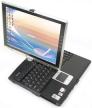 | Tablet based laptops are released, along with Windows XP Tablet edition. Features a swivel touch screen with pen and speech interactive options. |
 | An edition of Microsoft XP that features PC based TV recording, which turns a PC into a Personal Video Recorder (PVR). |
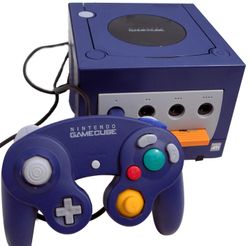 | The Nintendo GameCube uses a proprietary storage medium, the Nintendo GameCube Game Disc, based on Matsushita's optical-disc technology; the discs are approximately 3 1/8 inches in diameter (considerably smaller than the 12 cm CDs or DVDs used in competitors' consoles), and have a capacity of approximately 1.5 gigabytes. Contrary to popular belief, GameCube discs are not physically read any differently from a standard DVD disc, but are encrypted with a key derived from the Burst Cutting Area, a 'bar code' unreadable by most DVD drives. This move was intended to prevent unauthorized copying of GCN titles, but was eventually cracked. By exploiting a flaw in Phantasy Star Online Episode I & II, users were able to connect their GameCubes to their PCs and run homebrew programming on the console. |
 |
Serial ATA is a computer bus technology primarily designed for transfer of data to and from a hard disk. It is the successor to Advanced Technology Attachment standard (ATA). This older technology was retroactively renamed Parallel ATA (PATA) to distinguish it from Serial ATA. Both SATA and PATA drives are IDE (Integrated Drive Electronics) drives, although IDE is often misused to indicate PATA drives.
SATA drives are hot plugable and use smaller power and interfact cables. Unlike PATA, SATA drives cannot share the bus, so each device has a dedicated cable and bandwidth. SATA drives may be plugged into Serial Attached SCSI (SAS) controllers and communicate on the same physical cable as native SAS disks. SAS disks, however, may not be plugged into a SATA controller. First-generation SATA interfaces, also known as SATA/150 or SATA 1, run at 1.5 gigabits per second (Gbit/s), but uses encoding at the physical layer, resulting in an actual data transfer rate of 1.2 Gbit/s, or 150 megabytes per second (MB/s). The relative simplicity of a serial link and the use of LVDS allow both the use of longer drive cables and an easier transition path to higher speeds. Second generation SATA is known as SATA 3.0 Gbit/s, and runs at 2.4 Gbit/s or 300MB/s. The new controllers maintain backwards compatiblity with original SATA devices. External SATA is commonly called eSATA. Currently, most PC motherboards do not have an eSATA connector. eSATA may be enabled through the addition of an eSATA host bus adapter (HBA) or bracket connector for desktop systems or with a Cardbus or ExpressCard for notebooks. |
 | IETF ratifies the iSCSI standard over TCP/IP networks. Along with gigabit Ethernet, iSCSI becomes the new common way to build Storage Area Networks. |
 | The world's first handset combining a cell phone, Linux operating system, and Java technology with full PDA functionality. |
 |
One notable result of Cisco buying Linksys was the WRT54G router. To minimize costs, Linksys decided to base the firmware on Linux. In 2003, Columbia Law School Professor Eben Moglen pointed out that due to the Linux-based nature of the firmware, Cisco was legally obliged to release the source code to the routers, under the terms of the Linux GNU General Public License. Cisco acknowledged its obligation, released the code, and revealed the secrets of how the software code interfaced to the hardware. This subsequently spawned an open source community, dedicated to modding Linksys router firmware. Amateur programmers quickly learned how to add $600 features to $60 routers. This changed the dynamics of the router market as expectations of both stability and features on the part of consumers increased. Linksys and other vendors then had to respond, since open source firmware is now freely available for licensing and customization, which would enable new router vendors to enter the market without the traditional barrier of having to develop the firmware code. The best consumer routers are now arguably comparable to what were formerly high-end routers. |
 | Debuting on April 28, 2003, the iTunes Music Store was the first online music store to gain widespread media attention. Apple's store allows the user to purchase songs and transfer them easily to the iPod through iTunes. The iPod remains one of the few digital music players (besides some Motorola cell phones) that are intended to work with the iTunes Music Store, although some other digital music players will work with iTunes. |
 | AMD releases the first 64 bit processor that runs both 64bit and 32bit software environments. The AMD64 architecture has been adopted (under the name EM64T or IA-32e) by Intel. Due to the difference in names used by Intel and AMD, Microsoft's marketing instead uses the term x64. |
 | IBM releases it's PowerPC 970 64bit Processor as Apple releases an update to OS X that adds partial 64bit support for the new IBM chips. |
 | Intel releases the Pentium4 with Hyperthreading, which allows a single processor to act as if it were multiple processors, breaking requests into separate threads. |
 | SCO Group attempts to sue IBM over a claim that IBM took some of their proprietary code and put it into Linux. |
 | Introduced in March 2003, the Pentium M is an x86 (i686) architecture microprocessor designed and manufactured by Intel and forms part of the Intel Centrino platform. The processor was originally designed for use in laptop personal computers, thus the "M" for mobile. |
 |
(NT 5.2) Microsoft continues to improve the NT line. Unlike Windows 2000 Server, Windows Server 2003's default installation has none of the server components enabled, to reduce the attack surface of new machines. Windows Server 2003 brought in enhanced Active Directory compatibility, and better deployment support, to ease the transition from Windows NT 4.0 to Windows Server 2003 and Windows XP Professional. Significant enhancements have been made to various services such as the IIS web server (which was almost completely re-written to improve performance and security), Distributed File System (which now supports hosting multiple DFS roots on a single server), Terminal Server, Active Directory, Print Server, and a number of other areas. Windows Server 2003 was also the first operating system released by Microsoft after the announcement of their Trustworthy Computing initiative, and as a result, contains a number of improvements to security defaults and practices. |
 | ACM Turing Award Winner for pioneering many of the ideas at the root of contemporary object-oriented programming languages, leading the team that developed Smalltalk, and for fundamental contributions to personal computing. |
 | Macintosh 10.3 (Panther) is released. Featuring improved "Expose" window manager, mail client, file finder, and DVD player. New FileVault data security. |
 | AmigaOS 4.0 moves the Amiga Operating System to the modern Power PC chips enabling the easy use of off-the-shelf components from third party vendors. True to its heritage, AmigaOS 4.0 remains small, fast and robust. |
|
Features Hyperthreading, improved embedded system support, and NUMA (Non-Uniform Memory Access) a major leap forward for efficiency on systems that have many processors. 2.6 increased the maximum number of users and groups from 65,000 to over 4 billion, increased the maximum number of process ids from 32,000 to 1 billion, increased the maximum number of device types (major device) from 255 to 4095 and the maximum number of devices of each type (minor device) from 255 to more than a million. The 2.6 kernel improved 64-bit support and filesystems of up to 16 terabytes on common hardware, and improvements to the "overall responsiveness" for interactive processes (the kernel became fully pre-emptible and the I/O scheduler was rewritten). Support for futexes, a rewrite of threading infrastructure to allow the Native POSIX Thread Library (NPTL) to be used, support for SGI's XFS filesystem, iSCSI, infiniband, inotify, 9P, and FUSE support, among others. |
 |
Designed for portable systems, a low powered high speed processor. |
 | An integrated Cellular and PDA processor. |
 | In early 2003, Nintendo upgraded the Game Boy Advance giving it an internal front-light that can be turned on or off, a rechargeable lithium ion battery, as well as a folding case approximately half the size of the Game Boy Advance. It was designed to address some common complaints with the original Game Boy Advance which was criticized for being very uncomfortable. They also released a new backlit switch that controls the light now toggles between "normal" (which itself is already brighter than the original Game Boy Advance SP's screen), and "bright," an intense brightness level similar to LCD television set. |
 | Nokia released the N-Gage in 2003. It was designed as a combination mp3 player, cellphone, PDA, radio, and gaming device. The system received a lot of criticism alleging defects in its physical design and layout, including its vertically oriented screen and requirement of removing the battery to change game cartridges. The most well known of these was "sidetalking", or the act of placing the phone speaker and receiver on an edge of the device instead of one of the flat sides, causing the user to appear as if they are speaking into a taco. The N-Gage QD was later released to address the design flaws of the original. However, this practical redesign came at a cost: certain features available in the original N-Gage, including MP3 playback, FM radio reception, and USB connectivity were removed. |
 |
Exchange 6.5 features enhanced disaster recovery which allows the server to send and receive mail while the message stores are being recovered from backup. Outlook Mobile Access and server-side ActiveSync were included, dropping the Mobile Information server. Better anti-virus and anti-spam protection have also been added, both by providing built-in APIs that facilitate filtering software and built-in support for the basic methods of originating IP address, SPF ("Sender ID"), and DNSBL filtering.
Exchange accounts can also be accessed through a web browser, known as Outlook Web Access (OWA). Exchange 2003 also features a WAP version of OWA, called Outlook Mobile Access (OMA). Coupled with Windows Mobile 5.0 and SP2, Exchange Server 2003 supports "pushing" email to Windows mobile devices - similar to the operation of BlackBerry devices. |
 | The popular standards based web browser finally reached version 1.0 November 2004 by the Mozilla Foundation. Firefox becomes one of the most widely used free and open sourced applications in the universe...well okay, in the world. |
|
|
HP's 1st production quality Itanium based OS. |
 | Intel releases the 925X Express Chipset that integrates high graphics and sound core logic. Core logic connects the CPU and memory to mass storage, fast graphics, networking, audio, and other I/O. |
 | Integrated wireless 802.11 A,B & G protocols in the Centrino processor. |
 | IBM, original creator of the PC format, sells it's PC business to Lenovo. |
 | Once a huge tech conference, now forced to close out due to lack of attendance following the .com economic bubble bust. |
 |
Google began as a research project in 1996 by Larry Page and Sergey Brin, two Ph.D. students at Stanford. They hypothesized that a search engine that analyzed the relationships between websites would produce better results than existing techniques (which ranked results according to how many times the search term appeared on a page). In 2000 Google began selling advertisements associated with the search keyword to produce enhanced search results for the user. While the company does not provide detailed information about its hardware, a 2006 estimate consisted of over 450,000 servers, racked up in clusters located in data centers around the world. According to the Nielsen cabinet, Google is the first search engine on the web with a 54% market share, ahead of Yahoo! (23%) and MSN (13%). Google registers about a billion requests per day. |
 |
PeopleSoft, Inc. was a company that provided management software to Enterprise networks. The whole software suite of PeopleSoft moved from the traditional client-server based design to web-centric design. The end result was that all of a company's business functions could be accessed and run on a web client on any database.
In 2003, PeopleSoft performed a friendly merger with smaller rival J.D. Edwards software who provided similar services to small and mid sized businesses. J.D. Edwards product architecture is also designed to shield applications from both the operating system and database of the backend servers. Oracle made a hostile corporate takeover attempt. The U.S. Department of Justice filed suit to block Oracle, on the grounds that the acquisition would break anti-trust laws; however, in September 2004, the suit was rejected by a U.S. Federal judge, who found that the Justice Department had not proven its anti-trust case; in October, the same decision was handed down by the European Commission. Oracle will change the old products into their new product "Fusion", saying that fusion will take the best aspects of the PeopleSoft, JD Edwards and Oracle Applications and merge them into a new product suite. |
 PCI Express, or PCIe, (formerly known as Arapaho or 3GIO for 3rd Generation I/O, not to be mistaken for PCI-X or PXI) is an implementation of the PCI computer bus that uses existing PCI programming concepts, but bases it on a completely different and much faster serial physical-layer communications protocol. The higher speeds on PCI Express allow it to replace almost all existing internal buses, including AGP and PCI, and Intel envisions a single PCI Express controller talking to all external devices, as opposed to the northbridge/southbridge solution in current machines.
 | Scalable Link Interface is a method of linking two or more video cards together to increase performace. Based on the 1998 3dfx Scan Line Interleave, SLI has been re-written for the new PCI Express (PCIe) bus. |
 | The Nintendo DS is a Dual Screen handheld game console that features a clamshell design, the bottom screen is touch-sensitive. It features stereo speakers providing virtual surround sound, a built-in microphone, two ARM processors, an ARM946E-S main CPU and ARM7TDMI co-processor at clock speeds of 67 MHz and 33 MHz respectively, with 4 MB of main memory which requires 1.65 volts. The unit has built-in Wi-Fi functionality, which allows communications with a standard access point to access the Internet, and with other DS units through a modified WiFi protocol created by Nintendo and partially secured using RSA security signing. |
 |
The PlayStation Portable offers the ability to play video games, watch videos, listen to music, view images, as well as Internet browsing functionality. It supports a number of media formats including AAC, MP3, WMA, MPEG-4 and AVC video. With reasonable video and audio bit-rate settings (a resolution of 320×240, a video bit rate of 500 Kb per second, and an audio sampling rate of 22050 kHz) a 22 minute video file is roughly 55 MB, enough to fit on a Memory Stick Duo as small as a 64 MB. At the same rate, a hundred-minute feature film can fit on a 256 MB Memory Stick.
The PlayStation Portable can connect to a wireless network through Wi-Fi IEEE 802.11b which allows it to surf the web via the built-in Access Co. NetFront browser and connect to other PlayStation Portable units for multiplayer gaming world-wide. The Playstation Portable holds the unique distinction of being the first game console to launch with games supporting online gameplay. Ad-hoc wireless networking allows for up to 16 PlayStation Portables within range to communicate directly to each other (typically for multiplayer gaming). One unit acts as the host for a game, which is available to other PlayStation Portable units within that system's range, and appears in a list when the client PlayStation Portable searches for available hosts. One can also use an Ad-Hoc network to send images from one PlayStation Portable to another by use of the "send" and "receive" functions that appear in the "PHOTO" menu. The PlayStation Portable's main microprocessor is a multifunction device that includes a MIPS R4000-based CPU, hardware for multimedia decoding, as well as a vector unit dubbed "Virtual Mobile Engine". The system has 32 MiB main RAM and 4 MiB embedded DRAM. |
 | This version designed to use the .NET apps, runs on WindowsCE, and smart phones. |
 |
This merger puts the new company at the third largest wireless telecommunications network in the U.S. The tally now reads: #1 Cingular @ 55.8 million subscribers #2 Verizon @ 51.3 million subscribers #3 SprintNextel @ 48.3 million subscribers The Sprint Power Vision EV-DO network is the largest wireless broadband network in the U.S. They are also a provider of landline, long distance, and is a Tier 1 Internet service provider under the name SprintLink. The new company was created from the $35 billion purchase of NEXTEL Communications by Sprint. |
 | The first use of the term in public was by Jesse James Garrett in his February 2005 article Ajax: A New Approach to Web Applications. Although the term "Ajax" was coined in 2005, most histories of the technologies that enable Ajax start a decade earlier with Microsoft's initiatives in developing Remote Scripting. Techniques for the asynchronous loading of content on an existing web page without requiring a full reload date back to Internet Explorer 3 in 1996. Macromedia's Flash 4 could also, from version 4, load XML and CSV files from a remote server without requiring a browser refresh. Microsoft then created the XMLHttpRequest object in Internet Explorer version 5 and first took advantage of these techniques using XmlHttpRequest in Outlook Web Access supplied with the Microsoft Exchange Server 2000 release. In 2002, a user-community modification to Microsoft Remote Scripting was made to replace the Java applet with XMLHttpRequest, which is currently at the heart of the Ajax technique. |
 |
 |
Symantec expands its security market by purchasing data backup software company Veritas. With VERITAS valued at $13.5 billion, it was the largest software industry merger to date. |
 | Extended Memory 64-bit Technology (EM64T) is Intel's implementation of AMD64, a 64-bit extension to the IA-32 architecture, in direct competition with their own failing IA-64 architecture. Intel announced that their first dual-core EM64T processors will ship in the second quarter 2005 with the release of the Pentium Extreme Edition 840 and the new Pentium D chips. Analysts have speculated that the clock rate race between Intel and AMD is largely over, with no more exponential gains in clock rate looking likely. Instead, as long as Moore's Law holds up, it is expected that the increasing numbers of transistors that chip-makers can incorporate into their CPUs will be used to increase CPU throughput in other ways, such as by adding cores, as the Pentium D does. |
 |
With the announcement of the Intel Core brand for their future processors, the Pentium D is the final processor to carry the Pentium brand name that has been at the forefront of Intel's products since 1993, and the first in a line of EM64T architecture based chips. |
 | Not to be confused with the "Pentium 4 Extreme Edition", this processor is based on the dual core Pentium D, EM64T architecture, but it has Hyperthreading enabled, thus any operating system will see 4 logical processors (2 physical x 2 virtual cores). The only chipsets that will work with the Extreme Edition are Intel's 955X and NVIDIA's nForce4 SLI Intel Edition. Attempting to use an Extreme Edition with an Intel 945-series chipset will disable Hyperthreading, effectively turning the processor into a Pentium D. |
 | Apple Computer releases Mac OS X v10.4 (Tiger) for the Apple Macintosh. |
 | Microsoft publicly released Windows XP Professional x64 Edition for AMD64 and EM64T processors. |
 | AMD starts shipping their first dual-core 64-bit desktop processor, the Athlon 64 X2. |
 | In September 2005, Nintendo released a second redesign of the Game Boy Advance. This model, dubbed the Game Boy Micro, is similar in style to the original Game Boy Advance's horizontal orientation but is much smaller and sleeker. The Game Boy Micro also offers the user to switch between several colored faceplates to allow customization, a feature which Nintendo advertised heavily around the Game Boy Micro's launch. Unlike the previous Game Boy Advance models, Game Boy Micro does not support Game Boy or Game Boy Color titles. |
 | Microsoft debuts the Xbox 360, their second-generation console featuring a triple core, 3.2GHz G5 processor, 10MB RAM, 512MB GDDR3 ATi Video, 20GB Removeable Hard Drive, 100BASE-TX Ethernet, 802.11 a/b/g Wi-Fi, wireless controllers, 5.1 surround-sound, 3 USB ports, CD/DVD drive, integrated online gaming, and software features that let you record or pause live TV, rip CDs into MP3 or WMA, digital camera downloads, multimedia presentation software, and media streaming with Windows Media Center PCs. |
 | Ruby on Rails 1.0 was released December 2005, and had already gained a large number of developer and technology media interest. Ruby is an open sourced scipting language, and Rails is a web development framework application. |
 |
Digital Audio Player ($149 to $249) You get up to 4GB of capacity in a tiny device that nevertheless has room for a crisp color display. The iPod nano is Apple's fourth digital audio player combining features of both the iPod shuffle and iPod. It was introduced on September 7, 2005. Advertising emphasizes the iPod nano's small size: it is 1.6 inches (40 mm) wide, 3.5 inches (90 mm) long, 0.27 inches (6.9 mm) thick and weighs 1.5 ounces (42 grams). Its stated battery life is 14 hours. The screen is 176 x 132 pixels, 1.5 inches (38 mm) diagonal, and can display 65,536 colors (16-bit color).[3]
The iPod nano uses flash memory instead of a hard disk. As a result, it has no significant moving parts (excluding the click wheel), making it immune to skipping and far more durable than disk-based players. The tradeoff is flash memory has a finite number of read/write cycles, and is more expensive. |
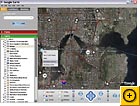 | Google Earth is a free-of-charge, downloadable virtual globe program. It maps the earth by the superimposition of images obtained from satellite imagery, aerial photography and GIS over a 3D globe. Google Earth was developed by Keyhole, Inc., a company acquired by Google in 2004. The product was renamed Google Earth in 2005. A feature implemented by Google after its acquisition of Keyhole is a 3D dataset for over 38 US cities. |
 |
Part of the EM64T architecture, Core Duo replaces the Pentium M brand used for earlier mobile processors with the same microarchitecture. Intel Core Duo consists of two cores, a 2 MiB L2 cache shared by both cores, and an arbiter bus that controls both L2 cache and FSB access. Upcoming steppings of Core Duo processors will also include the ability to disable one core to conserve power. |
 | Apple Computer introduces the MacBook Pro, their first Intel-based, dual-core mobile computer, as well as an Intel-based iMac. Apple has also included "Rosetta" an API that translates PowerPC coded applications to run properly on the Intel processor. Software that has been updated and tested to work with Rosetta are being labled "Universal" applications. Universal software will run on both PowerPC and Intel processors. |
 |
AMD releases the Turion 64-bit, low voltage processor for laptops. |
 |
VIIV is a specific set of Intel CPU, mainboard chipset, matrix storage, media server, Digital Rights Management and network card. It's target use
is as a media desktop with the ability to operate as a TV set top box.
I like to believe the name is a symbol for dual core Pentium 5. V being 5 in Roman numerals, separated by two slashes (used to separate systems in URLs). In that way it looks like 5//5. Some say it's VI for 6 and IV for 4, as in 64 bit. |
 |
With the introduction of 915 and 925 chipsets, Intel delivered a new, more flexible storage controller described as Matrix Storage Technology. It enables support of multiple simultaneous RAID arrays, based on the same sets of drives. A RAID array uses multiple drives simultaneously, to increase the disk subsystem performance while also improving data security from drive failures or defects.
At the very simplest level, RAID combines multiple hard drives into a single logical unit. Thus, instead of seeing several different hard drives, the operating system sees only one. Standard RAID Levels are: RAID 0: Stripped, not redundant. Creates a performance in speed via simultaneous I/O. Requires at least 2 drives. RAID 1: Mirrored, 100% redundant. Secures data against single drive failure. Requires at least 2 drives. RAID 5: Stripped, with full redundancy written as parity data that is only read if a data stripe has an error. Slightly faster, secures against single drive failure, but not doulbe drive failure. Requires at least 3 drives. RAID 6: Similar to RAID 5, with double parity data, premitting more than one drive failure. |
 |
Alienware will continue to operate under its own brand name. This is noticeable in many regards including the similar looking homepages. This has caused a lot of controversy with gamers. Alienware was a favorite among them while Dell supposedly caters to consumers and inexperienced computer users. However, Dell's acquisition seems to not have affected Alienware's quality. It is said that Alienware products will come out faster and cost less, by benefit of Dell. It was postulated by some that the Dell acquisition may lead to Alienware ceasing to use CPUs by AMD; however, with Dell having recently announced that it will begin to produce AMD-powered servers, it is believed that this will not come to pass. |
 | A redesigned DS system which is slimmer and lighter with brighter screens, a longer and thicker stylus for the touch screen, and a relocated microphone. Since the release of the DS Lite, Nintendo has decided to discontinue the original DS. DS Lite is 21% lighter than the original DS, and mimics some of the design features of the Nintendo Wii, comes in five colors, and is capable of receiving wi-fi signals from the original DS and the Wii. DS Lite uses the same ROM "Game Card" format resembling memory cards used in other devices. It currently supports cards up to 1 gigabit in size. The cards always have a small amount of flash memory to save user data. It also uses the same main CPU (67 MHz ARM946E-S) and co-processor (33 MHz ARM7TDMI) as the original DS. |
 |
Turion 64 X2 is AMD's 64-bit dual-core mobile processor, intended to compete with Intel's upcoming Core 2 processors. These processors use Socket S1, and feature DDR2 memory. They also include more power-saving features. |
 |
Part of the IA-64 architecture, used mostly in compute-bound supercomputers, and large corporate database servers, where massive parallelism and compile-time optimizations are most effective. |
 |
Core 2 is based on an all-new CPU design called the Intel Core Microarchitecture. The architecture features lower power and heat, it has multiple cores and hardware virtualisation support, as well as being EM64T and SSE4 compatible. |
 |
It is powered by the Conroe XE core and will replace the Pentium 4 Extreme Edition and the dual-core Pentium Extreme Edition processors. The major difference between the regular Core 2 Duo and Core 2 Extreme is the clock speed, and an unlocked multiplier, allowing it to basically simulate any E6x00 with 4 MB of L2 cache. This also allows it to gain a better overclocking ability than the other Core 2 processors, with up to a 14X multiplier |
 |
On July 24, 2006, AMD and ATI announced a plan to join forces, in a transaction that will combine AMD’s technology leadership in microprocessors with ATI’s strengths in graphics, chipsets and consumer electronics. The result is a processing powerhouse: a new competitor, better equipped to drive growth, innovation and choice for its customers in commercial and mobile computing segments and in rapidly-growing consumer electronics segments. The transaction, valued at US $5.4 billion, is expected to close in Q4 2006 subject to approval by ATI shareholders, court approval, regulatory approvals and other customary closing conditions. |
| Digital Transmission Content Protection over Internet Protocol (DTCP-IP) protects content sent over a home network. So far, this technology will only address content being sent from the PC to other devices on a home network. |
 | All PlayStation 3's come with a hard drive (either 20GB for $499 or 60GB for $599) and are ready to play Blu-Ray video discs and games out of the box. Controllers connect to the console through Bluetooth and are motion-sensitive, but unlike previous PlayStation family consoles, have no rumble features. |
 | Nintendo Wii (sounds like we) features a completely redesigned controller which resembles a TV remote, which also adds both motion and tilt sensors to its design. Wii is also the first Nintendo console to have internal memory. Wii can play GameCube games as well as its own software through a slot-loading disc drive, and features ports for GameCube controllers and memory cards, for full backwards compatibility. |
 | Web Classifieds (mostly free) established in over 450 cities around the globe by 2006, this community classified-ad service puts the hurt on newspapers' overpriced classifieds. It serves over 5 billion page views per month, putting it in 31st place overall among web sites world wide, 8th place overall among web sites in the United States (per Alexa.com on November 8, 2006), to 10 million unique visitors. With over 10 million new classified ads each month, Craigslist is the leading classifieds service in any medium. |
 | A free video sharing web site. Founded in February 2005 by three employees of PayPal, the San Bruno-based service utilizes Adobe Flash technology to display video. The wide variety of site content includes movie and TV clips and music videos, as well as amateur content such as videoblogging. Currently staffed by 67 employees,[1] the company was named TIME magazine's "Invention of the Year" for 2006. In October 2006, Google, Inc., announced that it had reached a deal to acquire the company for $1.65 billion USD in Google's stock. The deal closed on 13 November 2006. |
 | Google SketchUp, a freely-downloadable version of the @Last SketchUp 3D modelling program designed for professional architects, civil engineers, filmmakers, game developers, and related professions. It was designed to be intuitive, fun and flexible allowing designers to play with their designs, unlike most other 3D CAD software. It is marketed as an easy-to-use conceptual tool with a simple interface. The free version is not as capable as SketchUp Pro 5, but it includes integrated tools for uploading content to Google Earth and to the Google 3D Warehouse, a library of models created in SketchUp. It can export 3D Google Earth .kmz files and 2D graphics: .bmp .png .gif .tif. Google SketchUp Pro can export more 3D grahic files: .3ds .dwg .dxf .fbx .obj .xsi .wrl and more 2D graphics: .pdf .eps .epx .dwg .dxf. |
 |
MySpace is a social networking website offering user-submitted network of friends, personal profiles, blogs, groups, photos, music, and videos. MySpace also features an internal search engine and an internal e-mail system. Nothing new there, but by 2006 for some bizarre reason, mySpace skyrockets the pack by creating it's 100 millionth account, making it the number 1 social network by far, and the site reportedly attracts new registrations at a rate of 230,000 per day, which is beyond any other web site service in the world.
MySpace allows users to modify their user pages. Although JavaScript is not allowed, HTML/XHTML and CSS can be used to change the vast majority of the profile to the user's preference. Users also have the option to add embedded music into their profiles via MySpace Music, a service that allows bands to post songs onto their respective profiles. Videos, flash-based content, and almost anything else can be added, much like a standard HTML page. Since many users of MySpace do not know HTML, third-party code generating websites have appeared to help these users. As of 2006, The company's servers are all running Microsoft IIS 6.0 on the Windows Server 2003 OS. The company employs 300 staff and is owned by News Corporation. |
 | Microsoft Office 2007 main feature is the menu ribbon that enables a change view without altering your document upon a mouse over. Open XML and PDF save options add new compatibility. |
 | With four execution cores, the Intel Core 2 Quad processor takes the top desktop processor slot. Feature two 4 MB L2 caches and clock at 2.4 GHz |
 |
The release of Windows Vista comes more than five years after the introduction of its predecessor, Windows XP, making it the longest time span between two releases of Microsoft Windows.
Windows Vista contains hundreds of new and reworked features; some of the most significant include an updated graphical user interface and visual style dubbed Windows Aero, improved searching features, new multimedia creation tools such as Windows DVD Maker, and support for IPv6. Many gaming users claim that the biggest change is the fact that Vista is the exclusive OS for the new DirectX 10. |
 | Wrapping together Gmail, Google Docs and Spreadsheets, Google Calendar, Google Talk, and other services into a business-oriented package with features like the ability to use your own domain name. |
 | Samsung releases 64Gb Solid State Drive (SSD). |
 | Dell begins shipping laptops with Sandisk Solid State Drives. |
 |
 | Code name Leopard features Spotlight Desktop search that expands to other systems, cover flow finder, 10 way audio chat, 4 way video conferencing, 64 bit GUI, backup utility called Time Machine. |
 | Fiber Optic Internet and TV to the home. Featuring 30Mbps download and 5Mbps upload speeds, plus thousands of 'on demand' movies. |
 
|
With the NVIDIA Tegra family of computers-on-a-chip, NVIDIA now brings the power of advanced visual computing to a broad range of handheld and mobile platforms—from phones, MP3 players, and portable navigation devices (PNDs) to mobile internet devices (MIDs). Featuring an ARM11 processor core with a GeForce GPU, and dedicated image and HD video processing engines.
TEGRA processing units are coupled to a low-power DDR memory interface, display outputs - including HDMI and they support both NAND and NOR flash memory for storage. At idle, the chips consume less than 100 mW. |
  | The Intel Atom processor is based on an entirely new microarchitecture designed specifically for small devices and low power, while maintaining the Intel® Core™ 2 Duo instruction set compatibility consumers are accustomed to when using a standard PC and the Internet. The design also includes support for multiple threads for better performance and increased system responsiveness. All of this on a chip that measures less than 25 mm², making it Intel's smallest and lowest power processor yet.1 Up to 11 Intel Atom processor die -- the tiny slivers of silicon packed with 47 million transistors each -- would fit in an area the size of an American penny. |