
 |
|
The Life Story of
Major Henry Lee
Higginson
"Practical
Idealism and the Gift for Friendship"
Henry's story continues from Part II:
The Civil War Years
|
Part III: Life in the Business
World and among Friends
Early Business
Ventures: An Education of a Different Kind
During the final year of the Civil War, Henry had at last found an
opportunity for employment. From January through July of
1865, he worked as an agent for the Buckeye Oil Company
in Ohio, purchasing equipment and contracting laborers to
work in the oil fields. Living out of a
"shanty" boardinghouse was a "comfortless,
dirty and lonely" existence for Henry, though less
dreary after his wife Ida joined him during the latter
part of his stay there. However, the wells did not
produce the quantity of oil that the owners and investors
had anticipated. As a result, the company foundered and
the Higginsons returned home to Boston.
By autumn,
Henry grew enthusiastic about his next business venture:
raising cotton on a plantation in Georgia. In his
reminiscences, Higginson relates the details of why and
how he purchased "Cottonham":
|
...[A
couple of friends and I]
conceived the plan of going South and buying a
plantation on which to grow cotton. [We would pay
wages to any of the former slaves who chose to
remain and work on the plantation, provide
private housing for them with their own plot of
land on which to grow crops for their sustenance,
and set up a store for them to purchase goods
they might need. Later on, we planned on having a
school for the children, as] ... it seemed fair
that we should try to help in their education.
Two old comrades and friends—[Captain]
Channing Clapp [a Harvard classmate who served
with me in the 1st Massachusetts Cavalry,] and
[Colonel] Charles F. Morse [who graduated from
Harvard in 1858 and served with me in the 2nd
Massachusetts Infantry]—liked the
idea, and we three therefore went to Savannah in
a remarkably dirty steamer, hoping to proceed
from that point and get what we wanted....
|
|
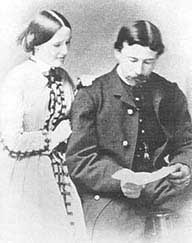 Henry Higginson with his wife Ida, photo care of Bliss Perry's book, image courtesy of Brian Pohanka.
|
We asked and asked about plantations and
about means of getting at them, and at last heard of one
called "Cottonham," belonging to an old man
named Rogers. After trying for a week to get means of
communication, we at last lighted on one venturesome
hack-driver who would take us, for there were only two
hacks in the town, and no means of conveyance except a
dray [cart]. The railroad was gone, and the plantation
was fifteen miles from the railroad. So we started out,
came to various broken bridges, got across somehow or
other, crossed the Ogeechee in a ferry and reached a
point on the railroad. From there it was a clean drive in
the sand to the plantation, fifteen miles, with not a
soul in sight and not an animal except one deer. We came
to a bridge some twenty feet wide, and tried it to see if
it was good. It seemed sound, and we drove on to
it. The horses went through with all eight legs and hung
there by their bellies. The driver was frantic, and said
we had ruined him. We unhitched the team, and worked hard
to get the horses' legs out on to something stable,
putting in fence-rails for that purpose. At last we got
them up, pulled the carriage over and drove to the
plantation.
The house was situated in a large field,
and was surrounded by beautiful live oaks. A
pleasant-looking old gentleman came out and greeted us,
and asked us to come in and pass the night. We had a
villainous supper of hominy, sweet potatoes and grease;
it was hot as tophet [hell], and we saw what our life was
going to be.
The next day, Channing Clapp, being a
good negotiator, traded with the old man, and we paid him
$30,000 for his five thousand acres of land. Of
course there was a good, roomy house, a good
stable for that country, a large negro settlement a mile
away, and some negro houses on the yard of eight acres
where the house stood. We went through the usual
formalities of purchase, and then the old gentleman
left....
On November 15, 1865, a month after purchasing Cottonham, Higginson
wrote to his father about his great expectations for the
success of this experiment:
We [Clapp, Morse, and I] mean to
cultivate 400 acres of cotton. A good yield is 120 lbs. to the acre on that plantation.... I have here
calculated everything to come in low, and every
expenditure high. Next year we can probably cultivate
much more land, and we shall average, one year with
another, much more cotton to the acre. I have left out
all gain of stock, such as cattle and hogs, which cost
literally nothing and are very productive.
With business
at the plantation running smoothly, Henry returned home
to Boston for Christmas. After the holidays he brought
Ida with him to Cottonham, and together they put their
heart and soul into work with the laborers, educating
them and preparing them for life outside the plantation.
But their hard efforts and good intentions were not
enough to overcome the differences between the two
cultures and lifestyles. Concepts such as receiving wages
for labor and dealing with cash to purchase goods were
difficult for these former slaves to understand, as they
never had ownership of anything in this country. How
could Henry and Ida convince these workers—who had only
known oppression in the hands of white men—that they had
their best interests at heart?
In August, Henry brought Ida home to Boston and returned to
Cottonham. This time, he encountered new struggles in
addition to those that involved his workers. The weather
turned foul, and the once-flourishing crops began to
perish. In letters to his father written during autumn
that year, Henry candidly reported:
The continual rains are injuring our crop
considerably. Yesterday we had two tremendous showers
lasting several hours altogether, and to-day we found
quite a lot of cotton beaten out and lying dirty and
useless in the sand.... It [the rain] has [arrived a
season too late and has] cut off all our profit, I
fancy.... We have made about half a crop; and seem likely
to get a low price for our best cotton.... So we have
lost a good deal of money.
But in his
communications to Ida, Henry tried to assuage her fears
about their finances:
Please remember that one great reason for
our coming here [to Cottonham] was the work of great
importance to be done for these blacks. Money is less
valuable than time and thought and labor, which you have
given and will give freely....
Ida returned
to Cottonham for Christmas to join Henry who was
beginning to have doubts about continuing this venture.
In January 1867, Henry confessed in his next letter to
his father:
I should have done better to enter your
office [—the stock brokerage house of Lee, Higginson and
Co.—] in '64 as a paid clerk with a prospect of becoming
partner: indeed should do so now, if that were possible.
Still this work, embracing as it does the whole black
question, is highly useful and important. If I were rich
enough to disregard gains, and could spend something on
the welfare of the blacks, Ida and I could doubtless
produce some satisfactory results in a few years. A
little money put into better houses and into the simplest
home-comforts would tell greatly.
Henry's woes with Cottonham increased as the year progressed. The
house servants and some laborers were caught stealing
from them. What's more, they discovered that Mr. Rogers
had really owned only 2500 of the 5000 acres he had sold
them. Though frustrated by the project in general,
Higginson remained patient and compassionate towards his
workers. In April, Henry wrote to his father:
The blacks will advance, if they are led,
and if they will trust anyone. Now they cannot be
induced to talk, to ask questions. They will listen, but
not heed much from a white man.
By late
spring, however, Cottonham's failure seemed inevitable.
Channing Clapp headed home after a wave of heat arrived
along with an infestation of rats, mice, fleas, and
malaria. When Ida developed a touch of malaria, Henry
decided it was time to give up the project entirely,
despite the fact that Ida believed they could make a
difference if they stayed another year. The Higginsons
left on May 21, 1867, with Charles Morse now the sole
overseer of the plantation. Morse held out hope for the
crops that began to revive during summer, but by
September when they were consumed by caterpillars, he too
realized that all hopes for Cottonham were in vain.
Building a Future with His Family
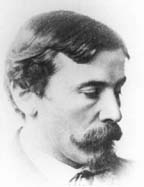 Photo
of Higginson from late 1860s or early 1870s, care
of Massachusetts/MOLLUS, USAMHI, Carlisle, PA. Image
courtesy of Brian Pohanka.
|
|
After Henry and Ida
returned from Georgia they moved into a small
apartment in Boston. Henry's unsuccessful
business ventures had left them more than $10,000
in debt, and at age 33—with responsibilities and
obligations to significant persons in his
life—he could no longer afford to invest much
time and money in romantic but impractical
dreams. Reluctantly, Henry settled down and faced
the reality of a future in the family business of
Lee, Higginson and Company.
Henry became a partner in
the firm on January 1, 1868, and a year later Frank
joined them. The two brothers added energy to the
respected brokerage that had a reputation for honesty and
integrity regarding their assessment of properties and
relationships with clients. At this point in time—with
the rebuilding of the nation after the war—investors
poured capital into manufacturing industries. Great
developments began to unfold in the West, in the
construction of railroads and speculation in gold, and
the firm enjoyed a renewed prosperity in the volume of
stocks and bonds they sold—despite a few setbacks in the
stock market.
|
The start of the next decade found the Higginsons celebrating the birth of
their daughter Cécile on January 5, 1870. That summer,
the family left their residence at Hotel Hamilton and
stayed in a rented cottage at Beverly Farms, near the
coast. Henry did not spend too much time away from work,
however, as his new career kept him well occupied, often
traveling to sites of prospective investment
opportunities. In this decade, he also began to expend
efforts to honor those dearest to him in some tangible
form that could benefit a number of people. The first of
these projects was the construction of the Hotel Agassiz,
a French flat (apartment house) that he named for Ida.
Built in 1872, this edifice still stands at 191
Commonwealth Avenue, its living spaces converted to
condominiums in recent times.
In the spring of 1873, for
the first time since he began his employment at the firm,
Higginson traveled to Europe on a non-business trip to
the Vienna Exposition. As one of the honorary
commissioners appointed by the Massachusetts Legislature,
he was reunited with friends and former Civil War
comrades Charles Adams (chairman of the commission) and
Greely Curtis (also an honorary commissioner). During the
several months he remained overseas, Henry revisited
Paris and London, and ventured on to Venice. As in his
former days abroad, he enjoyed the theatre, read books,
and wrote letters home. However, life was different than
it had been 15 years ago, and he spent a considerable
amount of his free time planning for his immediate
family's future, having dresses made for Ida, and
shopping for furniture in preparation for their move to
the Hotel Agassiz. Henry also pursued business
opportunities with British investors and bankers.
But despite the external
changes in his life, Henry remained true to himself and
his desires. While in Vienna in July, he called upon
friends in the music business whom he hadn't seen in
years. He reported joyously in a letter to his father:
...I'm pleased very much to be so kindly and
affectionately received by all and to find that I've not
been forgotten during this eighth of a
century—egotistical, is n't it? but very pleasant for
one who prizes friends. Then too I 'm greatly pleased to
see how sundry men, whom I knew, have grown larger and
better. One of them is director of the opera, another is
sub-director, another leader of the orchestra, etc., and
the chief of the Conservatorium, which is greatly
improved....
A month later, Henry's letter to his father expressed his pensive side. As in
days past when he first contemplated a career in the
firm, he was filled with self-doubt regarding the
non-fulfillment of his personal goals and his work in the
world. However, as he now approached his 39th birthday,
his view of his father had broadened and matured over
time. Having come to know George Higginson as a business
partner, Henry could now better appreciate his father's
personal character and accomplishments.
My real regret down-town, beyond my own ability to
regulate my life well and to do much without so much
worry to me, is, that I don't gain wisdom much. To lose
money is no such serious matter, but to see clearly that
one will lose and to act accordingly in due season
to avoid it—that is worth working for; and when shall I
get it? Another thing came to me clearly one day in
London: "We can't serve God and Mammon," which
always had a distinct enough meaning for me, but—if one
wishes a thing very much indeed and works and struggles
for it, one is likely to lose balance a little and may
sacrifice better things. You have preserved your honesty
entirely thro' a long and hard life, and it is a wonder.
Well, perhaps one reason has been that you 've cared more
to keep your balance and your honesty than to get
money....
Henry also reflected fondly on his mother:
To-day [August 16 (mother's birthday)] is to be
remembered always—and has been here. Sixty-two years
old—and 24 years since she died. It is a great
while, and has been a great deal longer for you than for
us, and I am older than mother was. You have had a hard
life—certainly not without its joys too, but still a
hard and dry life, which is all the more reason for my
being at home soon. How well I remember the last summer
of mother's life!
When Higginson returned to
Boston in September, panic hit the financial world as
cash became scarce due to over-trading, over-construction
in America, and excessive borrowing overseas. Businesses
shut down over night and many laborers lost their jobs.
Though it would take years for the economy to recover,
Lee, Higginson and Co. survived in its industry.
The ensuing years of the
decade brought more dynamic changes in Henry's personal
life. In February 1874, Henry and his family moved into
the Hotel Agassiz. Two months later, at the urging of his
partners, George Higginson retired from the firm at the
age of 70. The collapse of the economy had caused a great
deal of stress, and his family and friends did not want
George burdened with the day-to-day activities of the
business. In August 1875, the death of five-year-old
Cécile brought heartbreak to Henry and Ida. Despite the
joy over the birth of their son Alexander on April 2,
1876, Henry secretly bore his grief over the loss of his
daughter for the rest of his life.
The Beginnings of a Musical Legacy
Henry
Higginson was not one to quit in the face of adversity.
During the course of his life, challenges were not
obstacles but opportunities for learning, personal
growth, and higher achievement. Though he was dealt his
share of suffering, Henry continued with his noble ideals
for the betterment of the lives of his friends—even
those whom he would never meet—and his gifts to humanity
were enduring.
In March
1881, Henry unveiled to Boston his plan for an orchestra
that would perform "concerts of a lighter kind of
music." The product of Higginson's vision was the Boston
Symphony Orchestra—the
first of his great gifts—world renowned as one of the
finest orchestras to this day. On April 27,
1914, when Henry was nearly 80 years old, he delivered an
address to members of the orchestra, describing when his
idea of the Boston Symphony Orchestra was conceived, and
how his dream came to fruition:
Sixty years ago I wished to be a
musician, and therefore went to Vienna, where I studied
two years and a half diligently, learned of music,
something about musicians, and one other thing—that I
had no talent for music. I heard there and in other
European cities the best orchestras, and much wished that
our own country should have such fine orchestras. Coming
home at the end of 1860, I found our country in trouble,
and presently in a great war. Naturally I took part in
the war, [and thereafter pursued a few opportunities
before becoming a partner at the firm of Lee, Higginson,
and Co.].
For many years I had hard work to earn my
living and support my wife.... All these years I watched
the musical conditions in Boston, hoping to make them
better. I believed that an orchestra of excellent
musicians under one head and devoted to a single purpose
could produce fine results, and wished for the ability to
support such an undertaking; for I saw that it was
impossible to give music at fair prices and make the
Orchestra pay expenses.
After consulting with some European
friends, I laid out a plan, and at the end of two very
good years of business began concerts in the fall of
1881. It seemed best to undertake the matter
single-handed, and, beyond one fine gift from a dear
friend, I have borne the costs alone.... [The annual
costs amounted to] a large sum of money, which depended
on my business each year and on the public. If the
concert halls were filled, that would help me; if my own
business went well, that would help me; and the truth is,
that the great public has stood by me nobly.
In my eyes the requisites about the
Orchestra were these: to leave the choice and care of the
musicians, the choice and care of the music, the
rehearsals and direction of the Orchestra, to the
conductor, giving him every power possible; to leave to
an able manager the business affairs of the enterprise;
and on my part, to pay the bills, to be satisfied with
nothing short of perfection, and always to remember that
we were seeking high art and not money: art came first,
then the good of the public, and the money must be an
after consideration.
...Do not suppose that I am ignorant
about the various members of the orchestra. At one time I
knew every man; and if that is not the case now, I know
many of you, and listen carefully to the playing of this
or that man.... I watch the musicians almost too much,
for it often interferes with my pleasure, thinking
whether they are playing their best, and listening for
the various points instead of listening for the whole.
Whenever I go to a concert, there is always a sense of
responsibility on my mind, and there is always great joy.
...Ever since my boyhood I have longed to
have a part in some good work which would leave a lasting
mark in the world. To-day we have a noble orchestra—the
work of our hands—which gives joy and comfort to many
people....
But it was more than a boyhood desire and a love of music that
motivated Higginson to establish the Boston Symphony
Orchestra. In a letter to Miss Frances R. Morse on
September 18, 1881, he credited the sources of his
inspiration for undertaking this monumental achievement:
I had a noble set of men-friends and loved them much
and lived on them. They led me in part to thoughts and
hopes which have resulted in this scheme. It seems to me
to be worth while, and to be a little gravestone to them
if anything, for they are all dead but one—a great loss
to me and the world. To these friends I tried to give
everything, because my belief was that one cannot do or
give or take too much from a friend.

Part III of Henry's story continues:
Page 1 | Page 2 | Page 3 | Page 4

Index
to Higginson's Pages
Back | Home
Copyright © 2005 1st
Dragoon's Civil War Site. All rights
reserved.
|

