Surname List
Name Index
Sources
Email Us
Spouse: Thomas BRIGHAM. Thomas BRIGHAM and Isabel WATSON were married on 4 Feb 1600/1 in Holme-on-Spalding-Moor, Yorkshire, England.293 Children were: Ann BRIGHAM.
James WATSON281 signed a will on 10 Jul 1615 in Holme-on-Spalding-Moor, Yorkshire, England.281
Children were: Constance WATSON, Isabel WATSON.
Ann WELBY was born in 1600 in Whaplode, , Lincolnshire, England. She was christened in 1600 in , Moulton, Lincolnshire, England.308,1353 Parents: Richard WELBY and Frances BULKELEY.
Anthony WELBY was born in 1602 in Whaplode, , Lincolnshire, England. He was christened on 3 Dec 1602 in Whaplode, , Lincolnshire, England. He died in 1603. He was buried in 1603.308,1353 Parents: Richard WELBY and Frances BULKELEY.
Edward WELBY308,1353 was born on 22 Dec 1608 in , Moulton, Lincolnshire, England. He was christened on 22 Dec 1608 in , Moulton, Lincolnshire, England. Parents: Richard WELBY and Frances BULKELEY.
John WELBY.1354 Parents: Richard WELBY and Janet (Joan) STYNTE.
Morys WELBY.1354 Parents: Richard WELBY and Janet (Joan) STYNTE.
Mrs Grace WELBY.
Spouse: Richard de WELBY Knight. Richard de WELBY Knight and Mrs Grace WELBY were married. Children were: Richard WELBY.
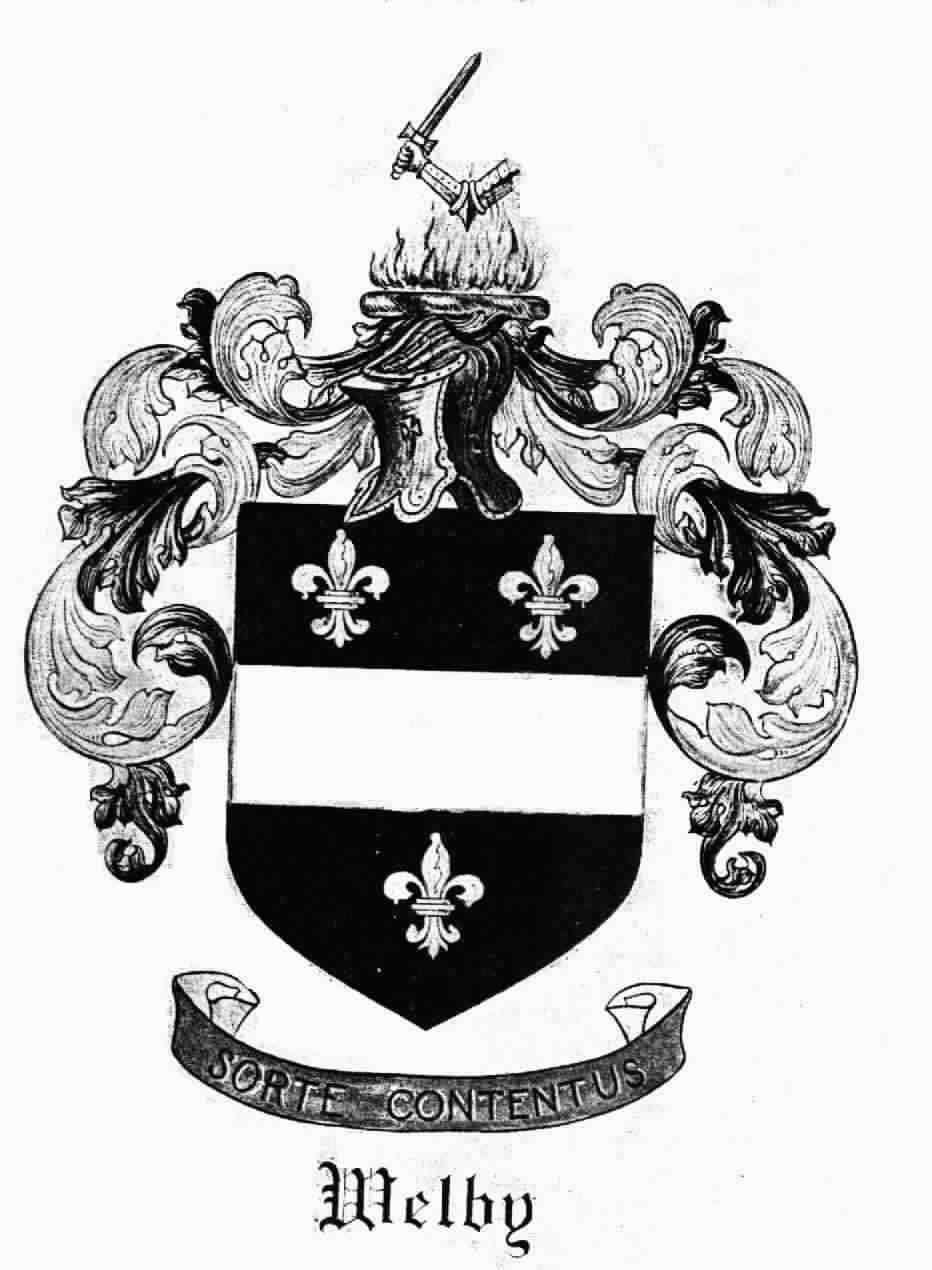 Olive WELBY6,78,309,310,311 was born on 17 Jun 1604 in ,
Moulton, Lincolnshire, England. She was christened on 17 Jun 1604
in , Moulton, Lincolnshire, England.1355
She died on 1 Mar 1692 in Chelmsford, Middlesex, Massachusetts, USA.656
Olive WELBY6,78,309,310,311 was born on 17 Jun 1604 in ,
Moulton, Lincolnshire, England. She was christened on 17 Jun 1604
in , Moulton, Lincolnshire, England.1355
She died on 1 Mar 1692 in Chelmsford, Middlesex, Massachusetts, USA.656
Extracted records from Boston Lincolnshire England Parents: Richard WELBY and Frances BULKELEY.
Spouse: Deacon Henry FARWELL. Deacon Henry FARWELL and Olive WELBY were married on 16 Apr 1629 in St Botolph, Boston, Lincolnshire, England.11,664 Children were: Elizabeth FARWELL, Samuel FARWELL, John FARWELL, Mary FARWELL, Joseph FARWELL, Olive FARWELL.
Richard WELBY
died in 1465 in , Moulton, Lincolnshire, England.267,1277 He
was buried in 1465 in St Katherine's Chapel in Parish Church, England.
He signed a will on 12 Aug 1465 in , , Lincolnshire, England.267,1277
WILL OF RICHARD WELBY of Multon 1465
"In the name of the Father, Son, and Holy Ghost, I, Richard Welby, the 2nd day of August, being whole in mind make my Testament, in manner that follows:
"First, I bequeath my soul to the most Eternal God, that made it, and with his bitter Passion redeemed it: my body to he buried in St. Catherine s where, item, ten pounds to the High Altar for tithes forgotten; item, twenty shillings to the Kirkwark; item, forty pence to every light; item, to the Kirkwark of Weston, six and eight pence; item, to our Lady Kirk of Lincoln, six and eight pence; item, to the sisters by Saint Catherine. three and four pence; for my mortuary, my bay foal that goeth into the Marsh. "The residue of my goods I put into disposition of my Executors, which shall be Janet my wife, Sir John Welby, Richard Welby, my son, and Sir Robert Sivet; they to dispose of my goods to the blessing of Cod and the health of my soul.
‘This is the last Will of Richard Welhy, of Multon. made there the 12th day of the month August, the year of our Lord 1465. "First, I will have 200 masses done and also many dirges for my soul, upon the day, if it may be, and else as shortly as they may be done, after my death; and every Priest or man of religion to have for singing of them 4d: item, I will, two Priests do sing for my soul in Multon Church, the space of two years; every Priest to have for his salary 100 S.; and over that, they or each of them daily to say dirge, if they be disposed, for my soul; item, I will have 100 gowns given in Roland. and in other places, where my Lifelode lies, to the most poor men, without any favor shewed: item, I will that there be bought as many sheets and coverlets, and they to be given in manner and form as is More rehearsed, to the sum of 28 marks: item, I will that my debts be paid before all other bequests; item, I will, that a chest be ordained with two locks and two keys. and set in the Abbey of Croland, the Abbot for to have one key, and my Executors the other: and the over plus, that cometh yearly of the said Lifelode, to be put in the said chest, and this to be continued tilt all my children come of plain age. "Item, I will, that if my wife can find sufficient surety to my Executors, that she shall never have husband after my decease, that then she be my chief Executor, and else be none, nor to have no more but her Jointure, and the one half of my stuff of household, except plate and that napery that I bought of the Executors of my Lord Cromwell, which napery I wish to be sold; it cost me 20 marks, and I had it as it was priced."
His sons Richard, Roger, William, John, Morys and Thomas are named for parts of the estate.
"Item, I will that every child have forty pounds in money, when he come at his plain age; item, in case that my Executors and Feoffies see that any of my children, to whom anything I have bequeathed, will not thrive, nor be virtuous, that then his part to be taken from him, and to be given to him that will thrive, haying regard to none. Item, I will that my Executors keep up my year day, and my ancestors, as long as they profit of my Lifelode. Item, I will that every Executor have 5 marks for his labour; and that my Executors once in the year take account of the bailiff"
This will is in the Registry of the Cathedral of Lincoln. Parents: Richard de WELBY Knight and Mrs Grace WELBY.
Spouse: Janet (Joan) STYNTE. Richard WELBY and Janet (Joan) STYNTE were married. Children were: Richard WELBY, Thomas WELBY Esquire, William WELBY, Roger WELBY, John WELBY, Morys WELBY.
Richard WELBY was born about 1462.
EXCERPT FROM THE WILL OF RICHARD WELBY of Multon, elder brother of Thomas Welby, Sons of Richard Welby
"In the name of God, Amen, the twelfth day of the month of November in the year of our Lord one thousand four hundred and eighty-seven. I Richard Welby,of Multon, Esquire, of whole mind and sound memory, do make my Testament in this manner.
In the first place, I bequeath my soul to Almighty God, and the Blessed Virgin Mary, and all the Saints of God; and my body to be buried beneath the Monestary of Saint Guthlace of Croyland, in the County of Lincoln; Also I bequeath to the High Altar of the Church of Multon, for Tithes by me forgotten, and for oblations by me forgotten, and other offenses by me committed, one hundred shillings. Also I will that immediately after my decease, my Executors cause be celebrated one thousand masses of repose, with placebo and dirge, by one thousand fitting secular and regular Chaplains, and also four trentals of the blessed Pope Gregory by four discreet secular or regular Chaplains, for my soul, and the souls of my wife, and of my parents; and the residue of all my effects, by this my present Testament and my last Will not bequeathed, my debts being fully paid and all restitution faithfully made; I give and bequeath to the disposal of Thomas Welby my brother (and three others) whom I ordain and constitute my true and faithfull executors. Also I will have a Priest to sing and to say Divine Service within the Monastery of Croyland, at the Altar, to pray for my Soul, and my wife Elizabeth, and Joan and my father's and mother's souls, and for the souls of my bretheren, Morris and Sir John; my good friends souls; and all cousins souls; which I will shall be performed of my purchased lands, and my goods not bequeathed by this my last Will. Also I WiII, that Joan my wife have one hundred pounds in money, and all her wine and plate, with all other her stuff of household, that she brought with her, That may be found whole. "Also, I will that my brother Thomas have my chain of gold and all the stuff of my chapel, except plate; and if he will buy any of my plate, I will he have it before any other man. Also, I will, that my brother William at the day of his marriage be made worth one hundred marks of my movable goods. "Also, I will have as much cloth bought for gowns and geds to poor folk, to the value of twenty pounds. "Also I will have prisoners found at Cambridge, and poor prisoners lying at Lincoln Castle and at Newgate in London, for their fees to be loosed and delivered to the value of forty pounds. "Also, I will that every serving man in my household have his whole wages paid for the whole year and horsed and harnessed like a yeoman. "Also, I will, that my brother ‘Thomas have all the houses and lands that I purchased in Stixwould and in Halsted and all meadows and fields of same; and also, all the lands in Muiton, called Vallentynes; so that he pay for them forty marks, and leave them to his heir; to have all the said lands to him and to his heirs and assigns, for ever more."
His brother William is given the lands in Wynthrope if he never trouble or vex his brother Thomas, else it revert to said Thomas.
His brother Roger is given all his lands in Holheach and also the lands in Holbeach and Flete, after the death of my cousin John Braunch, & to the heirs of his body lawfully begotten, for evermore.
The Thomas Welby mentioned in above will is of Olive Welby's direct lineage.
This will is filed in the Prerogative Court of Canterbury.
Excerpt from the will of Joan (will made 1495), wife of Richard Welby3 of Moulton. whose will was made 1487, which devised property to same Thomas Welby:
"I bequeath to the aforesaid Thomas Weiby my best gold seal, to Richard Welby, his son, one silver gilt standing goblet: to Thomas Welby, his brother, one other silver gilt standing goblet." Parents: Richard WELBY and Janet (Joan) STYNTE.
Spouse: . Richard WELBY and Joan were married.
Richard WELBY6,78,310,311
was born on 1 Jan 1564 in , Moulton, Lincolnshire, England. He was
christened in 1564 in , Moulton, Lincolnshire, England.308,309 He died
about 1645 in , Moulton, Lincolnshire, England.
RICHARD WELBY, of Moulton, Lincolnshire, 2nd son, baptized at Moulton, Lincolnsbire 7 Feb. 1564. He married at Whaplode, Lincolnsbire 4 June 1595 FRANCES BULKELEY, daughter of Rev. Edward Bulkeley, Rector of Odell, Bedfordshire (descendant of King Henry II), by Olive, daughter of John Irby, Gent., of Leighthorpe (in Cawthorpe), Lincolnshire [see BULKELEY 16 for her ancestry]. She was born about 1568. They had three sons, Thomas, Anthony, and Edward, and two daughters, Ann and Olive. His wife, Frances, was buried at Moulton, Lincolnshire 7 June 1610.
AS. Larken & AR. Maddison Lincolnshire Pods. 2 (H.S.P. 51) (1903): 541-543 (Irby pedigree); 4 (H.S.P. 55) (1906): 1313-1315 (Welby pedigree). J.H. Abbott & L.M. Wilson Farwell Fam. (1929): 1-34. D.L.Jacobus Bulkeley Con. (1933): 14-17,22-23.
On FHL film #183548 Heir Indexes, Richard shows as a relative of Heber J. Grant. Parents show in the IGI as Thomas Welby and Elizabeth Thimbleby Parents: Thomas WELBY and Elizabeth THIMBLEBY.
Spouse: Frances BULKELEY. Richard WELBY and Frances BULKELEY were married on 4 Jun 1595 in Whaplode, , Lincolnshire, England.313 Children were: Thomas WELBY, Ann WELBY, Anthony WELBY, Olive WELBY, Edward WELBY.
Richard de WELBY Knight.76
Richard Welby, of Multon, son and heir of Roger de Welby de Multon. Named in his father's will with Adlard, his brother. He was Knight of the Shire for the County of Lincoln, 1421. 9th. Henry V. Parents: Roger de WELBY High Sheriff of Lincolnshire and Margaret.
Spouse: Mrs Grace WELBY. Richard de WELBY Knight and Mrs Grace WELBY were married. Children were: Richard WELBY.
Roger WELBY.1277 Parents: Richard WELBY and Janet (Joan) STYNTE.
Roger de
WELBY High Sheriff of Lincolnshire had his estate probated in 1410 in , Moulton,
Lincolnshire, England.76
He was buried in Moulton, Lincolnshire, England.76
Roger de Welby de Multon, High Sheriff for County of Lincoln, 1397. Will proved 1410. m. Bur. at Multon (now Moulton) 20th. of Richard II.
In 1401, Roger Welby de Multon, Co. Lincoln, and others grant land to the church of St. Botolph's.
EXCERPT FROM THE WILL OF ROGER DE WELBY proved 1410
"In the name of God, Amen, I, Roger de Welby, of Multon on Monday in the feast of St. Dustan, the Bishop and Confessor, in the year of our Lord one thousand four hundred and ten, do make my Testament in the following manner.
"In the first place I bequeath my soul to Almighty God, the Blessed Virgin Mary, and all the Saints, and my body to be buried in the Church of Multon near the grave of my father.
"I also bequeath to the Vicar of the same my best Beast¹, in the name of my rational soul. To the High Altar of the same, for Tithes with held and forgotten twenty shillings.² To the three lights of same, ten shillings; to the Fabric of the Church of Multon, forty shillings, and to every Order of Brothers of St. Botolph, twenty shillings.
"I also wish to have four Secular Masses divinely celebrated, that is to say, two in the Parish of Multon for one year next after my decease, and two in the Chapel of St. James of Multon, for one year, or one for two years.
"I also desire that my funeral expenses shall not be made excessive for vain show, but soberly and decently to the honor of God, so that the money which would be expended in luxurious banquets may be distributed amongst the poor, and laid out in works of charity for the good of my soul.
"The remainder of my goods and chattels not bequeathed, my debts being first paid, and my last will well and faithfully carried into execution, I give and grant to Margaret, my wife, Richard de Pynchebeck, Richard and Adlard my sons, and William Case, Rector of East Bitham, whom by the advice and counsel of my Lord the Present Lord Prior of Spalding, I constitute my executors."
This will is in the Registry of the Cathedral of Lincoln.
In the Multon (Moulton) Welby line were Roger Welby, High Sheriff, 1397, Richard Welby, M. P., Lincolnshire, 1422, Richard Welby, M. P., 1450-2, Richard Welby, High Sheriff, 1471, and M. P., 1472-7, Richard Welby, High Sheriff, 1487, and Thomas Welby, High Sheriff. 1491.
In the period preceding the Norman Conquest two officers appear at the head of the county organization. These are the earldorman or earl, and the scirgerefa, or sheriff.
The latter was more particularly the representative of the king. Alter the Conquest the sheriff became a purely royal officer (vice-comes or ballivus). He held an annual court (the Sheriff's court or leet) to which the vassals of the king were suitors, arranged the assessment of rates and was in fact the financial representative of the Crown within his district. He presided over the assembly which elected the knights of the Shire.
From Fuller's "Worthies," written in 1662, speaking of the office of High Sheriff, he says: "From King Edward III until our own remembrance, the principal gentry in every shire were deputed for that place, keeping great attendance and hospitality: so that as some transcripts hath for the fairness of their character not only evened but exceeded the original, the Vice-comes has pro tempore equalled the Court himself and greater Lords in the land for their magnificence."
In the early part of the 17th century the family lost prestige and declined, but later made peace with the Crown and one branch made a rapid rise once more in Royal favor and purchased back a part, at least, of their estates.
The various Welby lines can be traced back to 1066 through the authorities cited:
Burke, Peerage and Baronetage, 1908.
Burke, Dormant and Extinct Peerage of the British Empire.
England, Boston Parish Register, County of Lincoln, 1599-1638, Vol. II, pp. 142, 147, 166, 176, 179.
Thompson, Pishey, History and Antiquities of Boston, 1856.
Visitation of Lincolnshire.
Publications of the Harleian Society, Vol. LV., p. 1315.
Maddison, A. B., Lincolnshire Pedsgrees-Lincoln Wills.
Ms. C. 23, Heralds' College.
Gibbons, A., Notes on the Visitation of Lincolnshire, 1634, pub. 1898.
Miscellanea Genealogica et Heraldica.
The Genealogist, Vol. 5,1881---Visitation of Lincolnshire, 1652.
Notices of the family of Welby, collected by a member of the family, printed by S.Rigde Street, Grantham, 1842, for private circulation.
Holles Collection, British Museum, Vol. 3, p. 682, Under Welby, Lincolnshire.
"Mr. P. H. Farwell,
Orange, Terse.
Dear Sir:
With regard to the Welb- Pedigree find this in an old collection of MSS. here I enclose a rough copy of the main descent herewith.
Arthur Cochrane
College of Arms, Norroy,
London, E. C. 4. Registrar.
King of Arms"
April 13, 1927.
---------------------------------------
¹"My best Beast. this was generally the most valuable horse in the possession of Persons of Rank: led caparisoned, and bearing the military weapons of the deceased, before the corpse at the funeral, and afterwards delivered up as a mortuary."
Ellers Hint, of Belvoir Castle, p. 27
²With reference to the value of money at this period, Henry in his history of Great Britain says that in the fifteenth century, three half pence would purchase as much of the necessaries of life as fifteen pence would do at the time he wrote, viz. 1780. Hence some estimate may be formed of the value of the numerous bequests to the Church, contained in this and in the other wills quoted.
Spouse: Margaret. Roger de WELBY High Sheriff of Lincolnshire and Margaret were married. Children were: Richard de WELBY Knight.
Thomas WELBY1353 was christened on 1 Jan 1597 in Whaplode, , Lincolnshire, England.308 Mayor of Boston 1645. Indicted for high treason for having joined with Parliament agaisnt Charles I. William Welby, a kinsman, also indicted, A.D. 1645 Parents: Richard WELBY and Frances BULKELEY.
Spouse: . Thomas WELBY and Elizabeth PARK were married on 15 Feb 1619/20.308
Thomas WELBY6,310,311,1293
was christened about 1524 in Moulton, Lincolnshire, England. He died
in 1570 in Bath, Somerset, England.268,1293,1294
Parents: Thomas WELBY and Catherine BRAY.Spouse: Elizabeth THIMBLEBY. Thomas WELBY and Elizabeth THIMBLEBY were married on 20 Jul 1560 in Irnham, Lincolnshire, England.268,1293 Children were: Richard WELBY.
Thomas WELBY
Esquire267 was born
about 1463. He signed a will in 1496.967
Thomas Welby, Esquire J. P. 1483, High Sheriff County Lincoln, 1491-2, of Gedney, 1496 bur. Croyland, 1496, near tomb of Richard Welby, his brother, in St. Mary's Chapel. Will dated 1496. Nmaed in father's will. Appointed Supervisor of the estate of Joan, widow of his brother Richard, together with the Lord Prior of ??????.
From the will of Thomas Welby Esquire: "The testator, Thomas welby buried in the Conventional church of Croland, held lands in Gedney in county Lincoln, and in the County of Norfolk: also at Halsted, North Carleton, and Croyle. He wills that "Lands purchased at Little Herum be appropriated for the support of one chaplain for ever, at Moulton, in County of Lincoln, to celebrate mass in future for the soul of the testator, and for the souls of (names his near kin) and all the ancestors of the aforesaid, and their benefactors." Parents: Richard WELBY and Janet (Joan) STYNTE.
Spouse: Joan LEAKE. Thomas WELBY Esquire and Joan LEAKE were married. Children were: Thomas WELBY.
Thomas WELBY
was born in 1484 of Moulton, Lincoln, England.268 He signed a will on 6 Sep 1520.267,268 He was
ill with was a lunatic in 1521. He died about 1524. He
had his estate probated on 18 Aug 1524.267,268
The following is an extract from Browne Willis' History of Mitred Parliamentary Abbeys, Vol. 1, p. 74, Abbey of Croland:
"Richard Welleby, Esq., of Henry VII, and Thomas Welleby, ‘- -his nephew and heir; they lay in a stately tomb." Parents: Thomas WELBY Esquire and Joan LEAKE.
Spouse: Catherine BRAY. Thomas WELBY and Catherine BRAY were married.268 Children were: Thomas WELBY.
William WELBY.1277 Parents: Richard WELBY and Janet (Joan) STYNTE.
Athelstan, Prince of WESSEX46 was born about 810 in , , Wessex, England. He died about 850. Parents: Egbert, King of WESSEX and Redburh, Queen of WESSEX.
Edith, Princess of WESSEX46 was born about 808 in , , Wessex, England. Parents: Egbert, King of WESSEX and Redburh, Queen of WESSEX.
 Egbert, King
of WESSEX25,46,1356 was
born about 770 in of, , Wessex, England.144
He Acceded to the throne in 802535
He died on 4 Feb 839 in , , Wessex, England.144
He was buried in , , Wessex, England.
Egbert, King
of WESSEX25,46,1356 was
born about 770 in of, , Wessex, England.144
He Acceded to the throne in 802535
He died on 4 Feb 839 in , , Wessex, England.144
He was buried in , , Wessex, England.
EGBERT BECOMES KING OF THE ANGLO-SAXON HEPTARCHY
Hume, David
827
From the time that the Britons called upon the Saxons to assist them against the Picts and Scots, about A.D. 410, the domination of the hardy Teutonic people in England was a foregone conclusion. The Britons had become exhausted through their long exposure to Roman influences, and in their state of enfeeblement were unable to resist the attacks of the rude highland tribes .
The Saxons rescued the Britons from their plight, but themselves became masters of the country which they had delivered. They were joined by the Angles and Jutes, and divided the territory into the kingdoms known in history as the Saxon Heptarchy, 1which had an existence of about two hundred and fifty years. The various members were involved in endless controversies with each other, often breaking out into savage wars, and the Saxons were also exposed to conflicts with their common enemies, the Britons. Their power was greatly impaired by the civil strifes which distracted them.
[Footnote 1: The seven kingdoms founded in England by seven different Saxon invaders. They were Kent, Sussex, Wessex, Essex, Northumbria, East Anglia, and Mercia.]
This condition continued until it became essential that under a strong hand a more solid union of the Saxons should be formed. And it was to Egbert, King of the West Saxons, the son of Ealhmund, King of Kent, that this great constructive task was committed. He took the throne of Wessex in 802, for twelve years enjoyed a peaceful reign, then became involved in wars, first with the Cornish and afterward with the Mercians. His victories in these wars resulted in the final establishment of his authority over the entire heptarchy, and this made him in fact, though not in name, the first real king of England.
When Brithric obtained possession of the government of Wessex, he enjoyed not that dignity without inquietude. Eoppa, nephew to KingIna, by his brother Ingild, who died before that prince, had begot Eata, father to Alchmond, from whom sprung Egbert, a young man of the most promising hopes, who gave great jealousy to Brithric, the reigning prince, both because he seemed by his birth better entitled to the crown and because he had acquired, to an eminent degree, the affections of the people. Egbert, sensible of his danger from the suspicions of Brithric, secretly withdrew into France, where he was well received by Charlemagne. By living in the court, and serving in the armies of that prince, the most able and most generous that had appeared in Europe during several ages, he acquired those accomplishments which afterward enabled him to make such a shining figure on the throne. And familiarizing himself to the manners of the French, who, as Malmesbury observes, were eminent both for valor and civility above all the western nations, he learned to polish the rudeness and barbarity of the Saxon character; his early misfortunes thus proved of singular advantage to him.
It was not long ere Egbert had opportunities of displaying his natural and acquired talents. Brithric, King of Wessex, had married Eadburga, natural daughter of Offa, King of Mercia , a profligate woman, equally infamous for cruelty and for incontinence. Having great influence over her husband, she often instigated him to destroy such of the nobility as were obnoxious to her; and where this expedient failed, she scrupled not being herself active in traitorous attempts against them. She had mixed a cup of poison for a young nobleman, who had acquire d her husband's friendship, and had on that account become the object of her jealousy; but unfortunately the King drank of the fatal cup along with his favorite, and soon after expired. This tragical incident, joined to her other crimes, rendered Eadburga so odious that she was obliged to fly into France; whence Egbert was at the same time recalled by the nobility, in order to ascend the throne of his ancestors. He attained that dignity in the last year of the eighth century.
See--Egbert The Great: Driven in his younger days to seek refuge at the Frankish court, Egbert of Wessex there learned many lessons that were valuable to him on his return to England. He extended his kingdom, and fought the invading Northmen.
In the kingdoms of the heptarchy, an exact rule of succession was either unknown or not strictly observed; and thence the reigning prince was continually agitated with jealousy against all the princes of the blood, whom he still considered as rivals, and whose death alone could give him entire security in his possession of the throne. From this fatal cause, together with the admiration of the monastic life, and the opinion of merit attending the preservation of chastity even in a married state, the royal families had been entirely extinguished in all the kingdoms except that of Wessex; and the emulations, suspicions, and conspiracies, which had former ly beenconfined to the princes of the blood alone, were now diffused among all the nobility in the several Saxon states. Egbert was the sole descendant of those first conquerors who subdued Britain, and who enhanced their authority by claiming a pedigree from Woden, the supreme divinity of their ancestors. But that prince, though invitedby this favorable circumstance to make attempts on the neighboring Saxons, gave them for some time no disturbance, and rather chose to turn his arms against the Britons in Cornwall, whom he defeated in several battles . He was recalled from the conquest of that country by an invasion made upon his dominions by Bernulf, King of Mercia.
The Mercians, before the accession of Egbert, had very nearly attained the absolute sovereignty in the heptarchy: they had reduced the East Angles under subjection, and established tribut ary princes inthe kingdoms of Kent and Essex. Northumberland was involved in anarchy; and no state of any consequence remained but that of Wessex,which, much inferior in extent to Mercia, was supported solely by the great qualities of its sovereign. Egbert led his army against the invaders; and encountering them at Ellandun, in Wiltshire, obtained a complete victory, and, by the great slaughter which he made of them in their flight, gave a mortal blow to the power of the Mercians. While he himself, in prosecution of his victory, entered their country on the side of Oxfordshire, and threatened the heart of their dominions,he sent an army into Kent, commanded by Ethelwulf, his eldest son, and, expelling Baldred, the tributary King, soon made himself master of that country.
The kingdom of Essex was conquered with equal facility, and the East Angles, from their hatred of the Mercian government, which had been established over them by treachery and violence, and probably exercised with tyranny, immediately rose in arms and craved the protection of Egbert. Bernulf, the Mercian King, who marched against them, was defeated and slain; and two years after, Ludican, his successor, met with the same fate. These insurrections and calamities facilitated the enterprises of Egbert, who advanced into the centre ofthe Mercian territories and made easy conquests over a dispirited and divided people. In order to engage them more easily to submission, he allowed Wiglef, their countryman, to retain the title of king, whilehe himself exercised the real powers of sovereignty. The anarchy which prevailed in Northumberland tempted him to carry still further his victorious arms; and the inhabitants, unable to resist his power,and desirous of possessing some established form of government, were forward, on his first appearance, to send deputies, who submitted to his authority and swore allegiance to him as their sovereign. Egbert, however, still allowed to Northumberland, as he had done to Mercia and East Anglia, the power of electing a king, who paid him tribute and was dependent on him.
Thus were united all the kingdoms of the heptarchy in one great state, near four hundred years after the first arrival of the Saxonsin Britain; and the fortunate arms and prudent policy of Egbert at last effected what had been so often attempted in vain by so many princes. Kent, Northumberland, and Mercia, which had successfully aspired to general dominion, were now incorporated in his empire; and the other subordinate kingdoms seemed willingly to share the same fate. His territories were nearly of the same extent with what is now properly called England ; and a favorable prospect was afforded to the Anglo-Saxons of establishing a civilized monarchy, possessed of tranquillity within itself, and secure against foreign invasion. This great event happened in the year 827.
The Saxons, though they had been so long settled in the island, seem not as yet to have been much improved beyond their German ancestors, either in arts, civility, knowledge, humanity , justice, or obedience to the laws. Even Christianity, though it opened the way to connections between them and the more polished states of Europe, had not hitherto been very effectual in banishing their ignorance or softening their barbarous manners. As they received that doctrine through the corrupted channels of Rome, it carried along with it agreat mixture of credulity and superstition, equally destructive to the understanding and to morals. The reverence toward saints and relics seems to have almost supplanted the adoration of the Supreme Being; monastic observances were esteemed more meritorious than the active virtues; the knowledge of natural causes was neglected, from the universal belief of miraculous interpositions and judgments; bounty to the Church atoned for every violence against society; and the remorses for cruelty, murder, treachery, assassination, and the more robust vices, were appeased, not by amendment of life, but by penances, servility to the monks, and an abject and illiberal devotion. 1The reverence for the clergy had been carried to such aheight that wherever a person appeared in a sacerdotal habit, though on the highway, the people flocked around him, and, showing him all marks of profound respect, received every word he uttered as the most sacred oracle. Even the military virtues, so inherent in all the Saxon tribes, began to be neglected; and the nobility, preferring the security and sloth of the cloister to the tumults and glory of war, valued themselves chiefly on endowing monasteries, of which they assumed the government. The several kings, too, being extremely impoverished by continual benefactions to the Church, to which the states of their kingdoms had weakly assented, could bestow no rewards on valor or military services, and retained not even sufficient influence to support their government.
[Footnote 1: These abuses were common to all the European churches; but the priests in Italy, Spain, and Gaul made some atonement for them by other advantages which they rendered society . For several ages they were almost all Romans, or, in other words, the ancient natives; and they preserved the Roman language and laws, with some remains of the former civility. But the priests in the heptarchy, after the first missionaries, were wholly Saxons, and almost as ignorant and barbarous as the laity. They contributed, therefore, little to the improvement of society in knowledge or the arts.]
Another inconvenience which attended this corrupt species of Christianity was the superstitious attachment to Rome, and the gradual subjection of the kingdom to a foreign jurisdiction. The Britons, having never acknowledged any subordination to the Roman pontiff, had conducted all acclesiastical government by their domestic synods and councils; but the Saxons, receiving their religion from Roman monks, were taught at the same time a profound reverence for that see, and were naturally led to regard it as the capital of their religion.Pilgrimages to Rome were represented as the most meritorious acts of devotion. Not only noblemen and ladies of rank undertook this tedious journey, but kings themselves, abdicating their crowns, sought for a secure passport to heaven at the feet of the Roman pontiff. New relics, perpetually sent fro m that inexhaustible mint of superstition,and magnified by lying miracles, invented in convents, operated on the astonished minds of the multitude. And every prince has attained the eulogies of the monks, the only historians of those ages, not inproportion to his civil and military virtues, but to his devoted attachment toward their order, and his superstitious reverence forRome.
The sovereign pontiff, encouraged by this blindness and submissive disposition of the people, advanced every day in his encroachments on the independence of the English churches. Wilfrid, bishop of Lindisferne, the sole prelate of the Northumbrian kingdom, increased this subjection in the eighth century, by his making an appeal to Rome against the decisions of an English synod, which had abridged his diocese by the erection of some new bishoprics. Agatho, the pope, readily embraced this precedent of an appeal to his court; and Wilfrid, though the haughtiest and most luxurious prelate of his age, having obtained with the people the character of sanctity, was thus able to lay the foundation of this papal pretension.
The great topic by which Wilfrid confounded the imaginations of men was that St. Peter, to whose custody the keys of heaven were intrusted, would certainly refuse admittance to everyone who should be wanting in respect to his successor. This conceit, well suited to vulgar conceptions, made great impression on the people during several ages, and has not even at present lost all influence in the Catholic countries.
Had this abject superstition produced general peace and tranquillity, it had made some atonement for the ills attending it; but besides the usual avidity of men for power and riches, frivolous controversies in theology were engendered by it, which were so much the more fatal as they admitted not, like the others, of any final determination from established possession. The disputes, excited in Britain, were of the most ridiculous kind, and entirely worthy of those ignorant and barbarous ages. There were some intricacies, observed by all the Christian churches, in adjusting the day of keeping Easter, which depended on a complicated consideration of the course of the sun and moon; and it happened that the missionaries who had converted the Scots and Britons had followed a different calendar from that which was observed at Rome, in the age when Augustine converted the Saxons.
The priests also of all the Christian churches were accustomed to shave part of their head; but the form given to this tonsure was different in the former from what was practised in the latter. The Scots and Britons pleaded the antiquity of their usages; the Romans and their disiciples, the Saxons, insisted on the universality of theirs. That Easter must necessarily be kept by a rule which comprehended both the day of the year and age of the moon, was agreed by all ; that the tonsure of a priest could not be omitted without the utmost impiety was a point undisputed; but the Romans and Saxons called their antagonists schismatics, because they celebrated Easter on the very day of the full moon in March, if that day fell on a Sunday, instead of waiting till the Sunday following; and because they shaved the fore part of their head from ear to ear, instead of making that tonsure on the crown of the head, and in a circular form. In order to render their antagonists odious they affirmed that once in seven years they concurred with the Jews in the time of celebrating that festival; and that they might recommend their own form of tonsure they maintained that it imitated symbolically the crown of thorns worn by Christ in his passion; whereas the other form was invented by Simon Magus, without any regard to that representation.
These controversies had from the beginning excited such animosity between the British and Ro ish priests that, instead of concurring in their endeavors to convert the idolatrous Saxons, they refused all communion together, and each regarded his opponent as no better than a pagan . The dispute lasted more than a century, and was at last finished, not by men's discovering the folly of it, which would have been too great an effort for human reason to accomplish, but by the entire prevalence of the Romish ritual over the Scotch and British. Wilfrid, bishop of Lindisferne, acquired great merit, both with the court of Rome and with all the southern Saxons, by expelling the"quartodeciman" schism, as it was called, from the Northumbriankingdom , into which the neighborhood of the Scots had formerly introduced it.
Theodore, Archbishop of Canterbury, called, in the year 680, a synod at Hatfield, consisting of all the bishops in Britain, where was accepted and ratified the decree of the Lateran council, summoned by Martin, against the heresy of the Monothelites. The council and synod maintained, in opposition to these heretics, that, though the divine and human nature in Christ made but one person, yet had they different inclinations, wills, acts, and sentiments, and that the unity of the person implied not any unity in the consciousness. This opinion it seems some what difficult to comprehend; and no one, unacquainted with the ecclesiastical history of those ages, could imagine the height of zeal and violence with which it was then inculcated. The decree of the Lateran council calls the Monothelites impious, execrable, wicked, abominable, and even diabolical, and curses and anathematizes them to all eternity.
The Saxons, from the first introduction of Christianity among them,had admitted the use of images; and perhaps that religion, without some of those exterior ornaments, had not made so quick a progress with these idolaters; but they had not paid any species of worship or address to images; and this abuse never prevailed among Christians till it received the sanction of the second council of Nice.
The kingdoms of the heptarchy, though united by so recent a conquest, seemed to be firmly cemented into one state under Egbert; and the inhabitants of the several provinces had lost all desire of revolting from that monarch or of restoring their former independent governments. Their language was everywhere nearly the same, their customs, laws, institutions, civil and religious; and as the race of the ancient kings was totally extinct in all the subjected states, the people readily transferred their allegiance to a prince who seemed to merit it by the splendor of his victories, the vigor of his administration, and the superior nobility of his birth . A union also in government opened to them the agreeable prospect of future tranquillity; and it appeared more probable that they would thenceforth become formidable to their neighbors than be exposed to their inroads and devastations. But these flattering views were soon overcast by the appearance of the Danes, who, during some centuries, kept the Anglo-Saxons in perpetual inquietude, committed the most barbarous ravages upon them, and at last reduced them to grievous servitude.
Copyright © 1994 Bureau of Electronic Publishing
Spouse: Redburh, Queen of WESSEX. Egbert, King of WESSEX and Redburh, Queen of WESSEX were married in , , Wessex, England.144 Children were: Edith, Princess of WESSEX, Athelstan, Prince of WESSEX, Ethelwulf King of WESSEX.
Ethelbald King of WESSEX25,46 was born about 840 in of, Wantage, Berkshire, England. ETHELBALD (r. 856-860)
Ethelbald was the eldest son of Ethelwulf. He took over his father's authority in 855 and married Judith, daughter of Charles the Bald, king of the Franks, who was also his stepmother. He died in 860. Parents: Ethelwulf King of WESSEX and Osburh Queen of WESSEX.
Ethelred I King of WESSEX25,46 was born about 844 in of, Wantage, Berkshire, England. He died in Apr 871. ETHELRED (r. 866-871)
Æthelred , d.871, king of Wessex (865-71), son of Æthelwulf and brother of Alfred. He succeeded his brother Æthelbert as king of Wessex and as overlord of Kent and possibly of East Anglia. Æthelred spent his short reign gathering forces to oppose the Danes, who occupied York (866) and ravaged much of England. Alfred was important as his second in command in a series of battles (870-71) and succeeded him in Apr., 871. Parents: Ethelwulf King of WESSEX and Osburh Queen of WESSEX.
 Ethelwulf
King of WESSEX25,46,1356 was
born about 806 in of, , Wessex, England. He Acceded to the throne
in 839535 He died on 13
Jan 857 in , , , England.144
He was buried in , Stamridge.
Ethelwulf
King of WESSEX25,46,1356 was
born about 806 in of, , Wessex, England. He Acceded to the throne
in 839535 He died on 13
Jan 857 in , , , England.144
He was buried in , Stamridge.
ETHELWULF (r. 839-856)
Æthelwulf , d. 858, king of Wessex (839-56), son and successor of Egbert; father of Æthelbert, Æthelred, and Alfred. He was lord of Kent, Surrey, Sussex, and Essex before his father's death in 839. As king of Wessex he was compelled to defend his realm against constant Danish attacks, and he won a notable victory over them at Aclea in 851. He also campaigned against the Welsh. A man of great piety, he went with his son Alfred to Rome in 855. In 856 he took as his second wife Judith, daughter of Charles II (Charles the Bald) of France. Learning before his return to England that his son Æthelbald, who had ruled in his absence, would resist his resumption of the kingship, Æthelwulf left his son as king of Wessex and himself ruled only in Kent and its dependencies, where Æthelbert succeeded him.
Parents: Egbert, King of WESSEX and Redburh, Queen of WESSEX.
Spouse: Osburh Queen of WESSEX. Ethelwulf King of WESSEX and Osburh Queen of WESSEX were married about 830.144 Children were: Athelstan King of KENT, ESSEX AND SUSSEX, Ethelbald King of WESSEX, Ethelred I King of WESSEX, Ethelswith Queen of MERCIA, Alfred "The Great" King of ENGLAND.
Spouse: Judith Princess of FRANCE. Ethelwulf King of WESSEX and Judith Princess of FRANCE were married on 1 Oct 856.144
Mrs-Oslac, Chief Butler of WESSEX46 was born about 790 in of, Wessex, England.
Spouse: Oslac, Chief Butler of WESSEX. Children were: Osburh Queen of WESSEX.
Osburh Queen of WESSEX25,46,535 was born about 810 in of, , Wessex, England. She died after 876.144 Parents: Oslac, Chief Butler of WESSEX and Mrs-Oslac, Chief Butler of WESSEX.
Spouse: Ethelwulf King of WESSEX. Ethelwulf King of WESSEX and Osburh Queen of WESSEX were married about 830.144 Children were: Athelstan King of KENT, ESSEX AND SUSSEX, Ethelbald King of WESSEX, Ethelred I King of WESSEX, Ethelswith Queen of MERCIA, Alfred "The Great" King of ENGLAND.
Oslac, Chief Butler of WESSEX46,535 was born about 785 in of, Wessex, England.
Spouse: Mrs-Oslac, Chief Butler of WESSEX. Children were: Osburh Queen of WESSEX.
Redburh, Queen of WESSEX25,46,144,535 was born about 788 in of, , Wessex, England.
Spouse: Egbert, King of WESSEX. Egbert, King of WESSEX and Redburh, Queen of WESSEX were married in , , Wessex, England.144 Children were: Edith, Princess of WESSEX, Athelstan, Prince of WESSEX, Ethelwulf King of WESSEX.
Mildred WESTON was born in 1528 in Timsbury, Hampshire, England. She died on 8 Jan 1567.
Spouse: John WHITE. Children were: Rev. John WHITE.
Gebhard Count of The WETTERAU46 was born in 912 in , , Schwaben, Bavaria. He died in 938. Parents: Udo Count of The WETTERAU and Miss de VERMANDOIS.
Judith Countess of The WETTERAU46 was born in 934 in of, Wetterau, , Germany. She died on 16 Oct 973. Parents: Udo Count of The WETTERAU and Miss de VERMANDOIS.
Udo Count of The WETTERAU46 was born in 866 in , , Schwaben, Bavaria. He died on 22 Jun 910. Killed
Children were: Udo Count of The WETTERAU, Hermann I Duke of SWABIA.
Udo Count of The WETTERAU46 was born in 880 in of, , Schwaben, Bavaria. He died on 2 Dec 949. Parents: Udo Count of The WETTERAU.
Spouse: Miss de VERMANDOIS. Udo Count of The WETTERAU and Miss de VERMANDOIS were married before 910. Children were: Konrad Count In The RHEINGUA, Gebhard Count of The WETTERAU, Heribert Count In KINZIGGAU, Udo Count of The WETTERAU, Judith Countess of The WETTERAU.
Udo Count of The WETTERAU46 was born in 916 in of, Wetterau, , Germany. He died on 15 Jul 982. Killed Parents: Udo Count of The WETTERAU and Miss de VERMANDOIS.
 Alice WHEELER632 was born prob 7 Oct 1563 in
Houghton Conquest, Bedfordshire, England. She was buried on 6 Jan
1649/50 in Aspley Guise, Bedfordshire, England.15
Alice WHEELER632 was born prob 7 Oct 1563 in
Houghton Conquest, Bedfordshire, England. She was buried on 6 Jan
1649/50 in Aspley Guise, Bedfordshire, England.15
In the Book “Abstracts of Probate Acts in the PCC” British 942 S2pa v-4 it says “FARRE, Stephen, of Aspley Guise, Beds. Will [92 Fairfax] pr. June 26 1649 by relict Alice.
Sister to Ralph Wheeler and probably daughter of Richard. Richard may have married twice.
Spouse: Steven FARRE. Steven FARRE and Alice WHEELER were married on 13 May 1611 in Aspley Guise, Bedfordshire, England.639 Children were: Stephen FURR, William FARR (MRCA), John FARRE.
Benjamin WHEELOCK1357 was born on 8 Jan 1639 in Dedham, Norfolk, Massachusetts, USA.407 He died on 13 Sep 1716 in Mendon, Worcester, Massachusetts, USA. Source: "Ralph Wheelock Family of Calais, Vt." by Marcus Warren Waite FHL book area US/CAN 929.273 W57W Parents: Ralph WHEELOCK and Rebecca CLARKE.
Spouse: . Benjamin WHEELOCK and Elizabeth BULLEN were married on 21 May 1668 in Medfield, Norfolk, Massachusetts, USA.
Spouse: .
Eleazer WHEELOCK1357 was born on 3 May 1654 in Medfield, Norfolk, Massachusetts, USA.407 He died on 24 May 1731 in Medfield, Norfolk, Massachusetts, USA. Source: "Ralph Wheelock Family of Calais, Vt." by Marcus Warren Waite FHL book area US/CAN 929.273 W57W Parents: Ralph WHEELOCK and Rebecca CLARKE.
Spouse: . Eleazer WHEELOCK and Elizabeth FULLER were married on 17 Apr 1678 in Rehoboth, Bristol, Massachusetts, USA.1358
Spouse: .
Experience WHEELOCK1357 was christened on 3 Sep 1648 in Medfield, Norfolk, Massachusetts, USA.407,1347 She died on 27 Feb 1710 in Medfield, Norfolk, Massachusetts, USA.22
Source: "Ralph Wheelock Family of Calais, Vt." by Marcus Warren Waite FHL book area US/CAN 929.273 W57W Parents: Ralph WHEELOCK and Rebecca CLARKE.
Spouse: Joseph WARREN. Joseph WARREN and Experience WHEELOCK were married on 21 May 1668 in Medfield, Norfolk, Massachusetts, USA.11,1347 Children were: Relief WARREN, Experience WARREN, Abigail WARREN, Rebecca WARREN, Joseph WARREN, Mehitable WARREN, Mary WARREN.
Gershom WHEELOCK1357 was christened on 3 Jan 1632/33 in , Banham, Norfolk, England.1359 He died on 28 Nov 1684 in Medfield, Norfolk, Massachusetts, USA. Birth place is "of England"
Source: "Ralph Wheelock Family of Calais, Vt." by Marcus Warren Waite FHL book area US/CAN 929.273 W57W Parents: Ralph WHEELOCK and Rebecca CLARKE.
Spouse: . Gershom WHEELOCK and Hannah STODDARD were married on 18 May 1658 in Medfield, Norfolk, Massachusetts, USA.
Mary WHEELOCK was christened on 3 Sep 1631 in , Banham, Norfolk, England.407 She died of Shrewsbury, Worcester, Massachusetts, USA. Source: "Ralph Wheelock Family of Calais, Vt." by Marcus Warren Waite FHL book area US/CAN 929.273 W57W Parents: Ralph WHEELOCK and Rebecca CLARKE.
Peregrina WHEELOCK was born about 1636/37.1360 She died on 1 Apr 1671 in Medfield, Norfolk, Massachusetts, USA. Source: "Ralph Wheelock Family of Calais, Vt." by Marcus Warren Waite FHL book area US/CAN 929.273 W57W Parents: Ralph WHEELOCK and Rebecca CLARKE.
Spouse: . John WARFIELD and Peregrina WHEELOCK were married on 26 Oct 1669 in Medfield, Norfolk, Massachusetts, USA.1349
Spouse: . Paul WARFIELD and Peregrina WHEELOCK were married in 1668/69 in Medfield, Norfolk, Massachusetts, USA.
Ralph WHEELOCK1357 was born on 14 May 1600 in Donington, Shropshire, England. He died on 11 Jan 1683/84 in Medfield, Norfolk, Massachusetts, USA.22,407 He had his estate probated on 1 May 1684 in , Suffolk, Massachusetts, USA.407
Ralph Wheelock was born probably in Shropshire, England, about the year 1600. He was graduated from the University of Cambridge with the degree of A.B. in 1626, and received the degree A.M. in 1631. He was a preacher, dissenting from the doctrines of the Established Church of England, and supporting the then unpopular doctrine of Puritanism. He, with his wife Rebecca, and one or two children, came to New England about the year 1637, locating first in Watertown. Mass., where they lived for a short time. About the time of their arrival at Watertown a plan was made for the establishment of a new settlement further up the Charles river, and Mr. Wheelock joined with others in carrying out that plan, thus we find him in Dedham (then called Contentment) the following year. He was made freeman there in 1639.
The town of Dedham boasts of having established the first free school in America, and although the early records of that school no longer exist, it is generally supposed that Ralph Wheelock was the schoolmaster.
In 1651 Dedham, having become quite populous, it was decided to make a new settlement still further up the Charles river, the place to be called New Dedham, and Mr. Wheelock was the prime mover in this undertaking. The new town thus founded is now the town of Medfield, Mass. Mr. Wheelock was selectman there in 1651, and for several years thereafter, and was also representative to the Great and General Court for several years.
In 1655 a school was established in Medfield, and Mr. Wheelock became the schoolmaster, a position he held for many years, and in work that appears to have been to his liking. Certainly no other was better qualified for the work. Although he was educated for the ministry, and at times occupied tbe pulpit in his own and adjoining towns, it is not known that he ever held a regular pastorate, apparently preferring to devote his time and talents to the education of the young, a trait that has been handed down through a long line of school-teacher descendants to the present day.
Rebecca wife of Ralph Wheelock, died in Medfeild Jan. 1, 1680/1. He died there Jan. 11, 1684. His will, on file in Suffolk County Probate Office (file 1339), a copy of which is in Book 6, p. 454. mentions his four sons, Gershom, Benjamin, Samuel and Eleazer, a1so his two son-in-laws, Increase Ward and Joseph Warren, and a grandchild, Rebecca Craft. He requests his "much respected Brother-In-law. George Barbur" to act as overseer, and appoints Samuel Wheelock, his son, as executor.
Children:
REBECCA, probably born in England. Married. June 7. 1654, John Crafts of Roxbury. They left issue.
I: Gershom, perhaps born in England. Married, May 18, 1658, Hannah Stodder, dau. of John, of Hingham. He died in Medfield Nov. 28, 1684. where five of his children are of record. His progeny has been numerous, living principally in Shrewsbury and Lancaster. Mass., until Revolutionary times, after which they spread to all parts of the country. The Wheelocks of Cavendish and Eden, Vt., descend from Gershom.
MARY, Married Jan. 28, 1663 Joseph Mills, and lived in Shrewsbury. Mr. Wheelock makes no
mention of her or her children in his will.
2: BENJAMIN, b. October 8, 1639; m. Elizabeth Bullen.
3: SAMUEL, b. Jy 22, 1642; m. Sarah Kendrick. He was executor of his father's will, and continued to live at the old Wheelock homestead in Medfield. He died Oct. 23, 1698, leaving a will bequeathing his estate to his widow Sarah, and daugters Sarah and Mehitable. He left no male Issue.
Peregrina, b. m. Oct. 26, 1669, John Warfield. She died 1671.
Record, b. Oct. 13, 1644; m. Oct.3, 1672, Increase Ward of Shrewsbury.
Experience, b. ca. 1648; m. May 20, 1668, Joseph Warren.
4: Eleazer, b. May 3,1654, In Medfield; m. in Rehoboth, Mass., Apr. 17, 1678, Elizabeth Fuller, who is believed to have been first married to Nehemiah Sabin of Reboboth, who was killed by the Indians in June 1676. Her Sabin children were brought up in the Eleazer Wheelock family. Elizabeth, wife of Eleazer Wheelock, d. in Mendon, Mass., Jan. 11, 1689. He married
(2) Mary Chenery, who was born about 1662. and died in Medfield Oct. 23, 1732. He died in Medfield May 24, 1730/1, leaving a will (in Suffolk Co. Probate Office, file 6086) which mentions wife Mary; son Ralph of Windham; dau. Rebecca Adams: g.-dau. Esther Wales: g-dau. Elizabeth Holbrook: g.-children Mary Lawrence, Daniel Lawrence and Esther Lawrence, children of his daughter Mary; g.-dau. Elizabeth daughter of son Ralph: son Ephraim: and g.-son Eleazer, son of Ephraim.
Among the things willed to son Ralph are: The Great Bible, The Annotations, The Concordance, The Dictionary, called Mr. Wilson's Dictionary. Mr. Perkins' works in folio, and Mr. Baster's works. This list of books gives us an idea of the type to which the Wheelocks belonged, as but few of the early Puritans owned books of any kind, even a bible.
After the death of Samuel Wheelock, his brother Eleazer Wheelock lived at the old Wheelock homestead in Medfield, previous to which he had lived in Mendon. Of his two sons, Ralph and Ephraim, Ralph lived in Windham, Conn., and was the ancestor of a notable line of educators, including Dr. Eleazer Wheelock, founder of Dartmouth College. Son Ephraim continued in Sturbridge, Westorough, Sherborn and other towns of Massachusetts.
Source: "Ralph Wheelock Family of Calais, Vt." by Marcus Warren Waite FHL book area US/CAN 929.273 W57W
Spouse: Rebecca CLARKE. Ralph WHEELOCK and Rebecca CLARKE were married on 17 May 1630 in Wramplingham, Norfolk, England.407,410,411 Children were: Mary WHEELOCK, Gershom WHEELOCK, Rebecca WHEELOCK, Peregrina WHEELOCK, Benjamin WHEELOCK, Samuel WHEELOCK, Record WHEELOCK, Experience WHEELOCK, Eleazer WHEELOCK.
Rebecca WHEELOCK1357 was christened on 24 Aug 1634 in , Banham, Norfolk, England.1359 She died on 24 Nov 1667 of Rosbury, Suffolk, Massachusetts, USA. Source: "Ralph Wheelock Family of Calais, Vt." by Marcus Warren Waite FHL book area US/CAN 929.273 W57W Parents: Ralph WHEELOCK and Rebecca CLARKE.
Spouse: . John CRAFTS and Rebecca WHEELOCK were married on 7 Jun 1654 in Roxbury, Suffolk, Massachusetts, USA.1357
Record WHEELOCK was born on 15 Dec 1644 in Dedham, Norfolk, Massachusetts, USA.407 She was buried in 1726. She died in Marlboro, Essex, Massachusetts, USA. Research dates Parents: Ralph WHEELOCK and Rebecca CLARKE.
Samuel WHEELOCK1357 was born on 22 Sep 1642 in Dedham, Norfolk, Massachusetts, USA.407 He died on 23 Oct 1698 in Medfield, Norfolk, Massachusetts, USA. Source: "Ralph Wheelock Family of Calais, Vt." by Marcus Warren Waite FHL book area US/CAN 929.273 W57W Parents: Ralph WHEELOCK and Rebecca CLARKE.
Spouse: . Samuel WHEELOCK and Sarah KENDRICK were married on 3 Apr 1678 in Rehoboth, Bristol, Massachusetts, USA.
Spouse: .
Alice WHITE123,127,179,1154 died on 13 Aug 1583 in Tiverton, Devonshire, England.
Spouse: John PROWSE. John PROWSE and Alice WHITE were married. Children were: John PROWSE II.
John WHITE was born in 1510 in Timsbury, Hampshire, England. He was buried on 1 Feb 1579/80. Parents: Mark WHITE.
Spouse: Mildred WESTON. Children were: Rev. John WHITE.
Rev. John WHITE1361 was born in 1550 in Stanton, St Johns, Hampshire, England. He died on 30 Sep 1616.
Rector of "Holy Trinity, Dorchester" Parents: John WHITE and Mildred WESTON.
Spouse: Elizabeth Isabelle BAWLE. Children were: Martha WHITE.

