Surname List
Name Index
Sources
Email Us
Spouse: Hugh Magnus FRANCE Duke of France. Hugh Magnus FRANCE Duke of France and Adelaide de VERMANDOIS Countess of Vermandois were married in 1067.128 Children were: Isabel (Elizabeth) de VERMANDOIS Countess of Leicester.
 Albert I
The Pious, Count of VERMANDOIS46,688 was born about 915 in of, Vermandois,
Neustria. He died on 7 Sep 978 in , St Quentin, Flandres.
He was buried in , St Quentin, Flandres. Parents: Herbert II Count of VERMANDOIS and Hildebrante
Princess of FRANCE.
Albert I
The Pious, Count of VERMANDOIS46,688 was born about 915 in of, Vermandois,
Neustria. He died on 7 Sep 978 in , St Quentin, Flandres.
He was buried in , St Quentin, Flandres. Parents: Herbert II Count of VERMANDOIS and Hildebrante
Princess of FRANCE.Bbeatrice de VERMANDOIS46,699,700 was born about 880 in of, Vermandois, Neustria. She died in Mar 931.685 Parents: Herbert I Count of VERMANDOIS and Miss Princess of FRANCE.
Spouse: Robert I King of FRANCE. Robert I King of FRANCE and Bbeatrice de VERMANDOIS were married in 895. Children were: Emma, Princess of FRANCE, Hildebrante Princess of FRANCE, Hugues Magnus, Duke of FRANCE.
Herbert de VERMANDOIS46 was born between 910 and 915 in of, Vermandois, Neustria. He died on 28 Dec 993. He was buried in Abbaye De Lagny, France. Parents: Herbert II Count of VERMANDOIS and Hildebrante Princess of FRANCE.
Herbert I
Count of VERMANDOIS46,688,694 was born
about 848 in of, Vermandois, Neustria. He died in 902.
Parents: Pbepin II Quentin Count of VERMANDOIS
and Mrs-Pbepin Countess of VERMANDOIS.Spouse: Miss Princess of FRANCE. Children were: Herbert II Count of VERMANDOIS, Bbeatrice de VERMANDOIS, Miss de VERMANDOIS.
Herbert II
Count of VERMANDOIS46,120,128,688 was born about 884 in of, Vermandois, Neustria.
He died on 23 Feb 943 in St Quentin. He was buried in St Quentin.
Parents: Herbert I Count of VERMANDOIS
and Miss Princess of FRANCE.Spouse: Hildebrante Princess of FRANCE. Herbert II Count of VERMANDOIS and Hildebrante Princess of FRANCE were married before 907 in , , , France. Children were: Herbert de VERMANDOIS, Adaele (Alice, Alix) de VERMANDOIS, Albert I The Pious, Count of VERMANDOIS, Eudes Count of VIENNOIS, Robert Count of VERMANDOIS AND MEAUX, Hugues Archbishop of REIMS, Ledgarde Duchess of NORMANDY.
Isabel (Elizabeth) de VERMANDOIS Countess of Leicester128,690 died on 13 Feb 1131. Parents: Hugh Magnus FRANCE Duke of France and Adelaide de VERMANDOIS Countess of Vermandois.
Spouse: William WARENNE 2nd Earl of Surrey. William WARENNE 2nd Earl of Surrey and Isabel (Elizabeth) de VERMANDOIS Countess of Leicester were married in 1118.690,1124 Children were: William de WARENNE 3rd Earl of Surrey.
Miss de VERMANDOIS46 was born about 882 in of, Vermandois, Neustria. She died on 12 Dec 949. Parents: Herbert I Count of VERMANDOIS and Miss Princess of FRANCE.
Spouse: Udo Count of The WETTERAU. Udo Count of The WETTERAU and Miss de VERMANDOIS were married before 910. Children were: Konrad Count In The RHEINGUA, Gebhard Count of The WETTERAU, Heribert Count In KINZIGGAU, Udo Count of The WETTERAU, Judith Countess of The WETTERAU.
Mrs-Pbepin Countess of VERMANDOIS46 was born about 820 in of, , , France.
Spouse: Pbepin II Quentin Count of VERMANDOIS. Children were: Bernard Count of SENLIS, Pbepin II Count of SENLIS, Herbert I Count of VERMANDOIS.
Pbepin II
Quentin Count of VERMANDOIS46,688,694
was born about 818 in of, Vermandois, Neustria. He died after 848
in Milan, Italy. Parents: Bernard
King of ITALY and Cunigunde, Queen of
ITALY.Spouse: Mrs-Pbepin Countess of VERMANDOIS. Children were: Bernard Count of SENLIS, Pbepin II Count of SENLIS, Herbert I Count of VERMANDOIS.
Robert Count
of VERMANDOIS AND MEAUX46
was born about 918 in of, Vermandois, Neustria. He died on 29 Aug
968. Parents: Herbert II Count
of VERMANDOIS and Hildebrante Princess
of FRANCE.Eudes Count of VIENNOIS46 was born about 916 in of, Vermandois, Neustria. He died after 19 Jun 946. He died after 19 Jun 946. Parents: Herbert II Count of VERMANDOIS and Hildebrante Princess of FRANCE.
Andrew VINCENT died in 1522 in Bildeston, Suffolk, England.1317
More on the Ancestry of Alice Blower, Wife of Richard Brackett of Braintree. Contributed by John B. Threlfall, Madison, Wisconsin.
In The American Genealogist (52 [19761. 65-75) it was shown that Nicholas Vincent of Bildeston, Suffolk, England, was the great-great-grandfather of Alice Blower, wife of Richard Brackett of Sudbury, England, and Braintree, Mass. The author recently discovered the following Prerogative Court of Canterbury will which was previously missed because of the erratic spelling of the name by the scribe. This was the will of the father of Nicholas, beyond all doubt, for toward the end of the will where Andrew names his son Nicholas to be one of the executors, the scribe more correctly spells the name Vynsent. Although the will names only one son and a son-in-law specifically, the other bequests suggest grandchildren by other daughters.
21 February 1521/2 the will of Andrewe Wensent of Bylston, diocese of Norwich . . . to be buried in the church yard of Bildeston . . . to the church of Bildeston for the painting of the roll 13s.4d. . . . William Byrche my son in law to have my house and land in Whatfield which was William Goodwynnes and he to fynde in the church of Whatfield a lamp burning and every year to bestow for dirge and mass Sd. and this to be done by them that shall have the occupation of the said house and land called Good~nnes... Thomas Chapleyne of Monks Eleigh to have a certain land called Bentesse and to bestow for dirge and mass every year 12d. and after his death to the son of the said Thomas who was begotten of his first wife, and if the son die, then to remain to the 2 daughters his sisters ... to Nettlestead church 6s.8d. My wife to have the house and land in Naughton for life, then to Nicholas my son and to his heirs. Nicholas to have all my houses and lands in Bildeston except I will my wife his mother have her dwelling house for life if she keep her widow, also the movables, and if it be that she cannot be with Nicholas and his wife, then she to take her movables and her chamber or dwelling where it pleases her... Nicholas my son to have the tenement at Monks Eleigh called Shoppis, and my ground lying in Chellesworth. to Edy Broke 3s.4d., Andrew Broke 6s.Sd., William Broke 20d., and Alice his sister 20d., Andrew Hommys l2d., Andrew Bonde 12d., William Byrche the younger l2d., Andrew Vynsent the younger to have 6s.8d. to pray for me. Executors to be Nicholas Vynsent of Bildeston and William Byrche of Cheflesworth, and Thomas Chappelen of Monks Eleigh to be supervisor. Witnesses: Nicholas Brownsmyth, John Taillor, Richard Wryth, Edmund Raycroft, et alia. Also. 26s.8d. for my burial, at my 7th day lOs., at my month day 20s., every year an obit for thirty years for which 6s.8d. Proved 16 May 1522 (Prerogative Court of Canterbury, 3 Ayloffe).
Printed from NEHG Register, Volume 139, April 1985,0 New England Historic Genealogical Society & Broderbund Software, Inc., Banner Blue Division, March 4,2001
Children were: Nicholas VINCENT.
Andrew VINCENT was born about 1525 in Bildeston, Suffolk, England.4
ANDREW VINCENT (Nicholas) of Bildeston, Suffolk, England was probably born 1520-1530 at Bildeston. He married Alice ____ and had eight known children. He made his will on 3 December 1580, being sick and knowing that death was near. He probably died the next day for he was buried on the 5th in the churchyard at Bildeston. An abstract of his will follows. From this will it can be seen that he owned a fair amount of property and was a substantial man of his day. Some of this property, if not all, had been inherited from his father. His home was on Newbery Street in Bildeston.
3 December 1580-The will of ANDREW VINSENT of Bildeston, Suffolk, yeoman... being sick in body.. . to Alice my wife all my messuages, houses, lands and tenements in the parishes of Naughton, Whatfield and Offton for her life, then to my four daughters, viz. Alice, Susanne, Brigett and Marie for a term of 9 years after the death of my said wife. At the end of the 9 years to my son Nicholas Vinsent for ever. To my said wife my capital messuage where I dwell in, sometime Whim Kookes, with all the houses, lands, tenements, meadows, feedings and pastures now in my occupation, and the meadow called the brook, for her natural life, and after her decease to my son Nicholas .... To Alice my daughter all my messuage or tenement called Gatinolds lying in Newbery street... To Marie my daughter my messuage or tenement called Bennys late partings lying in Newbery street.... To Brigett my daughter my messuage or tenement called Bulls tenement lying in Newbery Street.. To Alice my daughter £10 to be paid on the feast day of Saint Michael the Archangel 1582. To Susanne my daughter £10 to be paid Same day 1584. To Brigett my daughter £10 to be paid same day 1586. To my daughter Marie £10 to be paid her at her age of 24.... £15 owed against the tenement called Bulls, payable at 2Os per year, my executrix shall fully discharge and pay.... All moveables unbequeathed to Alice my wife whom I make sole executrix. Witnesses: John Barker, Thomas Grymwade, Thomas Bantofte and Willm Grymwade (Proved 19 June 1581 at Bury St. Edmunds) (Browne 274)
Children, probably all born at Bildeston:
ANDREW, named in his grandfather Vincent's will of 1553; apparently d.y., as not mentioned in his father's will of 1581
NICHOLAS, perhaps b about 1556; m 1, Susan ____; had: a son b and buried 20 Sept. 1581, Joshua bapt. 18 Aug. 1583; his wife Susan was buried 26 Aug. 1583; hem 2, Agnes/Ann; ch.: Susan bapt. 2 Feb. 1584/5, Caleb bapt. 4 Sept. 1586 - buried 22 Dec. 1588, Andrew bapt. 18 Dec. 1588 .. also buried 22 Dec. 1588, Phebe bapt. 5 April 1590, Samuel bapt. 3 Dec. 1592 - buried 1 April 1593 [P.R. reads bapt. ], Nathaniel bapt. 9 Jan. 1593/4
Parents: Nicholas VINCENT and Agnes.
Spouse: Alice. Children were: Susan VINCENT.
Nicholas VINCENT was born about 1495 in Bildeston, Suffolk, England.1
NICHOLAS VINCENT (Andrew) of Bildeston, Suffolk, England was probably born about 1494-7 in or near Bildeston, where he apparently spent his life and where he owned considerable property, being a substantial yeoman farmer of his day. In the 1524 Subsidy return, he was listed at Bildeston for a tax of 9 shillings on £6 worth of goods. On 13 November 1553, he made his will. Altho he did not state in the preamble of the will that he was sick, he probably was and anticipated death. He died shortly thereafter and the will was proved 12 March following. He is undoubtedly buried in the churchyard at Bildeston, as he requested in his will. He married Agnes, who survived him. His home was on Newbery Street in Bildeston. Parents: Andrew VINCENT.
Spouse: Agnes. Children were: Andrew VINCENT.
Susan VINCENT was born about 1562 in , , , England. Parents: Andrew VINCENT and Alice.
Spouse: Thomas BLOWER. Thomas BLOWER and Susan VINCENT were married on 27 Feb 1581 in Bildeston, Suffolk, England.239 Children were: Thomas BLOWER.
Gerold I Count of VINZGAU46,697 was born in 710 in of, Aachen, Rhineland, Prussia.
Spouse: Imma Duchess of SWABIA. Children were: Hildegard Empress of The HOLY ROMAN EMPIRE.
Eustachia WADECOTT.178
Spouse: William PROWSE. William PROWSE and Eustachia WADECOTT were married. Children were: John PROWSE.
Gwladus Duu of WALES.6 Parents: Llewellyn ap IORWERTH Prince of Wales and Joan PLANTAGENET Princess of Wales.
Spouse: Ralph de MORTIMER. Ralph de MORTIMER and Gwladus Duu of WALES were married. Children were: Roger de MORTIMER Knight.
Anne WALKER was christened on 8 Mar 1568 in Southam, Warwick, England.1318 Parents: John WALKER and Kathren BICKNILL.
 Augustine
WALKER was christened on 22 Feb 1564 in Southam, Warwick, England.
He signed a will on 19 Apr 1613 in Great Amwell, Hertsfordshire, England.1319 He was buried on 18 Aug 1614
in Great Amwell, Hertsfordshire, England.1320
Augustine
WALKER was christened on 22 Feb 1564 in Southam, Warwick, England.
He signed a will on 19 Apr 1613 in Great Amwell, Hertsfordshire, England.1319 He was buried on 18 Aug 1614
in Great Amwell, Hertsfordshire, England.1320
In the name of god amen The xixth daye of Aprill in the yeere of oure lord god 1613. and in the yeeres of the raigne of our sovraigne Lord James by the grace of god of England Fraunce and Ireland the eleventh and of Sco[tla]nd the six and fortieth kinge defender of the faith. I Augustine Walker of much Amwell in the Com of Herts: yeoma[n] now beinge in good health and of p[er]fect memorie thankes be unto the lorde therefore; doe make and ordayne this my last Will & Testament, in manner and forme followinge (vizt) First I com[m]end my Soule into the hands of the Allmightie god my Creator, not doubtinge to obtayne free remission of my sines by and through the death and demeryts [sic] of my saviour Christ Jesus Alsoe I bequeath my bodie to xpian buriall, to be buried in the Church or Church yearde of much Amwell aforesaide, as to my Executrix shall be best beseemeinge And as touching the disposinge of such temporall goods wherewth the lorde hath endued mee I give and bequeath them in manner and forme as followeth (vizt) First I give & bequeath Unto my daughter Elizabeth Warren wife of Richard Warren Sixteene pounds of lawefull money of England, and unto her three Children Marcy, Ann and Sarey Warren Fower pounds of like Englishe money equally betwixt them three to be devyded and to be payde unto the saide Richard Warren to the use of the saide child[ren] and the survivour or survivours of them Alsoe I give to Thomas, John, and Frauncis Holland children of Thomas Holland & of my daughter Ann his wife, Twentie shillinges apeece, And unto that Childe, whether sone or daughter, wherewth the saide Ann is now conceyved Twenty shillinges Alsoe unto her the said Ann, wife of the saide Thomas Holland, Twenty shillinges wth severall Leagacies I will to be payed unto the saide Thomas Holland the Father to the use of his afore saide Wife & Children and the survyvor of them Alsoe I give to my daughter Mary Johnson Twenty shillinges Alsoe I give to Syrnon Adams sone of Symon Adams Citizen & drap[er] of London Twentie shillinges And to Dorothie his daughter Twentie shilling[s] and a Gymmoll-Ringe of gold wch was her mothers. Which Legacyes I will shalbe payed and delyvered unto the saide Symon Adams the Father, to thuse [i.e., the use] of his saide Children The rest & reasidue of my goods and Chattels, after my debts and Leagacyes payde & my Funerall charges discharged I give and bequeath as followeth (vizt) Thone [i.e., the one] half of my saide goods & chattells unto my afore saide daughter Elizabeth and her Children, to bepayde & delyvered unto them and the survivour or survivors of them or eyther of them after the decease of Marey my wife; And the residue (vizt) the other halfe of my goods & chattells unto the saide Marey my wife Ordayninge and makeing her the the [sic] saide Marey my Wife my full sole & only Executrix of this my last Will & Testamte, Orderinge & further ordayninge, that, half of that half p[ar]t of such my goods & chattells (as after my decease) shall remayne undispoosed in the hand or possession of Mary my now Wif: shall (after her death & decease) of right be due & belonginge Unto Elizab: Warren, Wife of thafore named Rich: Warren, my daughter or to her then lawefull survyvant heire or Assigne whatsoever Alsoe I give unto Thomas Hassall Vicar of much Amwell afore saide Tenn shillinges of lawefull englishe money to preach one Sermond at my funerall in Amwell Church afore saide Alsoe unto the poore of the saide Towne of much Amwell my Will is to have given and distributed at my buriall Five shillinges And I appoynte the afore named Symon Adams thelder Cittizen and drap[er] of London to be my lawefull Overseer of this my last will and Testament, And for his paynes therein to be taken I give him Tenn shillinges In wyttnesse whereof to this my last will & Testamte contayninge Only On[e] sheete
The markes of Augustine Walker
and twoe lynes of paper I have here unto sett my usuall marke & seale, the daye and yeeres first above written
The marke of Augustine Walker.
Signed & sealed in the p[rese]nce of us whose names are hereunto
subscribed Thomas Holmested Thomas Robarts John Larke
[no date of probate] Parents: John WALKER and Kathren BICKNILL.
Spouse: Unknown. Augustine WALKER and Unknown were married. Children were: Dorothy WALKER, Elizabeth WALKER.
Spouse: . Augustine WALKER and Mary STRINGER were married on 27 Jun 1597 in Great Amwell, Hertsfordshire, England.1321 Children were: Ann WALKER, Mary WALKER.
Dorothy WALKER was christened in 1573 in Baldock, Hertfordshire, England.1322 Parents: Augustine WALKER and Unknown.
 Elizabeth
WALKER1319 was christened
in Sep 1583 in Baldock, Hertfordshire, England.1320 She died on 2 Oct 1673 in Plymouth, Plymouth, Massachusetts,
USA.1323
Elizabeth
WALKER1319 was christened
in Sep 1583 in Baldock, Hertfordshire, England.1320 She died on 2 Oct 1673 in Plymouth, Plymouth, Massachusetts,
USA.1323
Death: 2 OCT 1673 Plymouth,Massachusetts
Burial: 13 OCT 1673 Plymouth,Massachusetts
Came to America in The Anne in 1623 with her five girls: Mary, Anna, Sarah, Elizabeth, and Abigail.
The maiden name has not been proven. The oft cited claim that she was Elizabeth (Jaunealt) Marsh has been discredited -- the ages on the records of that person just don't agree with what is known. (New information from a probate record of Augustine Walker sheds new light on this. See Richard's notes and Augustine's notes.)
Death: Plymouth Register, in Shurtleff 8:35: "Mistris Elizabeth Warren, an aged widdow, aged aboue 90 yeares, deceased on the second of October, 1673, whoe, haueing liued a godly life, came to her graue as a shoke of corn fully ripe. Shee was honorably buried on the 24th of October aforesaid." m: Richard Warren (BEF 1575- 1628) Parents: Augustine WALKER and Unknown.
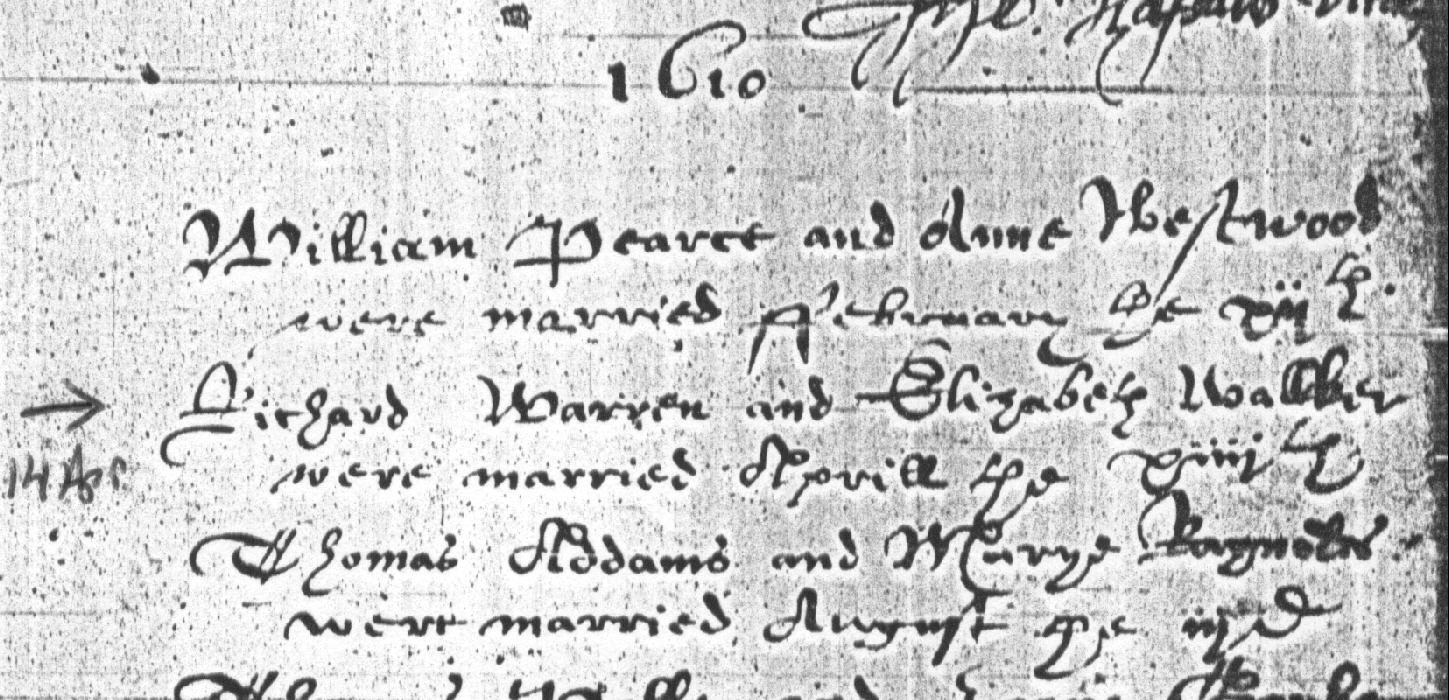
Spouse: Richard WARREN. Richard WARREN and Elizabeth WALKER were married on 14 Apr 1610 in Great Amwell, Hertsfordshire, England.11,1321 The CD version includes Torrey's sources. Children were: Mary WARREN, Anna WARREN, Sarah WARREN, Elizabeth WARREN, Abigail WARREN, Nathaniel WARREN, Joseph WARREN.
Henrie WALKER was christened on 18 Sep 1565 in Southam, Warwick, England.1324 Parents: John WALKER and Kathren BICKNILL.
John WALKER.
Spouse: Kathren BICKNILL. John WALKER and Kathren BICKNILL were married on 24 Feb 1554 in Southam, Warwick, England.225 Children were: Margaret WALKER, John WALKER, Michael WALKER, William WALKER, Augustine WALKER, Henrie WALKER, Miles WALKER, Anne WALKER, John WALKER.
John WALKER was christened on 4 Jul 1574 in Southam, Warwick, England.1325 Parents: John WALKER and Kathren BICKNILL.
John WALKER was buried on 6 Feb 1556 in Southam, Warwick, England.1326 Parents: John WALKER and Kathren BICKNILL.
Margaret WALKER was christened on 2 Jun 1555 in Southam, Warwick, England.1327 She was born on 2 Jun 1555 in Southampton, Warwick, England.102 Parents: John WALKER and Kathren BICKNILL.
Michael WALKER was christened on 7 Sep 1557 in Southam, Warwick, England.1327 Parents: John WALKER and Kathren BICKNILL.
Miles WALKER was buried on 2 Sep 1568 in Southam, Warwick, England.1328 Parents: John WALKER and Kathren BICKNILL.
William WALKER was christened on 13 Oct 1561 in Southam, Warwick, England.1329 Parents: John WALKER and Kathren BICKNILL.
 William Holmes
WALKER was born on 29 Aug 1820 in Peacham, Caledonia, Vermont, USA.429,613
He died on 9 Jan 1908 in Lewisville, Jefferson, Idaho, USA.429,613 He was
buried on 12 Jan 1908 in Lewisville, Jefferson, Idaho, USA.
William Holmes
WALKER was born on 29 Aug 1820 in Peacham, Caledonia, Vermont, USA.429,613
He died on 9 Jan 1908 in Lewisville, Jefferson, Idaho, USA.429,613 He was
buried on 12 Jan 1908 in Lewisville, Jefferson, Idaho, USA.
William Walker, autobiography, typescript, BYU, p.11 November 1, 1843, I married Olive Hovey Farr, daughter of Winslow and Olive Hovey Freeman Farr. Myself and wife boarded at the [p.12] mansion six months, then we moved into a two-story brick house on Parley Street belonging to the Prophet, but I still continued to be in his employ. We had living with us five of my younger brothers and sisters and gave them a home for a year. My father then returned from his mission and soon he provided a home for them.
Taken from William Holmes Walker's Journal--Father joined Mormons, 1832. To Far West, Missouri, 1834. To Nauvoo, 1839. Conversations with Joseph Smith. Married. Exodus from Nauvoo, 1846. Mormon Battalion, 1846-47. To Salt Lake City. Mission to South Africa, 1852-57. Mission president from 1855. Return to Salt Lake City. Called to settle in Dixie, 1861. Routine entries about family, Church activities, work, financial accounts.
Commments: #61. William was chosen as one of the presidents of the 57th Quorum of seventy. From 1840 until the expulsion of the Saints from Illinois in 1846, he resided in Nauvoo, Illinois, whence he moved to Council Bluffs, Iowa. Here he enlisted as a member of the famous Mormon Battalion, and crossed the great plains and deserts to the Pacific coast. After serving his time as a soldier he made his way to Salt Lake City, where he arrived in the fall of 1847. After residing in Salt Lake City for a number of years he moved to Big Cottonwood, Salt Lake county. In 1852 he was called on a mission to South Africa, where he spent about five years laboring in the Cape of Good Hope and in the neighboring province on the east. He worked both in the Logan and Salt Lake Temples.
LDS Biographical Encyclopedia, Andrew Jenson, Vol. 1, p.565
Walker, William H., a Patriarch in the Granite Stake of Zion, is the son of John Walker and Lydia Holmes, and was born in Peacham, Caledonia county, Vermont, Aug. 28, 1820. He was baptized in September, 1835, by Abraham Palmer, and ordained a Seventy by Benj. Clapp in 1846. Later, he was chosen as one of the presidents of the 57th quorum of Seventy. May 20, 1892, he was ordained a High Priest and a Patriarch by Pres. Joseph F. Smith. From 1840 till the expulsion of the Saints from Illinois in 1846, he resided in Nauvoo, Ill., whence he moved to Council Bluffs, Iowa. Here he enlisted as a member of the famous Mormon Battalion, and crossed the great plains and deserts to the Pacific coast. After serving his time as a soldier he made his way to Salt Lake City, where he arrived in the fall of 1847. After residing in Salt Lake City for a number of years he moved to Big Cottonwood, Salt Lake county, where he has continued to reside ever since. In 1852 he was called on a mission to South Africa, where he spent about five years laboring in the Cape of Good Hope and in the neighboring province on the east. During the past sixteen years he has keen engaged in Temple work both in the Logan and Salt Lake Temples, and together with his sisters he has performed ordinances for over ten thousand people.
William Holmes Walker
Orson F. Whitney, History of Utah, Vol. 4, p.192-196
The subject of this narrative was a member of the Mormon Battalion and virtually one of the pioneers of Utah. The son of John and Lydia Holmes Walker, he was born at Peacham, Caledonia county, Vermont, August 28, 1820. His parents were members of the Congregational church, and he was trained in all the tenets of the same. When, in the spring of 1832, his father joined the Church of Jesus Christ of Latter-day Saints, William, who at that time was from home, living with an uncle and attending school, shared with his devout mother and other relatives the astonishment and disgust experienced by them on learning of what had taken place. John Walker, a carpenter by trade and something of a machinist, went soon after his baptism to Stanstead Plains, Canada, where he had charge of a manufacturing establishment, putting in improved machinery. During his absence his wife made a diligent and thorough investigation of Mormonism, with the result that she herself was converted. After her husband's return home, she and her children in 1834 accompanied him to Ogdensburg, New York, where there was an organized branch of the Church. They resided there three or four years, and in 1835 William, one of his brothers and two sisters embraced the faith.
In the spring of 1838 the Walkers with several other families left Ogdensburg for Western Missouri, where they arrived just as the anti-Mormon troubles were at their height. While traveling through the State they were surrounded by an armed mob who searched their wagons, robbed them of their rifles and ammunition and warned them that they would be killed if they went any farther. Terrified by these threats two families stayed behind, while the others continued on to Shoal Creek, camping five miles below Haun's Mill. William's father visited that ill-starred settlement in quest of information as to the true state of affairs, and was there when Comstock's murderous ruffians fell upon the defenseless settlers and massacred nearly a score. Mr. Walker was wounded, and while hiding under some slabs that projected over or leaned against the bank of the creek near the mill, witnessed the brutal butchery of the revolutionary veteran, Father McBride, who, while pleading for mercy, was hacked to pieces by a stalwart Missourian with an old corn-cutter. Refugees from the mills reported the massacre to the campers on Shoal Creek, who supposed Mr. Walker to be among the slain. To their great joy they learned to the contrary after moving their camp about one hundred miles, when William sought and found his sire and brought him back to his family and friends. In November, while temporarily occupying a log house, the Walkers, father and son, assisted President Joseph Young and family, refugees from Haun's Mill, a distance of a hundred and fifty miles, on their way to Illinois.
The Walker family left Missouri early in 1839 and settled near Quincy, Illinois, where the father obtained work at his trade, while his sons William and Lewis tilled a farm that he had rented. During his subsequent mission through the Middle States, it was their labor that supported the family. William Walker's first meeting with the Prophet [p.193] Joseph Smith, with whom he became very intimate, was in the spring of 1840, when he was sent by his father to transact some business with him at Nauvoo. He arrived at the Prophet's home about nine o'clock in the evening, just as the family were singing before the usual evening prayer; Emma Smith, the Prophet's wife, leading the melodious chant. "I thought," says he, "I had never heard such sweet, heavenly music, and I was equally impressed with the prayer offered by the Prophet."
William and his parents having moved to Nauvoo, he was welcomed into the Prophet's home, where he remained during the next three years as a member of the household. As early as January, 1841, if not earlier, the Prophet spoke to him about the principle of plural marriage, and in the spring of 1843, Father Walker being absent on a mission, Joseph asked and obtained William's consent to marry his sister Lucy. His sire subsequently sanctioned the proceedings. William says of the Prophet: "The more extensive my acquaintance and experience with him, the more my confidence increased in him. I worked in the hay field with him, when he assisted in mowing grass with a scythe, many a day putting in ten hours work. Very few if any were his superiors in that kind of labor. I was entrusted by him with important business. The Urim and Thummim was once in my charge for the time being. On one occasion when he was the mayor of Nauvoo, it became his duty to fine a negro for selling liquor in violation of the city ordinances. The negro begged for leniency, stating that his object in selling the liquor was to raise money to send for his family. The mayor would not shrink from his duty; he fined him seventy-five dollars, but added that if he would honor the law in future, he would make him a present of a horse to aid him in his purpose. The gift was gladly accepted and the required promise made. When the Mansion House was finished and furnished and the Prophet and his family moved into it, I had charge of it under his direction. In regard to his private life, as to purity, honesty, charity, benevolence, refinement of feeling and nobility of character, his superior did not exist on earth. An incident occurred at the Mansion House to illustrate his contempt for and detestation of anything low and vile. Not long after the house was opened as a hotel, a stranger came and registered his name. Just before supper he insulted one of the hired girls. The Prophet heard of it after the stranger had retired, and next morning met him as he came down from his room. 'Sir,' said he, 'I understand that you insulted one of the employes of this house last evening.' The fellow began to make all kinds of apologies, but the Prophet cut him short by telling him to get into his buggy and leave the place at once, and this in such unmistakable language and in such a tone as to almost make the man's hair stand on end. He offered to pay his bill, but his money was refused. 'I want you to get out,' said the indignant proprietor. 'I want none of your money, nor the money of any man of your stamp.' Thereupon the stranger made a hasty exit."
November 1st, 1843, witnessed the marriage of William Holmes Walker with Olive Hovey Farr, daughter of Winslow and Olive Hovey Freeman Farr. He and his wife boarded at the Mansion House for six months, and then moved into a two-story brick house on Parley Street, belonging to the Prophet. William's mother was now dead, his father was on a mission, and five of his younger brothers and sisters were living with him. He still continued in the Prophet's employ, loaded and hauled rock for the Temple and officiated as president of the young men's and young ladies' relief society, organized to supply the needs of the poor.
When the Prophet was about to go to Carthage to give himself up for trial, he sent William Walker to Burlington for an important witness, whose affidavit was secured and sent to Carthage by express. The same day it was returned to him with the request that he go again for the witness. He started immediately, rode all night, and while taking breakfast with George J. Adams at Augusta, heard the awful news of the massacre in Carthage jail. He returned to Nauvoo in time to meet the dead bodies of Joseph and Hyrum on their arrival there. In the fall of 1845 he assisted to quell the mobs that were burning Mormon property around Nauvoo, and during the remaining months of his residence there made preparations to accompany his people in their westward flight.
The date of his departure from Nauvoo was February 21, 1846. He crossed the Mississippi (two miles wide) on the ice, and joined the migrating Saints on Sugar Creek. The camp was so organized that all able-bodied men who could possibly be spared went ahead and took contracts for splitting rails, building fences, or any other work that could be had, in order to supply the camp with grain. Mr. Walker, with his brother-in-law, Aaron F. Farr and Lorenzo D. Young, went into northern Missouri to trade their horses for oxen, which were found much better than horses for the journey. From that time he was actively engaged in hauling supplies through the storms that beat upon the [p.194] travelers, almost incessantly, as they wended their way towards the Missouri river, where he arrived with the advance company about the middle of June.
Next came the call for the Battalion. "I enlisted," says Mr. Walker, "more as a necessity than as a volunteer. It was a heavy draft upon the camp, and it required much effort upon the part of President Young and others to meet the demand." He was in Company "B," Jesse D. Hunter, Captain. From Fort Leavenworth to Santa Fe he suffered much with chills and fever, and experienced rather harsh treatment from some in command, who did not realize his weak condition and required service impossible for him to perform. Finally the medical examiner passed upon his case, excused him, and he was sent with the disabled portion of the Battalion to Pueblo, where he passed the winter. This detachment left Pueblo late in May, 1847. Mr. Walker with a few others went on in advance and overtook the Pioneers at Green river, from which point he returned with a number of them on horseback to meet his family in the following emigration. He rode for days barefooted, (his moccasins being worn out), with a handkerchief wrapped around the foot that was exposed to the sun. Near Fort Kearney he met his wife, who had driven two yoke of oxen most of the way from the Missouri river, and was now sick, worn out with fatigue. They arrived in Salt Lake valley on the first day of October.
His wagon box was his first abode, but he lost no time in going to the canyon for logs to build a house, into which he moved in December. "Aaron F. Farr and myself cut the logs and sawed the first lumber in Utah, and I made the first three-panel doors. I also worked on the first grist-mill, a corn cracker, run by water power, and built by Charles Crismon on City Creek. I then hewed timber and framed a saw mill for Heber C. Kimball. Subsequently I worked on Neff's flouring mill. I drew a lot one mile north of what is now called Holladay, and after getting the ground broke, sent my oxen back to the Missouri river to help the immigration. In 1848 I fought the crickets, and the next year moved my house out of the Fort onto my city lot in the Sixteenth ward. I traded with the Indians and gold diggers, the latter on their way to California, and at the same time cultivated my land. In November of that year my brother Edwin, a member of the Battalion, who had served in the second enlistment, arrived from California. In the Provo Indian campaign of February, 1850, I drove the old cannon called 'Long Range.' I was in the thick of the fight on Provo river and in the final combat at the head of Utah Lake, where the hostiles were almost annihilated. On the 28th of the following April, I married Mary Jane Shadding, and next day went to Farmington to build and open a farm. In the fall my father arrived from Winter Quarters. The next year I built a two-story house at Salt Lake City, and in December, with my father-in-law, Winslow Farr, and my brother-in-law, Aaron F. Farr, began opening a road, building bridges and hewing timber for a saw-mill in Little Cottonwood Canyon. Our mill was just ready to raise, and I had started for Salt Lake to get men to help us put it up, when I learned that I had been called on a mission to South Africa. Instead of taking out men to raise the mill, I took one out to purchase my interest therein."
Elder Walker started upon his mission about the middle of September, 1852, accompanied by Jesse Haven and Leonard I. Smith. He left his affairs in the hands of an Englishman named Hill, a bad man who had been recommended to him as a good one, and who wasted his substance, mistreated his family and absconded before his employer's return. While the latter and his companions were crossing the plains an attempt was made, presumably by Indians, to run off their horses, quite a numerous band, as they were traveling in company with many other Elders, bound for missions in various parts. They had just made camp one evening on the Platte, when a strange horse, saddled but riderless, came galloping in from the darkness. A powder horn and a tin cup were tied to the horn of the saddle, and every jump made by the horse produced a peculiar ring and rattle. The unusual noise frightened the other horses, and quick as a flash they started on a stampede and were chased for six miles before they could be checked and turned. Proceeding on their way the missionaries soon met a band of Pawnees, three thousand strong, who divided to the right and left and allowed them to pass, showing no signs of hostility, though they had burned the grass for a distance of a hundred and fifty miles.
At Kanesville Elder Walker made arrangements for the emigration of his youngest sister, Mary, the next season. He then went on to Illinois to visit his brother Lorin, who had married the eldest daughter of the martyred Patriarch Hyrum Smith. He spent two days with the Prophet's family, at Nauvoo, and was kindly received by them. Emma Smith had remarried, and was then Mrs. Major Bidamon. He found his brother at Macedonia, where also dwelt the Prophet's sisters, Catherine and Sophronia, both widows. [p.195] All were glad to see him. He assisted Lorin in his preparations to emigrate to Utah. At Washington, D. C., he visited both houses of Congress, by invitation of his friend, Delegate Bernhisel, and on the 16th of December sailed from New York, landing at Liverpool on the 3rd of January. Elder Walker had his first experience in public speaking at Preston, the birthplace of the British Mission. Having visited Wales and various parts of England, he sailed from London for the Cape of Good Hope on the 11th of February. Crossing the Equator, he and his party escaped the usual experience meted out to neophytes in Neptune's realm—i. e., a salt water douse, a lathering with tar and a shave with an iron hoop—by informing the sea-god, or the sailor impersonating him, that they were missionaries. A small present was accepted as a substitute for the usual ceremony of initiation.
Elders Walker, Haven and Smith landed at the Cape of Good Hope April 19, 1853. The usual storms were raging in that locality. They preached in Cape Town and other places and met with much opposition, being mobbed repeatedly and slandered almost incessantly. The first six months they baptized forty-five persons and organized two branches of the Church. In November Elder Walker visited the Eastern province, on the borders of Kaffirland, and at Beaufort baptized nine and organized a branch. He also held some interesting meetings at Grahamtown and other points, laboring arduously against great opposition, Subsequently he was joined by his companions. At the close of his ministry in that land two conferences had been established at Beaufort and Port Elizabeth. One of his converts was Charles Roper, a wealthy rancher at Wintberg, who, when the ship-owners formed a league refusing to carry Mormon emigrants out of the country, purchased with others a ship called the "Unity" and placed it at the disposal of the missionaries. Thereupon the ship-owners gave notice that they would carry all Mormon emigrants that wanted to go. Elder Walker had been sustained as president of the South African Mission, Elder Smith had been released to take the first company to Utah, and Elder Haven was on the point of sailing for Liverpool, to report progress to the Presidency of the European Mission, when a letter came from President Brigham Young honorably releasing them to return home.
Sailing from Cape Town November 27, 1855, their ship, the "Unity," on December 13 touched at St. Helena, where they viewed Napoleon's tomb and preached under the shade of some trees on one of the streets of the town. Subsequently Elder Walker preached on board, the captain and crew paying respectful attention. The ship arrived at the London docks, January 30, 1856. Elder Walker left it at Gravesend, and took train for London, thence proceeding to Liverpool, where he met in council with President Franklin D. Richards, Daniel Spencer, George D. Grant, William H. Kimball, John Kay, Thomas Williams, James Little, Edward Tullidge and others, and after reporting his mission, discussed with them the subject, "Wheelbarrow or Handcart Emigration." Late in February he sailed from Liverpool on the ship "Caravan," with a company of Saints presided over by Daniel Tyler, to whom he acted as first counselor; Edward Bunker and Leonard I. Smith being the other counselors. From New York, where they landed late in March, Elder Walker had charge of the company to Iowa City, which was reached early in April. While waiting the word to start across the plains he visited relatives and friends in Illinois, among them the venerable Lucy Smith, the Prophet's mother, who was nearing the end of her life. He assisted President Daniel Spencer in emigrational matters on the frontier, and was preparing to follow the handcart companies, with his brother Lorin and family, but found it impossible to secure teamsters that late in the season; it being about the first of October when he reached Winter Quarters. He therefore remained on the Missouri, and escaped the disaster that befell the companies on the plains. At the head of a company of emigrants he reached Salt Lake City September 1st, 1857, having been absent from home five years, lacking fifteen days.
Scarcely had he greeted his family when he was called to take part in the "Echo Canyon war." He was all ready to go, when he was assigned the duty of selecting and forwarding supplies to his comrades at the front. Returning from the move in July, 1858, he purchased a farm four miles west of Ogden. August 30th of that year was the date of his marriage to his third wife, Olive Louisa Bingham. He now added to agriculture the occupation of dairying. He also established a carding machine at Farmington, freighting the machinery from the East. He had barely put up his buildings for this industry when he was called upon a mission into Southern Utah.
In company with his wife Olive H. he started upon this mission in May, 1862. At Toquerville, where they settled, he planted cotton, sugar cane and grape vines. In July he returned to Salt Lake to procure a cotton gin, but found no machinist who could make one. He next engaged in freighting from California and the East. In the spring [p.196] of 1863 he sent two four-mule teams to the States, with baled cotton for William S. Godbe, his wagons bringing back new card clothing for his carding machine. With four of his teams his brother Edwin freighted between Salt Lake, Boise City and Southern California. In 1864 he and his little son Simeon went to the Missouri river, taking passengers and bringing back freight. At Deseret he put up a flouring mill and in Oak Creek canyon a saw mill. On April 24, 1865, he married his fourth wife, Harriet Paul, who went to "Dixie" to live, his wife Olive L. going to Deseret. In the spring of 1866 he arrived at Salt Lake City from the south, with two tons of cotton for President Young's Deseret Mills. He was now released from the Dixie mission, sold out his interests there, and concentrated his energies upon his mills.
In the fall of 1872 Mr. Walker sold to the Utah Central railroad company a lot in Salt Lake City for eight thousand dollars, and purchased with the greater part of the proceeds the Farr estate on Big Cottonwood, resolving to turn his attention to farming and initiate his sons in that line. A serious accident befell him about this time, a young horse rearing up and striking its hoof on his shoulder, knocking the bone down into the armpit. Drs. Bernhisel and Benedict reduced the dislocation, but it was six months before the patient could raise his hand to the top of his head. In June, 1874, he became interested in a stamp mill at Ophir, and for a short time was business manager of the concern. In March, 1875, he began building his first house at Big Cottonwood, where he afterwards built two others. On completing the structure he fitted up a room as a school, hired a teacher and had fifteen of his children taught there. The neighbors also sent their children to this school, which was quite successful. In February, 1876, he was elected senior school trustee for the district and during his term of office a new school house was erected, for which he took the contract, advancing means for the materials. He also made the desks and other furniture, did the painting and varnishing, and provided a large bell for the cupola of the building. His last act as trustee was to have the school-house grounds fenced, leveled, sown to grass and planted with shade trees; also to arrange for the care and cultivation of the same during the next five years. William Walker was one of the first stockholders in Z. C. M. I., and also took stock in the Sixteenth ward co-operative store. He is now a stockholder in the Utah Sugar Company.
In April, 1884, he accompanied four of his married sons to Idaho, where they purchased and took up lands at Lewisville. There he settled with a portion of his family, and with his sons William A. and Don C. opened a small store, which was afterwards closed out to Z. C. M. I. He left Utah just in time to escape the beginning of the anti-polygamy crusade, but soon found that he was not much safer in Idaho, since the crusade began there about the same time. To avoid the prowling deputies he went into retirement for a season, camping out in the woods in an ingeniously planned retreat which he finally had to abandon as danger drew nearer.
During the winter of 1885–6, and at intervals during the next five years, he worked in the Logan Temple, where his sisters, Lucy, Jane and Mary assisted him in sacred labors for their dead ancestors. Leaving Logan in February, 1891, he worked during the next few weeks on the Salt Lake County Seminary, making a donation of half his labor to the institution. He was then engaged for six months on the Salt Lake Temple, laying floors, donating half his labor in like manner. He had the same tools that he had used on the Nauvoo Temple fifty years before. In July, 1893, he began working in the Salt Lake Temple, and until recently was regularly engaged there.
On May 20, 1892, the worthy veteran, a Seventy since December, 1844, and one of the presidency of the Fifty-seventh quorum since July 27, 1869, was ordained a High Priest and Patriarch, under the hands of Presidents George Q. Cannon and Joseph F. Smith, the latter pronouncing the ordination. He still resides at Holladay, whence he reported himself in 1897 to the Utah Jubilee Commission, and from them received due recognition as one of the pioneer founders of the commonwealth. [p.197]
Spouse: Olive Hovey FARR. William Holmes WALKER and Olive Hovey FARR were married on 1 Nov 1843 in Nauvoo, Hancock, Illinois, USA.613 Married by Joseph Smith Jr.
Ela Fitz WALTER.6 Parents: Walter Fitz ROBERT and Ida LONGESPEE.
Spouse: William de ODDINGSELES Knight. William de ODDINGSELES Knight and Ela Fitz WALTER were married. Children were: Ida de ODDINGSELES.
Margaret WALTER was christened on 8 Sep 1564 in Nayland, Suffolk, England.186 Parents: Richard WALTER and Mrs Margaret WALTER.
Spouse: John BARKER. John BARKER and Margaret WALTER were married on 29 Jun 1585 in Stoke Nayland, Sudbury, Suffolk, England.186 Children were: John BARKER, Margaret BARKER, Child BARKER, John BARKER, Thomas BARKER, Richard BARKER, Samuel BARKER, Anne BARKER, Mary BARKER, Child BARKER, John BARKER.
Mrs Margaret WALTER.186
Spouse: Richard WALTER. Children were: Margaret WALTER.
Richard WALTER.186
Spouse: Mrs Margaret WALTER. Children were: Margaret WALTER.
Andrew WALTON. Parents: William WALTON and Margaret DYES.
Spouse: Joan CLARKE Clercks. Andrew WALTON and Joan CLARKE Clercks were married. Children were: William WALTON.
Elizabeth WALTON was born on 27 Oct 1629 in , Seaton, Devonshire, England.440 She was christened on 27 Oct 1629 in , Seaton, Devonshire, England.444 She died in Beverly, Essex, Massachusetts, USA.
Elizabeth WALTON CONANT's second husband, Andrew MANSFIELD was the father-in-law of her two oldest sons.
Sources: LDS Ancestral File; Research of John F. Chandler Parents: Rev. William WALTON and Elizabeth COOKE.
Spouse: Lot CONANT. Lot CONANT and Elizabeth WALTON were married in 1649 in Beverly, Essex, Massachusetts, USA.11 Children were: Nathaniel CONANT, John CONANT, Lot CONANT, Elizabeth CONANT, Mary CONANT, Martha CONANT, Sarah CONANT Twin, William CONANT Twin, Roger CONANT, Rebecca CONANT.
Spouse: Andrew MANSFIELD. Andrew MANSFIELD and Elizabeth WALTON were married on 10 Jan 1680/81 in Lynn, Essex, Massachusetts, USA.11
Jane WALTON was christened on 18 Feb 1634 in , Seaton, Devonshire, England. She was born in , Seaton, Devonshire, England. Parents: Rev. William WALTON and Elizabeth COOKE.
John WALTON was born on 6 Apr 1628 in , Seaton, Devonshire, England. Parents: Rev. William WALTON and Elizabeth COOKE.
Josiah WALTON was born on 20 Jan 1641 in Marblehead, Essex, Massachusetts, USA. He died on 23 Jun 1673 in Marblehead, Essex, Massachusetts, USA.1330 He had his estate probated on 27 Nov 1673 in Salem, Essex, Massachusetts, USA.1330 Was brought in from sea after his wound from the lighting on June 23, 1673. Lists the following relations: Nathaniel Walton (brother), Martha Munjoy (sister), Samuel Walton (brother), Elizabeth Conant (sister), Mary Bartlett (sister), Elizabeth Walton (widow).
Source: Film #0876181 Essex Co. Probates 1638-1673, Originals
ESTATE of JOSIAH WALTON OF (MARBLEHEAD?).
"We whose names are underwritten being present with Josiah Walthom when he was brought in first from Sea after his wound by the lightning,.on June 23, 1673, affirme & declare that upon the Companys motion to ye Sd Josiah Waltorn that he would setle his estate He ye 5d Josiah Waltom being of perfect memory and apprehensive of his dissolution, did declare that his Will was that his Brother Nathaniell Waltorn, and his sister Martha Munjoy should have his grey horse for their owne betwixt them, and his other estate he gave it to his Mother Waltom, for her use, & benefit during her naturall life, and after her decease to he disposed off by her, and divided among his brothers Nathaniell & Samuell Walthorn and his three sisters, Martha Mnnjoy, Elizabeth Conant and Mary Bartlett to enjoy an equall part, all alike, saving that his sister Munjoy should have the better part, and that ye land should not no out of ye name of ye Walthoms."
Samuell Cheever, Moses Mavericke, James Dennes. Proved 27: 9: 1673 by ~[oses Maverick and James Dennis,
and Eliza Walton, the widow, was appointed administratrix. Parents: Rev. William WALTON and Elizabeth COOKE.
Spouse: . Josiah WALTON and Elizabeth were married.
Martha WALTON was born on 26 Apr 1632 in , Seaton, Devonshire, England. Parents: Rev. William WALTON and Elizabeth COOKE.
Spouse: . Benjamin MOUNTJOY and Martha WALTON were married on 20 Apr 1692 in Salem, Essex, Massachusetts, USA.
Spouse: .
Mary WALTON was born on 14 Mar 1644 in Marblehead, Essex, Massachusetts, USA. She died on 3 Jul 1676. Parents: Rev. William WALTON and Elizabeth COOKE.
Spouse: .
Nathaniel WALTON was born on 3 Mar 1636 in , Hingham, Plymouth, England. Will Proved Parents: Rev. William WALTON and Elizabeth COOKE.
Robert WALTON was born in 1579. Parents: William WALTON and Anne MAYS.
Spouse: Margaret FITZWILLIAMS. Children were: Rev. William WALTON.
Samuel WALTON was born on 5 Jun 1639 in Marblehead, Essex, Massachusetts, USA. He died on 22 Mar 1717/18 in Reading, Middlesex, Massachusetts, USA. Parents: Rev. William WALTON and Elizabeth COOKE.
Spouse: . Samuel WALTON and Sarah MAVERICK were married in 1674 in Reading, Middlesex, Massachusetts, USA.
William WALTON.
Spouse: Margaret DYES. William WALTON and Margaret DYES were married in 1532 of St Michaels, Queenslittle, England. Children were: Andrew WALTON.
William WALTON was born in 1556. Parents: Andrew WALTON and Joan CLARKE Clercks.
Spouse: Anne MAYS. Children were: Robert WALTON.
Rev. William WALTON1331 was born in 1601 in Seaton, Devonshire, England. He died on 6 Nov 1668 in Marblehead, Essex, Massachusetts, USA. He was buried on 9 Nov 1668. He had his estate probated on 24 Nov 1668 in Marblehead, Essex, Massachusetts, USA.1332
of Seaton
First minister of Marblehead.
Administration on the estate of Mr. William Walton, intestate, granted 24:9:1668, to Elizabeth Walton, the widow, who brought in an inventory. The house and land in Marblehead were to be held for security. Salem Quarterly Court Records 5:18
Debts of Mr. William Waltun: To Mr. George Corwin, £ 8 14s 8d; to Mr, William Browne, sr., £ 10 12s 1d; to Mr. Moses Mavericke, £ 73 1s 4d; to Mr. Samuel Ward, £ 12 7s; to Mr. Phellep Cromwell, £ 2 12s 9d; to Mr. Walter Price, £ 1 15s; to Dockter Checkaren, £ 1 4s; to Mestress Woodcock, £ 8; to William Huet, £ 1 12s; to James Denes, 8s: total £ 120 6s 10d. Due from the town £ 39.
Inventory of the estate of Mr. William Waltun of Marblehead, lately deceased, taken Nov. 23, 1668, by John Peach, sr. and Samll. Ward: Dwelling house with a garden & orchard, £ 120; parcell of land bounded with Mr. Mavericks land on ye one side & Rich. Rowlands land on the other side, with an old barn, £ 80; £ 10 in the first purchase in ye farme neere the towne, £ 20; 2 Cowes pastoridge in the twone Commons, £ 10; 2 heifers at £ 6; 1 Cow at £ 4, £ 10; his Library Viewed by Mr Higginson and Mr. Hale, £ 20; 1 bed and bedsted, £ 5; 2 fetherbeds, £ 7; 4 pewter platters, 16s; 3 small old dishes, 3s; 4 Candlesticks, 8s; 1 paire of Andriosns, 12s; 1 Spitt, 1 paire tongs, 1 Crooke, 7s; 1 Chamber pott, 1 drinking pott, 4s; 1 silver bowle & 1 saltseller, £ 3; 2 potts being defective, 12s; 1 table Cloth, 6s 6d; napkins, 6s, 12s 6d; 2 stills, £ 1 5s; 1 Gun, £ 1; 2 tables, 1 forme, £ 1 6s; 1 trunke, 5s; wearing Clothes, viz; 2 Cloakes, 1 Coate, 1 paire Stockings, 1 old paire breeches & 1 old Dublett, £ 5; total £ 287 10s 6d. Essex County Quarterly Court Files 13:138,139
Elizabeth Walton, relict of Mr. William Walton, was ordered June 19, 1779, to keep the whole estate in her hand during her ilfe, she being administratrix, with the consent of all thechildren. She was to pay all the debts of the estate, and at her death, said estate was to be divided among the children, Nathaniell, the eldest, to have a double portion, of which he had already received £ 30, and Samuell having had £ 8 of his portion. Salem Quarterly Court Records, 5:25
"Wee whoes names are underwritten being desired by nathanill Waltown to vew a parsell of medow and upland lying in marblhead which acordinglie we did and to the best of our Judgment it is worth the sum of fortie pounds." Dated June 25, 1669, and signed by John Peach, sr. and Samll. Ward. "the Charges that I haue ben out vpon the mash for fencing and daming aginst the see: 20:00:00"
Moses Mavericke and Samll. Ward, on June 29, 1669, appraised for Samuel Waltown, a parcel of land at marblehead, called Williams' lot at £ 10, and the parcel on which his house stands at £ 8. Essex County Quarterly Court Files, 14:132
Whereas by an order of the County court held at Salem June 29, 1669, the estate of our father mr. William Walton, deceased instate, was left in the hands of our mother and the remainder at her decease to be divided among the six children left, viz. Nath., Samiel and Josiah Walton, Elizabeth Mansfeild, Martha Munjoy and Mary Bartlett, the eldest to have a couble portion and our mother having died the last year and by means of the death of our brother Josiah Walton, his part by will and what he had of his own was bequeathed to be divided amongst us, we have made the following agreement and settlement; the accounts shall stand and the debts shall be paid out of the estate; the bill of slae made by our mother for one half of the lot sold to our brother nathaniel Walton and Martha munjoy for £ 40 of debt was confirmed; Robert Bartlett shall for £ 20 of debt paid by him have that quarter part of the lot whereon his house stands; the books shall be shared equally, the eldest son to have his double share; Sam. Walton shall have one cow lease at £ 5 to be allowed out of his £ 25 and one cow; the whole remainder of the estate to Nathaniel Walton and Martha Munjoy they to pay to us £ 25 each, which we accept as our portion.
Signed and sealed march 29, 1683 by Andrew Mansfeild, Nathaniel Walton, Marth, Munjoy, Robart Bartlett. Witness: Samuel Cheever, William Bartlett. Essex County Quarterly Court Files, 45:12 Parents: Robert WALTON and Margaret FITZWILLIAMS.
Spouse: Elizabeth COOKE. Rev. William WALTON and Elizabeth COOKE were married on 10 Apr 1627 in Dorchester, Holy Trinity Church, Dorset, England.11,476 Children were: John WALTON, Elizabeth WALTON, Martha WALTON, Jane WALTON, Nathaniel WALTON, William WALTON, Samuel WALTON, Josiah WALTON, Mary WALTON.
William WALTON was born about 1637 in , Hingham, Plymouth, England. He died on 3 Sep 1640. Parents: Rev. William WALTON and Elizabeth COOKE.

