Surname List
Name Index
Sources
Email Us
 Rebecca PATTEN
was born on 29 Jan 1675 in Billerica, Middlesex, Massachusetts, USA.162 She died on 13 Feb 1750/51 in Billerica, Middlesex,
Massachusetts, USA.162
Parents: Thomas PATTEN and Rebecca PAINE.
Rebecca PATTEN
was born on 29 Jan 1675 in Billerica, Middlesex, Massachusetts, USA.162 She died on 13 Feb 1750/51 in Billerica, Middlesex,
Massachusetts, USA.162
Parents: Thomas PATTEN and Rebecca PAINE.Spouse: Joseph DAVIS. Joseph DAVIS and Rebecca PATTEN were married on 18 Jun 1691 in Billerica, Middlesex, Massachusetts, USA.171,519 Children were: Rebecca DAVIS, Hannah DAVIS, Joseph DAVIS, Elizabeth DAVIS, Benjamin DAVIS, Mary DAVIS, Sarah DAVIS, Susanna DAVIS, Joshua DAVIS, Ester DAVIS, Thomas DAVIS.
Sarah PATTEN was born on 27 Jan 1638 in Cambridge, Middlesex, Massachusetts, USA.22 year given as 16___ Parents: William PATTEN and Mary.
Sarah PATTEN was born on 27 Nov 1641 in Cambridge, Middlesex, Massachusetts, USA.22 Year given as 16___ Parents: William PATTEN and Mary.
Sarah PATTEN was born on 26 Jan 1645 in Cambridge, Middlesex, Massachusetts, USA. She died on 24 Sep 1677. Parents: William PATTEN and Mary.
Spouse: . Amos WOODWARD and Sarah PATTEN were married in Cambridge, Middlesex, Massachusetts, USA.
Sarah PATTEN was born on 18 Jun 1677 in Billerica, Middlesex, Massachusetts, USA.162 Parents: Thomas PATTEN and Rebecca PAINE.
Thomas PATTEN
was born in Oct 1636 in Cambridge, Middlesex, Massachusetts, USA.22,1104 He
died on 16 Jan 1690 in Billerica, Middlesex, Massachusetts, USA.22,162 Parents:
William PATTEN and Mary.Spouse: Rebecca PAINE. Thomas PATTEN and Rebecca PAINE were married on 1 Feb 1662 in Billerica, Middlesex, Massachusetts, USA.11,730 Children were: Mary PATTEN, Thomas PATTEN, Nathaniel PATTEN, William PATTEN, Rebecca PATTEN, Sarah PATTEN, Elizabeth PATTEN.
Spouse: . Thomas PATTEN and Sarah KENDALL were married on 20 May 1686 in Billerica, Middlesex, Massachusetts, USA.11,162 Children were: Mehetabel PATTEN, Kendall PATTEN.
Thomas PATTEN was born on 22 Mar 1665 in Billerica, Middlesex, Massachusetts, USA.162,1104 He died on 10 Oct 1747.1104 Parents: Thomas PATTEN and Rebecca PAINE.
Spouse: . Thomas PATTEN and Miriam STEARNS were married.
William PATTEN88,1105
was born in 1606 in Hardington, Mandeville, Somerset, England.89 He died on 10 Dec 1668 in Cambridge, Middlesex, Massachusetts,
USA.88,1104 He had his estate probated on 2 Apr 1669 in Cambridge,
Middlesex, Massachusetts, USA.1106
WILLIAM PATTEN OF CAMBRIDGE
(512) 1. WILLIAM PATTEN. The origin and location of the ancestry of William Patten has always been an open question. There are traditions regarding the family in England, but, in his case, there is no evidence in support of them. It is reported that a family of Pattens was in the north of England and went from there to Scotland in the fifteenth century, and about a century later some of their descendants went to the north of Ireland. Such a theory may be correct regarding the Pattens who came to this country in the eighteenth century, as they are stated to have come from Scotland and from Ireland.
A survey of Great Britain at the time of the settlement of New England shows but a few places where the name of Patten occurs to any very great extent. One of these was Lancaster County. In the parish of Warrington, sixteen miles east from Liverpool, there was a family of Pattens, and it was from this neighborhood that many settlers came to Dorchester and its vicinity. It is also from this region that the William Patten went who was Bishop of Winchester and founder of Magdalen College. The latter is a man who is claimed by most of the Pattens in this country as their ancestor, but we have so far failed to find any proof which could connect them with him. The earliest will to be found in this region is that of Thomas Patten, of Warrington, in 1579. After this we find no other wills until 1653, when one Thomas Patten, of Warrington, made his will and in it expressed gratitude to his brother William for various kind favors and appointed him as his executor. This could hardly have been our William, for as he had already been in this country at least eighteen years, it is not probable that he would at that time have been appointed an executor of a will in England.
Another locality where there were many Pattens was the county of Somerset, and it is to this family that we are inclined to think our William belonged. Nothing has been found to show by what vessel he came here, and if this point could be established a clue would perhaps be furnished to his residence before coming to this country.
We find also traditions in the family, not only in one branch but in many, that three brothers came to this country and settled in different places. This is a tradition that can be found to exist in a large number of New England families. This fact, as far as this family is concerned, is not supported by any evidence. Besides William Patten there seems to have been but one other of that name mentioned in the records of that time. This was Nathaniel Patten, who settled in Dorchester. Nathaniel Patten came from Crewkerne [crucis urna, the place of the cross], in the county of Somerset, England, and while he may possibly have been related in some way to our William, there is no evidence that he was a brother. In fact, the evidence is to the contrary. There is evidence existing to show clearly how and when he came to this country. In the notebook of Thomas Lechford, an attorney of that time, there is a legal document in which Nathaniel s former residence is stated and particulars as to his coming over as one of the charterers of the ship Charles of Bristol, on which he sailed on 18 June, 1640.
In the notebook, referred to is a notice of an account for which he brought suit against the undertakers of the ships Charles of Bristol and the Hopewell of London. The last items in the bill were as follows:
Itm for a bag of hoppes spoyled by the raine because some of the undertakers gave orders it should not be received aboard
Itm for a nimming sheet and rugg lent unto the Steward Robert Ring for the undertakers use
Itm fora cabbin bought in the ship because Ihad not convenience in the ship according to agreement for myselfe & family
Itm for a womans pillion lost in the ship Hopewell
Itm costs & charges att B ristoll from the 24th of May till thel8th of June for myselfe & family because att the said 24th day we should have bin gone
Itm they undertooke to victuall the said ship Charlesfor 16 weeks & to carry but 150 passingers to my remembrance, and they the passingers were debarred of our beere & water before landing & i/we had bin put to a long voyage we must needs have suffered much more than we did, wch I leave to the consideration of the Cort.
He settled in Dorchester and was a prominent citizen there and was interested in considerable real estate. In Suffolk Registiy of Deeds, under date of 21 July, 1671, we find that Nathaniel Patten, of Dorchester, in the county of Suffolk, appointed his "trusty and welbeloved kinsman Thomas Patten of Bristoll nowe resident in Boston" his true and lawful attorney to act in all business matters for him. This Thomas Patten probably did not remain here permanently, as there is no further evidence of him after the settlement of the estate of Nathaniel. Nathaniel Patten died 31 January, 1661. He left no surviving children that there is any record of. He left no will, but his wife Justine made a will dated 2 January, 1673. In this, she mentions different relatives to whom she left property, but no children. An agreement was entered into 14 December, 1674, between Benjamin Bale of Dorchester, and Thomas Patten, attorney for his father John Patten of Severalls in the parish of Crewkern, within the realm of England, referring to the settlement of the estate of Nathaniel Patten of Dorchester. This agreement refers to Benjamin Bale as being Nathaniel Patten s sister s son, and provided that all his estate outside of what the court had set aside for the widow should be divided into two equal parts; one part to be given to Benjamin Bale and the other part to Thomas Patten, attorney for John Patten, for the use of said John Patten and any other person concerned with him. By this agreement a division of the real estate was also made, one part being set off to Benjamin Bale in consideration of his delivering to Thomas Patten, sometime the next summer, one load of fresh hay. The other part was set off to Thomas Patten in consideration of his paying to Benjamin Bale fifty-nine pounds.
In England we find the will of Thomas Patten of Crewkern, in Somerset County, and he was clearly the father of Nathaniel. In this will, which was dated 27 March, 1629, mention is made of his nephews Robert and Thomas Patten; also his sons John, Thomas and Nathaniel; his daughters Sarah, Joane and Elizabeth, and his brother John; but the name of William nowhere appears in this family, thus showing that William and this Nathaniel were not brothers.
In Somersetshire we find the will of one Thomas Petten of Hardington Manfylde [Mandeville], Somerset, which we give here: In the Name of God Amen. The ninth daie of November in the second year of the Raigne of our Soveraigne lord Charles by the grace of god King of England, Scotland, Fraunce and Ireland defender of the faith, Anrw Domini One thousand sixe hundred twentie sixe I Thomas Petten of Hardington Man fyZde in the Co untie of Somset, carpenter, being verie sick of my body, but pfect of remembraunce thankes bee given to god therefore doe make my last will & testamt as followeth ffirst I give and bequeath my soule unto the allmightie god whoe gave it and is my maker and Redeemer of all mankind and my bodie to bee buried in the church yard of Hardington Man fyld. Item I give and bequeath unto four said (aforesaid) sonne William Petten one white calfe, one spitt, one Pyckeaxe, one co/er, my best wearing clot heres, my bedd, a Coverled and one paire of dowlish sheets. Item I give and bequeath unto my daughter Jone Petten a debt of neere eleaven pounds of lawful money a/England and the bill obligatory/or the same debt wch debt is in the hands of one WIlliam Joye ofLie and one little cow theme, one co/er and my old cloke. Item I give and bequeath unto my sonne Andrewe Petten All my carpenters working tooles; alsoe I the said Thomas Petten doe ordaine and make my two daughters Margaret Petten and Anne Petten to bee my whole executors joyntly and equallie and shall have all the Residue a/my goods and chattells whatsoever wch is not giver nor bequeathed upon this my last will and Testament. In witness hereof I have hereunto set my hand and seale the daie and yeare first above written.
Signed sealed and published in the presents of us John Marsh, John Apley, John Marsh the younger.
Proved at London 10 May, 1627.
Here we find a William Patten mentioned who may have been our pioneer. The county of Somerset was essentially farming country, and what would be more natural than that one coming from such a country should be selected by the inhabitants of Cambridge as a proper person and one well fitted to take the care of their town cattle. Unfortunately for us, the parish registers for that vicinity in England are not in existence for that period. The Hardington Mandeville registers only go back to the year 1687.
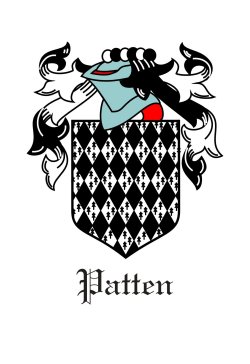
Another question that has been raised is whether there is any coat of arms of the family. We have found, in several branches, what has been held to be a Patten coat of arms, and while we have seen two or three of these,we have found no two of them exactly alike, and probably others, of which we have heard but not seen, have the same dissimilarity. Not every family in England was entitled to bear arms, and we are inclined to the opinion that the Somersetshire Pattens, being a farming class, were not of those who had this right, and consequently there is no true coat of arms for this branch of the family.
The first mention of William Patten to be found in this country is in the Cambridge Town Records under the date of 13 March, 1635/36, when the following vote was passed: Agreed Wth William Patten to kepe 100 Cattell on the otherside the Riuer for the space of seauen Mount hes to begine when the Towne shall appoint him and to haue Twenty pounds the one halfe paid him In Monny when he hath kept halfe his tyme and the other halfe In Come when he hath done keeping at the price wch the Comon Rate of Come goeth when he is to be paid and he is to have a man to help him the first 14 days he payinge him for one weeke the Towne for the other alsoe he is to lodg ther exsept once a weeke and to haue a man to keepe them everj other Sct both day and hee to paye Xs a beast/or every beast he shall loese and to keepe noe Cattell of anny man exsept the Townsmen give leaue vpon the for/etuer of 5s a head for every head he shall soe keepe.
In 1638 there appears the following record: Agreed Wth William Patten to keep three score cowes more or lesse vnder 4 score att the direction a/the Townsmen/or all this sumr vntill they take them in att lOs a weeke the one hal/e to bepd in the first weeke in July eithr in monie or good come & thothr halfe when he leaveth a/keeping them in monie & those that Refuse to paye in monie shall paye in come att the price that it is att when it is merchantable he is to pay 3d/or eur cowe he lea veth out a night & Xs a cowe for eurie one that is lost through his Defaulte he is to take noe oth cattell without the townsmens consent he is to dryve them out by six a/the clock in the morning & bring them home by sunn hal/e an houre high att night at the latest & to bring them into the towne eure Evening he is to keepe them but eurie third Sabt & thoth to be prvided for as in former tyme & whoe eur shall bring in anie strange cattell shall synde a helpe for 2 or 3 dayes & the owners to bring them into the common eure morning by the tyme appoynted & his owne cow to be kept free as long as he keepeth them & he is to pay 6d damage for eurie morning that he is not gone out by the tyme appoynted.
In 1646 we find that Brother Patten was fined thrice one shilling for one hog without keeper. On the twentieth day of the third month in 1649, we find that Andrew Stevenson and William Patten were appointed to execute the town order concerning hogs, and to levy on all such as shall be found breaking that order the just penalty of the same therein prescribed. In the same year liberty was granted some of the townsmen, among them William Patten, for the present hay time to mow the common meadow at Shawshine, "prvided they intrench uppon noe prpriety."
On two or three different occasions we find him appointed as one of the surveyors of fences, his district being that about the Menotomy Fields. He was also appointed surveyor of highways on one or two occasions.
The Common, as it was called, was well-timbered, for we find that when anyone wished for lumber he went to the selectmen for permission to get it from the Common. In 1660, at a meeting of the selectmen, several people, among them William Patten, were granted liberty to take timber to repair their fences and for "reparaccon of their houses. In 1663 he was granted liberty to take timber from the Common for a cart, and at another time for a cow-house and half a hundred "rayles7 In November, 1665, he was granted liberty to fell timber to build a lean-to and an end to his barn, and in 1668 to "repayre his old house at towne." He did not always ask for permission, for in 1662 we find that he was fined twenty shillings for felling trees on the Common contrary to town orders. Fines levied by the selectmen were sometimes abated, for in 1663 we find that a fine imposed upon William Patten was abated five shillings. In 1642 we find William Patten enrolled as a member of the honorable Artillery Company of Boston.
William Patten lived on what is now Massachusetts Avenue, opposite the Common. We find in the proprietors records that William Patten had: One house and garden. about halfe an Acre upon the Cow Common, John Means East, Cow Common South, Thomas Blogget west pine swampe North. In the new Lotts next Manotomie two Acres of planteing grounde Persivall Greene East, Willam Manning west Richard Champnies South, Gregory Stone North. In 1645, forty-seven lots on the west side of Menotomy River were granted to the several inhabitants of the town. In this distribution William Patten had "three acr more or lesse, Richard Francis East Daniell Kempster West, Charlestowne lyne north Comon south." A reference to the accompanying plan will give an idea of the location of his place. In 1901 the city of Cambridge published its early town records and with them a plan of the place in 1635 which had been compiled from the best sources obtainable. By the courtesy of the city clerk we are able to reproduce that plan here.
An agreement was made by the church 9 June, 1652, as to the division of Shawshine. In this William Patten was assigned lot 87, containing ninety acres. Although by the generosity of the church all the inhabitants received allotments of the Shawshine lands, comparatively few established a residence there. Although the name William Patten appears often in the matters of land distribution in the settlement of Billerica, it is doubtful if he ever took up his residence there, but remained in Cambridge until his death. As early as 1655, there were so many householders there that they were incorporated as a distinct town named Billerica. The town records, 29 January, 1654155, show that in answer to a letter sent them by their neighbors of Shawshine, alias Billerica, wherein they desire that the whole tract may be disengaged from this place and be one entire body by itself, a committee of five was appointed, who drew up an agreement for a separation, and this was consented to by William Patten and others present, the inhabitants of Shawshme. This agreement, or "Great Deed," as it is called, has been carefully preserved by the town ofBillerica, and bound between two covers which bear the title, "The Great Deed from the Cambridge Proprietors to the Billerica Proprietors, 1654." The body of the deed reads as follows:
To ALL PEOPLE to whome these prsents shall come Greeting KNOW YE that wee whose names are Subscribed FOR Sundry good consideracions us the reunto moving and for valluable consideracions to us respectively paid well & truly the recite whereof wee do by these prsents respectively acknowledge and therewth to be fully sattesfied & payd and thereof and of every part & parcell the reof do fully clearely and absolutely acquitt exonerate & discharge the Inhabitants of Billerica their heyres successors Ex ors administratoLtrs and Assignees forever by their prsent have given granted bargained sold aliened enfeoffed and con firmd unto & by these prsents do fully clearly and absolutely give grant bargain & sell alien enfeofe & con firme unto the Inhabitants of Billerica aforesaid their heyres assignes & such others as shall from time to time be by them admitted as free denizens of the said place & to the enjoyment of the priviledges thereof all our respective rights & interest therein unto any part of parcell of the said land now called by the said name of Billerica als Shawshine with all the.priviledges & appurtenances to the same appert eyning or in any wise belonging (only excepting & reserving our Joynt & respective interest that any of us have in the farme wherein John Parker now dwelleth comonly called by the name of the Churches farme (i.e.) the church at Cambridge with free liberty on all the comons of the said place for the Inhabitants on the said farme from time to time for the herbage timber & firewood as any other of the Inhabitants and a joint interest therein together with ye said towne & inhabitants thereof)
TO HAVE AND TO HOLD the said bargained prmises with all the priviledges & appurtenances (except before excepted) unto them the said Inhabitants their heyres assigns & successours for ever to their & their only propper use & behooffe. AND we whose names are subscri bed for us our heyres exorrs & administrators do respectively covenant promise grant to and with the Inhabitants of the said place their heyres assignes & law full associates & successors that they the said Inhabitants their heyres assignes successours & law full associates shall or may at all times & from time to time for ever hereafter lawfully & peaceably have hold occupy possess & Injoy the said bargaines & assigned prmises & every part & parcell the re of with all and singular priviledges & appurtenances thereof without the law full claims let hindrance contradiccon or denial of us or any of us whose names are subscribed our heyres executors administrators or assignes or any of them or of any other person or persons whatsoever claiming by from or under us or any of us provided always this instrument is to be understood of every mans engagement to be only for & in the behealfe of himself his owne heires executors & adm strators &c and no further or other. IN WITNESS whereof we have put our hands & seales this 25th day of March Anno Dom 1654.
This is the foundation upon which the town of Billerica was started, and to this document the name of William Patten with others was signed. We here reproduce the document, so that his descendants may see his name as he wrote it. The name may be seen in the fifth column, about halfway down.
He married before coming to this country a woman named Mary, who died 20 September, 1673.
William Patten died 10 December, 1668. He left no will, but on 2 April, 1669, his wife filed with the court the following inventory of his property:
His wearing Apparell:
1 Gray Coate
1 Strayte bodyed Coate
I Shagg d Coate 13s
2 pr Breeches
old cloaks, Jackett, & wescote
S/woes & stockins
Shirts, bands, cuffs & handkerchiefs
2 hatts
In ye Hall:
2 Tables & a forme
5 old chayres
1 cubbard & cubbard cloath
1 small chest
1 Tub & old payle
2 Sives, great bowle, trenchers, ladle
earthen ware
Iron Pott & kettle
Pewter, & a brass candlesticke
brass ware
A spitt
A smoothing Iron
And Iron, fire shovell, tongs, liakes, gridiron,
bellows, sheers, peel
Stone Jug
Hand Saw, Trowell, Scales, weights,
2 axes, beetle rings
4 old cushins
4 pr sheets
2 Table cloaths & 4 napkins
4 Pillow beers
1 file
In ye Parlor, Parlor charnb. Hall chamb. & cellar:
1 chest
1 old warmeing Pan
1 old wheele for spinning
1 old Tub
1 old trundle bedstead, thin flocke bed,
pillows, blanket
1 beame knife, with &Paring Knife
1 bedstead & furniture
2 spinning wheels
Sword & muskett
4 bush 1/2 barley
15 bush. Ry
1 halfe bush
1 Croscutt Saw
2 ft wood
3 bush pease
in cheese
Pillion & old coverled
Old Iron & Sithes
Porke
Coopers ware & 2 glass bottles
Sope
In ye yard & barnes:
Swine
5 Cowes
1payre oxen
21 yearlings
22 yearlings
1 old mare
1 horse
1 sucking calfe
cart rope & horse harness
1fann
forkes, rakes, flailes
Iron frow
Old Butt
25 bush Indian
1 old sacke
1 dung forke shovell & spade
4 sheep & a lamb
Plough, cart, yoakes, chaynes, cart ladders,
old hoops and boxes
old hows & grindstone & mattocks
House, barne, & 10 acres of land, where of 75
5 acres is sowne with Ry
4 acres plow land in west field
3 acres of swamp land
Iron wedges
House & yard at Towne
Spouse: Mary. William PATTEN and Mary were married by 1632 in , , , England.11 Children were: Mary PATTEN, Thomas PATTEN, Sarah PATTEN, Nathaniel PATTEN, William PATTEN, Sarah PATTEN, Nathaniel PATTEN, Sarah PATTEN.
William PATTEN was born about 1641 in Cambridge, Middlesex, Massachusetts, USA. He died on 22 Mar 1645. He was buried on 22 Mar 1645/46 in Cambridge, Middlesex, Massachusetts, USA.22 Parents: William PATTEN and Mary.
William PATTEN was born on 12 May 1671 in Billerica, Middlesex, Massachusetts, USA.162 He died on 5 Oct 1730 in Cambridge, Middlesex, Massachusetts, USA.1104 Parents: Thomas PATTEN and Rebecca PAINE.
Spouse: . William PATTEN and Mary ROGERS were married.
Anne PAYNE was born on 17 Dec 1587 in , Lavenham, Suffolk, England. She was christened on 17 Dec 1587 in , Lavenham, Suffolk, England.1050 Parents: William PAINE and Agnes NEVES.
Spouse: . Richard NEVE and Anne PAYNE were married on 2 Sep 1613.1074
Jane PAYNE was born about 1593 in , Lavenham, Suffolk, England. She was buried on 26 Jul 1594 in , Lavenham, Suffolk, England.1050 Parents: William PAINE and Agnes NEVES.
Judith PAYNE was born on 22 Jun 1589 in , Lavenham, Suffolk, England. She was christened on 22 Jun 1589 in , Lavenham, Suffolk, England.1050 Parents: William PAINE and Agnes NEVES.
Richard PAYNE was born on 20 Feb 1596/97 in , Lavenham, Suffolk, England. He was christened on 20 Feb 1596/97 in , Lavenham, Suffolk, England.1050 Parents: William PAINE and Agnes NEVES.
Spouse: .
Spouse: .
Susan PAYNE was born on 1 Jan 1590/91 in , Lavenham, Suffolk, England. She was christened on 1 Jan 1590/91 in , Lavenham, Suffolk, England.1050 She was buried on 9 Oct 1591. She died in , Lavenham, Suffolk, England. Parents: William PAINE and Agnes NEVES.
Susan PAYNE was born on 9 Apr 1592 in , Lavenham, Suffolk, England. She was christened on 9 Apr 1592 in , Lavenham, Suffolk, England.1050 Parents: William PAINE and Agnes NEVES.
Elizabeth PEACOCK was born about 1502 in , Kempsey, Worcestershire, England.
Spouse: Thomas WINSLOW. Thomas WINSLOW and Elizabeth PEACOCK were married about 1524 in , Kempsey, Worcestershire, England. Children were: Kenelm WINSLOW.
James PEMBERTON was christened on 14 Sep 1633 in Charlestown, Suffolk, Massachusetts, USA.10 Parents: James PEMBERTON and Alice.
James PEMBERTON9 was born in 1607 in , , , England. He signed a will on 23 Mar 1659/60 in Malden, Middlesex, Massachusetts, USA.1107 He died on 5 Feb 1662 in Malden, Middlesex, Massachusetts, USA.10 He had his estate probated on 1 Apr 1662 in Malden, Middlesex, Massachusetts, USA.1108
JAMES PEMBERTON
ORIGIN: Unknown
MIGRATION: 1630
FIRST RESIDENCE: Charlestown
REMOVES: Malden
FREEMAN: Requested 19 October 1630 [MBCR 1:80].
EDUCATION: He made his mark to his will.
ESTATE: Granted two acres of planting ground at Charlestown, 10 January 1634/5 [ChTR 12]. Had hay ground allotment of one in 1635, which was increased to two [ChTR 19, 20]. Had five acres of land Mystic Side, 1637 [ChTR 27]. Had 2½ cow commons, 1637 [ChTR]. In Mystic Side allotments of 23 April 1638 received five shares as his first proprotion [ChTR 36 (second and third proportions illegible)]. In cow commons on stinted common had 2½, 30 December 1638 [ChTR 42].
In the 1638 Charlestown Book of Possessions James Pemberton held eight parcels: half a rood of ground; two acres arable land in East Field; two acres arable land in Line Field; two and a half cow commons; five acres woodland in Mystic Field; one acre meadow in Mystic Field; five acres woodland in Mystic Field; and thirty-two acres of land in Water Field [ChBOP 14].
On 12 May 1648 James Pemberton acknowledged that he had sold one stinted cow common to Robert Hale of Charlestown [ChBOP 104].
In his will, dated 23 March 1659/60 and proved 1 April 1662, "James Pemberton of Maldon ... being weak in body" bequeathed to "my son Edward Barlow all that my upland ground he now is resident upon containing four acres and to my daughter Mary his wife and to the heirs of their two bodies for ever"; to "my son Edward Barlow, his wife, my daughter, and their children aforesaid, my orchard plot and the fresh meadow thereunto adjoining containing one acre ... only one half part of the grass for hay for my wife during her life"; to "my daughter Sara £10"; "my dwelling house with all the land belonging to it being ten acres more or less, five acres of land in the great swamp, all my salt marsh ... with all other my estate whatsoever not before particularly disposed of I give one half part unto my son John ... the other half part I give unto my beloved wife Margit Pemberton during her life, and after her decease to my son John and his heirs"; "my wife and my son John executors"; "my friend Joseph Hills Sr." overseer [MPR Case #17117].
The inventory of the estate of James Pemberton was taken 5 February 1661[/2] and totalled £84 12s. including £72 in real estate: "one dwelling house," £12; "ten acres of upland, and five of swamp," £30; "four acres of upland more and one acre of orchard & meadow," £18; and "four acres of meadow more," £12 [MPR Case #17117].
BIRTH: By about 1608 based on estimated date of marriage.
DEATH: Malden 5 February 1661/2.
MARRIAGE: (1) By 1633 Alice _____; "Alice Pemberton" was admitted to Charlestown church 31 August 1633 [ChChR 8]; she died after 1642 and before 1653.
(2) By 1653 Margaret _____, named in his will. She deposed on 15 December 1662 aged about fifty years [Pope, citing Middlesex Files].
COMMENTS: James Pemberton was admitted as an inhabitant of Charlestown in December 1633, and was in the lists of inhabitants of 9 January 1633/4 and January 1635/6 [ChTR 9, 10, 15]. He signed the town agreement establishing the office of selectman, 10 February 1634/5 [ChTR 12].
There is no record of this James Pemberton in New England between his request for freemanship in September 1630 and his reappearance in Charlestown in 1633. This gap, and especially the fact that he was not made a freeman in May of 1631, suggests that he returned to England for some portion of these years. There is even the possibility that the 1630 man is not the same as the one who appeared in 1633 in Charlestown.
About 1640, James Pemberton, Prudence Wilkinson, and others petitioned that having been inhabitants of Charlestown and now planters on Mystick side, found that the town meeting had passed very prejudicial and unreasonable rules to the detriment of the planters and they sought redress from the court [Lechford 365].
Savage notes that this James Pemberton "perhaps removed to Hull for a short time, about 1647" [Savage 3:387]. Savage is off by a decade, and it is not certain that these records apply to James Pemberton of Charlestown. 12 March 1637/8: "James Pemberton is referred to the committee of the next Court about the ground which he had at Nantascot" [MBCR 1:226]. 2 May 1638: "There is ten acres of land granted to James Pemberton, part of it the land formerly planted by him, & the rest joining to it at Nantascot" [MBCR 1:229].
On 19 October 1652 the court judged that the island claimed by James Pemberton, and called by his name, did belong to him [MBCR 3:291].
Spouse: Alice. James PEMBERTON and Alice were married about 1633 in Charlestown, Suffolk, Massachusetts, USA.10,11 Children were: James PEMBERTON, Mary PEMBERTON, Sarah PEMBERTON, John PEMBERTON.
Spouse: . James PEMBERTON and Margaret were married about 1653.10,11
John PEMBERTON was christened on 24 Apr 1642 in Charlestown, Suffolk, Massachusetts, USA.10 He was born in 1642 in Charlestown, Suffolk, Massachusetts, USA. He died in 1691. Parents: James PEMBERTON and Alice.
Spouse: . John PEMBERTON and Deborah HILLS were married about 1668 in Charlestown, Suffolk, Massachusetts, USA.1109
Mary PEMBERTON was christened on 3 Feb 1636 in Charlestown, Suffolk, Massachusetts, USA.10 Parents: James PEMBERTON and Alice.
Spouse: Edmund BARLOWE. Edmund BARLOWE and Mary PEMBERTON were married by 1661 in Charlestown, Suffolk, Massachusetts, USA.11 Children were: Mary BARLOW, Edmund BARLOW, Thomas BARLOW, James BARLOW, Sarah BARLOW, Mary BARLOW, Elizabeth BARLOW, Deborah BARLOW.
Sarah PEMBERTON was born between 1638 and 1647 in Cambridge, Middlesex, Massachusetts, USA. She was christened on 30 Dec 1638 in Charlestown, Suffolk, Massachusetts, USA.10 She died on 10 Oct 1676. Parents: James PEMBERTON and Alice.
Spouse: . Samuel GIBSON and Sarah PEMBERTON were married on 30 Oct 1668 in Cambridge, Middlesex, Massachusetts, USA.10,1103,1110
William I PERIGORD46 was born about 868 in of, Angouleme, Charente, France. Parents: Wulgrim de ANGOULEME and Rosalinde Countess of AGENOIS.
 Thankslord
PERKINS1111 was born
about 1612 in , London, Middlesex, England.1112
She died before 1681 in Malden, Middlesex, Massachusetts, USA.1112
Thankslord
PERKINS1111 was born
about 1612 in , London, Middlesex, England.1112
She died before 1681 in Malden, Middlesex, Massachusetts, USA.1112
Source: British FHL film #380154, Marriage record reads Thankslorde Perkins, listed as a spinster not a widow.
FHL US/CAN Book 974 D2thj pp. 275-282, includes a copy of Thankslorde's signature. Lord is part of given name.
Spouse: Ralph SHEPARD. Ralph SHEPARD and Thankslord PERKINS were married on 21 May 1633 in St Bride's, London, Middlesex, England.1113 Children were: Sarah SHEPARD, Thomas SHEPARD, John SHEPARD, Isaac SHEPARD, Trial SHEPARD, Abraham SHEPARD, Walter SHEPARD, Thanks SHEPARD, Jacob SHEPARD, Mary SHEPARD.
Margaret PERRY1114 was born in 1624 in , , Devonshire, England. She died in Sandwich, Barnstable, Massachusetts, USA.
Marriage: FHL Number 775836
Spouse: Edmund FREEMAN Jr. Edmund FREEMAN Jr and Margaret PERRY were married on 18 Jul 1651 in Sandwich, Barnstable, Massachusetts, USA.11,711 Children were: Margaret FREEMAN, Rachel FREEMAN, Edmond FREEMAN, Alice FREEMAN, Sarah FREEMAN, Deborah FREEMAN.
Sir Adam de PESHALL Sheriff.96 Parents: Sir Richard PESHALL Knight and Margaret HUGH.
Spouse: CAVERSWALL. Sir Adam de PESHALL Sheriff and CAVERSWALL were married. Children were: Sir Richard de PESHALL.
Isabella PESHALL.96
PESHALL, OF HORSLEY.
CREATED DORMANT
25th Nov. 1612. since Feb. 1712.
Lineage.
RICHARD DE PERSHALL, son of Sir Richard Peshall by Alice Swinnerton, his wife, was a knight and a person of great power in Staffordshire, having been high sheriff, an office in those days of great authority, 7 EDWARD III. and from the 11th to the 15th of the same king. He rn Margaret, daughter and heir of Hugh, lord of Knighton, and thus added that manor to his possessions. He was a. by his son, SIR ADAM DE PESHALL, who was sheriff 15 EDWARD III. and made a similar accession to his estate by marriage with two heiresses, the daughters of John Weston, lord of Weston Lizard, in the county of Salop, and John de Caverswall, of Bishop's Offiey.
By the former he had a son and heir,
SIR ADAM DE PESHALL, of Weston Lizard, whose grandson and heir, another
SIR ADAM PESHALL, left two daughters, his co.heirs, viz.
MARGARRT PESHALL, who rn. Sir Richard Mytton, and conveyed to him the estate of Weston Lizard. (Refer to BURKE'S Commoners, vol. ii. p. 518.)
JOHANNA PESHALL, rn. to W. de Birmingham.
By the latter he had a son, SIR RICHARD DE PESHALL, who acquired a considerable fortune with his wife, Johanna, daughter and heir of Reginald Chetwynde, of Chetwynde, and left a son and heir, Sir THOMAS PESHALL, knt. living 4 RICHARD II.
who, by his first wife, Philippa, had two sons,
RICHARD, who m. temp. HENRY IV. two sisters, the daughters of Hugh Malpas of -
Nicholas -Checkley, and thus brought great estates into the family. RICHARD, the elder son, left two daughters, rn. in the time of HENRY VII.; the eIder, Isabella, to Sir THOMAS GROSVENOR; and the younger, Jocosa, to W. PIGOTT, of Cheshire. Of NICHOLAS, more presently.
Parents: Richard PESHALL.
Spouse: Thomas GROSVENOR. Children were: Randell GROSVENOR.
Richard PESHALL.96 Parents: Sir Thomas PESHALL and Phillipa.
Children were: Isabella PESHALL.
Sir Richard PESHALL Knight.96
PESHALL, OF HORSLEY.
CREATED DORMANT
25th Nov. 1612. since Feb. 1712.
Lineage.
RICHARD DE PERSHALL, son of Sir Richard Peshall by Alice Swinnerton, his wife, was a knight and a person of great power in Staffordshire, having been high sheriff, an office in those days of great authority, 7 EDWARD III. and from the 11th to the 15th of the same king. He rn Margaret, daughter and heir of Hugh, lord of Knighton, and thus added that manor to his possessions. He was a. by his son, SIR ADAM DE PESHALL, who was sheriff 15 EDWARD III. and made a similar accession to his estate by marriage with two heiresses, the daughters of John Weston, lord of Weston Lizard, in the county of Salop, and John de Caverswall, of Bishop's Offiey.
By the former he had a son and heir,
SIR ADAM DE PESHALL, of Weston Lizard, whose grandson and heir, another
SIR ADAM PESHALL, left two daughters, his co.heirs, viz.
MARGARRT PESHALL, who rn. Sir Richard Mytton, and conveyed to him the estate of Weston Lizard. (Refer to BURKE'S Commoners, vol. ii. p. 518.)
JOHANNA PESHALL, rn. to W. de Birmingham.
By the latter he had a son, SIR RICHARD DE PESHALL, who acquired a considerable fortune with his wife, Johanna, daughter and heir of Reginald Chetwynde, of Chetwynde, and left a son and heir, Sir THOMAS PESHALL, knt. living 4 RICHARD II.
who, by his first wife, Philippa, had two sons,
RICHARD, who m. temp. HENRY IV. two sisters, the daughters of Hugh Malpas of -
Nicholas -Checkley, and thus brought great estates into the family. RICHARD, the elder son, left two daughters, rn. in the time of HENRY VII.; the eIder, Isabella, to Sir THOMAS GROSVENOR; and the younger, Jocosa, to W. PIGOTT, of Cheshire. Of NICHOLAS, more presently. Parents: Sir Richard PESHALL and Alice SWINNERTON.
Spouse: Margaret HUGH. Sir Richard PESHALL Knight and Margaret HUGH were married. Children were: Sir Adam de PESHALL Sheriff.
Sir Richard PESHALL.96
Spouse: Alice SWINNERTON. Sir Richard PESHALL and Alice SWINNERTON were married. Children were: Sir Richard PESHALL Knight.
Sir Richard de PESHALL.96 Parents: Sir Adam de PESHALL Sheriff and CAVERSWALL.
Spouse: Johanna CHETWYNDE. Sir Richard de PESHALL and Johanna CHETWYNDE were married. Children were: Sir Thomas PESHALL.
Sir Thomas PESHALL.96 Parents: Sir Richard de PESHALL and Johanna CHETWYNDE.
Spouse: Phillipa. Sir Thomas PESHALL and Phillipa were married. Children were: Richard PESHALL.
Judith PHIPPEN832 was born in 1618 in Stepney, London, England.1115 She died on 3 Jan 1689.
Spouse: William SIMONDS. William SIMONDS and Judith PHIPPEN were married on 18 Mar 1643 in Woburn, Middlesex, Massachusetts, USA.832,1116,1117 Children were: Sarah SIMONDS, Judith SIMONDS.
Spouse: . James HAYWARD and Judith PHIPPEN were married by 1642 in Woburn, Middlesex, Massachusetts, USA.1117,1118 Children were: Rebecca HAYWARD.
Sarah PIKE was born in 1617 in Scituate, Plymouth, Massachusetts, USA. She died on 16 Jun 1652 in Scituate, Plymouth, Massachusetts, USA.1119
PLYMOUTH COLONY VITAL RECORDS
[p. 24] Deathes: Sarah King the wife of Thomas Kinge Deceased June the sixt 1652 Surname may be Brown
Spouse: Thomas KING. Thomas KING and Sarah PIKE were married in 1637 in Scituate, Plymouth, Massachusetts, USA.11 Children were: Rhoda KING, George KING, Daniel KING, Thomas KING, Sarah KING, John KING.
Elizabeth PILE was born about 1580 of Sidbury, Devonshire, England.1120 She died on 14 Mar 1631 in Venn Ottery, Devonshire, England.1120
Spouse: Nicholas CLAPP. Nicholas CLAPP and Elizabeth PILE were married in 1603 in Sidbury, Devonshire, England.372 Children were: daughter CLAPP, daughter CLAPP, Richard CLAPP, Prudence CLAPP, Jane CLAPP, Deacon Thomas CLAPP, Nicholas CLAPP, Barbara CLAPP, Radigon CLAPP, John CLAPP, Ambrose CLAPP.
Agnes PLANTAGENET46 was born about 1130 in , Le Mans, Sarthe, France. She died in 1192 in of, Anyore, , England. Parents: Geoffrey V "le Bon" PLANTAGENET Count d'Anjou and Matilda (Maud) Empress of GERMANY Lady of the English.
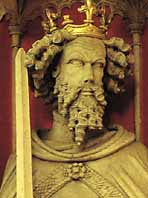 Edward I
Longshanks PLANTAGENET King Of England6,46,78,131,311,343,544
was born on 17 Jun 1239 in Westminster Palace, London, Middlesex, England.133,343,538 He was christened on 21 Jun
1239 in , Westminster, Middlesex, England. He Acceded to the throne
on 19 Aug 1274133,343 He died on 7 Jul 1307 in Burgh-on-the-Sands, Near
Carlisle.343,538,1121 He
was buried on 28 Oct 1307 in Westminster Abbey, Westminster, Middlesex, England.
Edward I
Longshanks PLANTAGENET King Of England6,46,78,131,311,343,544
was born on 17 Jun 1239 in Westminster Palace, London, Middlesex, England.133,343,538 He was christened on 21 Jun
1239 in , Westminster, Middlesex, England. He Acceded to the throne
on 19 Aug 1274133,343 He died on 7 Jul 1307 in Burgh-on-the-Sands, Near
Carlisle.343,538,1121 He
was buried on 28 Oct 1307 in Westminster Abbey, Westminster, Middlesex, England.
Historical Figures Gallery
Bio for Edward I
Edward I was the first King of England to make government accountable to its supporters, and he instituted reforms that created the country's first parliamentary body.
Edward was the oldest son of Henry III and Eleanor of Provence. When he married Eleanor of Castile, his father gave him authority over the administration of Ireland and Wales, as well as Gascony in France. He inherited the throne of England when his father died in 1272.
As a young man, Edward distinguished himself in the military. In an uprising of the nobility sometimes called "The Baron's War," he led the King's army and killed his father's rival, Simon de Montfort. He also played an important part in the eighth crusade.
Edward's monarchy was noteworthy for his efforts to use the rule of law to improve conditions in his country. He believed that the nobles who paid for the government should have a say in how it was run, and he expanded the Great Council until it actually had parliamentary powers. He also created the first Statute of Westminster to deal with administrative abuse, issued the Quo Warranto to protect feudal power, and the Statute of Mortmain to stop the unlicensed donation of land to the Catholic Church.
Much of Edward's reign, however, was spent on unsuccessful efforts to enforce his authority over outlying parts of the kingdom. Unable to negotiate, he had to go to war in order to annex Wales.
His efforts to overcome Scotland were even more complex. Initially, Alexander III cooperated by turning over Scottish lands in England to Edward. However, Edward's efforts to formally link the two countries were undermined when a proposed marriage of the heirs to the two counties in infancy was undone by the death of the Scottish King's daughter.
When the Scottish throne became vacant, Edward was called on to choose a successor. Although Robert Bruce was the popular choice, Edward appointed John Balliol who was prepared to take an oath of loyalty to England.
At this time, Edward was also having difficulty controlling his French territories and was becoming increasingly unpopular at home. To deal with his domestic problems, he called the first assembly of the three estates, which came to be known as the Model Parliament. His difficulties in France were reduced by his second marriage, for which he chose the French King's sister.
This freed him to focus on the further problems that had erupted in Scotland. Edward's first act was to take the stone that was used in Scottish coronations and bring it to England. When the Scotch took up arms, Edward led his troops north and defeated them. Eventually, their leader, William Wallace, was captured and put to death.
In defiance, Robert Bruce took over the leadership of his country and arranged to have himself crowned King Robert I. When Edward marched north to fight Robert, he was brought down by his own old age and ill health. He died near Carlisle in Scotland.
Major Events
1254 - Married Eleanor of Castile.
1265 - Defeated Simon de Montfort.
1270 - Eighth Crusade.
1274 - Crowned King of England.
1275 - First Statute of Westminster.
1282 - Conquest of Wales.
1290 - Death of Eleanor.
1295 - Model Parliament.
1296 - Removed Scottish coronation stone to England. Married Princess Margaret of France.
1298 - British victory at Falkirk.
1305 - Executed William Wallace.
1306 - Crowned Robert Bruce.
Did you know?
Edward's first wife, Eleanor, went with him on the eighth crusade.
Copyright © 1994 Bureau of Electronic Publishing
EDWARD I (r. 1272-1307)
Born in June 1239 at Westminster, Edward was named by his father Henry III after the last Anglo Saxon king (and his father's favourite saint), Edward the Confessor. Edward's parents were renowned for their patronage of the arts (his mother, Eleanor of Provence, encouraged Henry III to spend money on the arts, which included the rebuilding of Westminster Abbey and a still-extant magnificent shrine to house the body of Edward the Confessor), and Edward received a disciplined education - reading and writing in Latin and French, with training in the arts, sciences and music.
In 1254, Edward travelled to Spain for an arranged marriage at the age of 15 to 9-year-old Eleanor of Castile. Just before Edward's marriage, Henry III gave him the duchy of Gascony, one of the few remnants of the once vast French possessions of the English Angevin kings. Gascony was part of a package which included parts of Ireland, the Channel Islands and the King's lands in Wales to provide an income for Edward. Edward then spent a year in Gascony, studying its administration.
Edward spent his young adulthood learning harsh lessons from Henry III's failures as a king, culminating in a civil war in which he fought to defend his father. Henry's ill-judged and expensive intervention in Sicilian affairs (lured by the Pope's offer of the Sicilian crown to Henry's younger son) failed, and aroused the anger of powerful barons including Henry's brother-in-law Simon de Montfort. Bankrupt and threatened with excommunication, Henry was forced to agree to the Provisions of Oxford in 1258, under which his debts were paid in exchange for substantial reforms; a Great Council of 24, partly nominated by the barons, assumed the functions of the King's Council.
Henry repudiated the Provisions in 1261 and sought the help of the French king Louis IX (later known as St Louis for his piety and other qualities). This was the only time Edward was tempted to side with his charismatic and politically ruthless godfather Simon de Montfort - he supported holding a Parliament in his father's absence.
However, by the time Louis IX decided to side with Henry in the dispute and civil war broke out in England in 1263, Edward had returned to his father's side and became de Montfort's greatest enemy. After winning the battle of Lewes in 1264 (after which Edward became a hostage to ensure his father abided by the terms of the peace), de Montfort summoned the Great Parliament in 1265 - this was the first time cities and burghs sent representatives to the parliament. (Historians differ as to whether de Montfort was an enlightened liberal reformer or an unscrupulous opportunist using any means to advance himself.)
In May 1265, Edward escaped from tight supervision whilst hunting. On 4 August, Edward and his allies outmanoeuvred de Montfort in a savage battle at Evesham; de Montfort predicted his own defeat and death 'let us commend our souls to God, because our bodies are theirs ... they are approaching wisely, they learned this from me.' With the ending of the civil war, Edward worked hard at social and political reconciliation between his father and the rebels, and by 1267 the realm had been pacified.
In April 1270 Parliament agreed an unprecedented levy of one-twentieth of every citizen's goods and possessions to finance Edward's Crusade to the Holy Lands. Edward left England in August 1270 to join the highly respected French king Louis IX on Crusade. At a time when popes were using the crusading ideal to further their own political ends in Italy and elsewhere, Edward and King Louis were the last crusaders in the medieval tradition of aiming to recover the Holy Lands. Louis died of the plague in Tunis before Edward's arrival, and the French forces were bought off from pursuing their campaign. Edward decided to continue regardless: 'by the blood of God, though all my fellow soldiers and countrymen desert me, I will enter Acre ... and I will keep my word and my oath to the death'.
Edward arrived in Acre in May 1271 with 1,000 knights; his crusade was to prove an anticlimax. Edward's small force limited him to the relief of Acre and a handful of raids, and divisions amongst the international force of Christian Crusaders led to Edward's compromise truce with the Baibars. In June 1272, Edward survived a murder attempt by an Assassin (an order of Shi'ite Muslims) and left for Sicily later in the year. He was never to return on crusade.
Meanwhile, Henry III died on 16 November 1272. Edward succeeded to the throne without opposition - given his track record in military ability and his proven determination to give peace to the country, enhanced by his magnified exploits on crusade. In Edward's absence, a proclamation in his name delcared that he had succeeded by hereditary right, and the barons swore allegeiance to him. Edward finally arrived in London in August 1274 and was crowned at Westminster Abbey. Aged 35, he was a veteran warrior ('the best lance in all the world', according to contemporaries), a leader with energy and vision, and with a formidable temper.
Edward was determined to enforce English kings' claims to primacy in the British Isles. The first part of his reign was dominated by Wales. At that time, Wales consisted of a number of disunited small Welsh princedoms; the South Welsh princes were in uneasy alliance with the Marcher lords (feudal earldoms and baronies set up by the Norman kings to protect the English border against Welsh raids) against the Northern Welsh based in the rocky wilds of Gwynedd, under the strong leadership of Llywelyn ap Gruffyd, Prince of Gwynedd. In 1247, under the Treaty of Woodstock, Llywelyn had agreed that he held North Wales in fee to the English king. By 1272, Llywelyn had taken advantage of the English civil wars to consolidate his position, and the Peace of Montgomery (1267) had confirmed his title as Prince of Wales and recognised his conquests.
However, Llywelyn maintained that the rights of his principality were 'entirely separate from the rights' of England; he did not attend Edward's coronation and refused to do homage. Finally, in 1277 Edward decided to fight Llywelyn 'as a rebel and disturber of the peace', and quickly defeated him. War broke out again in 1282 when Llywelyn joined his brother David in rebellion. Edward's determination, military experience and skilful use of ships brought from England for deployment along the North Welsh coast, drove Llywelyn back into the mountains of North Wales. The death of Llywelyn in a chance battle in 1282 and the subsequent execution of his brother David effectively ended attempts at Welsh independence.
Under the Statute of Wales of 1284, Wales was brought into the English legal framework and the shire system was extended. In the same year, a son was born in Wales to Edward and Queen Eleanor (also named Edward, this future king was proclaimed the first English Prince of Wales in 1301). The Welsh campaign had produced one of the largest armies ever assembled by an English king - some 15,000 infantry (including 9,000 Welsh and a Gascon contingent); the army was a formidable combination of heavy Anglo-Norman cavalry and Welsh archers, whose longbow skills laid the foundations of later military victories in France such as that at Agincourt. As symbols of his military strength and political authority, Edward spent some £80,000 on a network of castles and lesser strongholds in North Wales, employing a work-force of up to 3, 500 men drawn from all over England. (Some castles, such as Conway and Caernarvon, remain in their ruined layouts today, as examples of fortresses integrated with fortified towns.)
Edward's campaign in Wales was based on his determination to ensure peace and extend royal authority, and it had broad support in England. Edward saw the need to widen support among lesser landowners and the merchants and traders of the towns. The campaigns in Wales, France and Scotland left Edward deeply in debt, and the taxation required to meet those debts meant enrolling national support for his policies.
To raise money, Edward summoned Parliament - up to 1286 he summoned Parliaments twice a year. (The word 'Parliament' came from the 'parley' or talks which the King had with larger groups of advisers.) In 1295, when money was needed to wage war against Philip of France (who had confiscated the duchy of Gascony), Edward summoned the most comprehensive assembly ever summoned in England. This became known as the Model Parliament, for it represented various estates: barons, clergy, and knights and townspeople. By the end of Edward's reign, Parliament usually contained representatives of all these estates.
Edward used his royal authority to establish the rights of the Crown at the expense of traditional feudal privileges, to promote the uniform administration of justice, to raise income to meet the costs of war and government, and to codify the legal system. In doing so, his methods emphasised the role of Parliament and the common law. With the able help of his Chancellor, Robert Burnell, Bishop of Bath and Wells, Edward introduced much new legislation. He began by commissioning a thorough survey of local government (with the results entered into documents known as the Hundred Rolls), which not only defined royal rights and possessions but also revealed administrative abuses.
The First Statute of Westminster (1275) codified 51 existing laws - many originating from Magna Carta - covering areas ranging from extortion by royal officers, lawyers and bailiffs, methods of procedure in civil and criminal cases to freedom of elections. Edward's first Parliament also enacted legislation on wool, England's most important export at the time. At the request of the merchants, Edward was given a customs grant on wool and hides which amounted to nearly £10,000 a year. Edward also obtained income from the licence fees imposed by the Statute of Mortmain (1279), under which gifts of land to the Church (often made to evade death duties) had to have a royal licence.
The Statutes of Gloucester (1278) and Quo Warranto (1290) attempted to define and regulate feudal jurisdictions, which were an obstacle to royal authority and to a uniform system of justice for all; the Statute of Winchester (1285) codified the policing system for preserving public order. Other statutes had a long-term effect on land law and on the feudal framework in England. The Second Statute of Westminster (1285) restricted the alienation of land and kept entailed estates within families: tenants were only tenants for life and not able to sell the property to others. The Third Statute of Westminster or Quia Emptores (1290) stopped subinfeudation (in which tenants of land belonging to the King or to barons subcontracted their properties and related feudal services).
Edward's assertion that the King of Scotland owed feudal allegiance to him, and the embittered Anglo-Scottish relations leading to war which followed, were to overshadow the rest of Edward's reign in what was to become known as the 'Great Cause'. Under a treaty of 1174, William the Lion of Scotland had become the vassal to Henry II, but in 1189 Richard I had absolved William from his allegiance. Intermarriage between the English and Scottish royal houses promoted peace between the two countries until the premature death of Alexander III in 1286. In 1290, his granddaughter and heiress, Margaret the 'Maid of Norway' (daughter of the King of Norway, she was pledged to be married to Edward's then only surviving son, Edward of Caernarvon), also died. For Edward, this dynastic blow was made worse by the death in the same year of his much-loved wife Eleanor (her body was ceremonially carried from Lincoln to Westminster for burial, and a memorial cross erected at every one of the twelve resting places, including what became known as Charing Cross in London).
In the absence of an obvious heir to the Scottish throne, the disunited Scottish magnates invited Edward to determine the dispute. In order to gain acceptance of his authority in reaching a verdict, Edward sought and obtained recognition from the rival claimants that he had the 'sovereign lordship of Scotland and the right to determine our several pretensions'. In November 1292, Edward and his 104 assessors gave the whole kingdom to John Balliol or Baliol as the claimant closest to the royal line; Balliol duly swore loyalty to Edward and was crowned at Scone.
John Balliol's position proved difficult. Edward insisted that Scotland was not independent and he, as sovereign lord, had the right to hear in England appeals against Balliol's judgements in Scotland. In 1294, Balliol lost authority amongst Scottish magnates by going to Westminster after receiving a summons from Edward; the magnates decided to seek allies in France and concluded the 'Auld Alliance' with France (then at war with England over the duchy of Gascony) - an alliance which was to influence Scottish history for the next 300 years. In March 1296, having failed to negotiate a settlement, the English led by Edward sacked the city of Berwick near the River Tweed. Balliol formally renounced his homage to Edward in April 1296, speaking of 'grievous and intolerable injuries ... for instance by summoning us outside our realm ... as your own whim dictated ... and so ... we renounce the fealty and homage which we have done to you'. Pausing to design and start the rebuilding of Berwick as the financial capital of the country, Edward's forces overran remaining Scottish resistance. Scots leaders were taken hostage, and Edinburgh Castle, amongst others, was seized. Balliol surrendered his realm and spent the rest of his life in exile in England and Normandy.
Having humiliated Balliol, Edward's insensitive policies in Scotland continued: he appointed a trio of Englishmen to run the country. Edward had the Stone of Scone - also known as the Stone of Destiny - on which Scottish sovereigns had been crowned removed to London and subsequently placed in the Coronation Chair in Westminster Abbey (where it remained until it was returned to Scotland in 1996). Edward never built stone castles on strategic sites in Scotland, as he had done so successfully in Wales - possibly because he did not have the funds for another ambitious castle-building programme.
By 1297, Edward was facing the biggest crisis in his reign, and his commitments outweighed his resources. Chronic debts were being incurred by wars against France, in Flanders, Gascony and Wales as well as Scotland; the clergy were refusing to pay their share of the costs, with the Archbishop of Canterbury threatening excommunication; Parliament was reluctant to contribute to Edward's expensive and unsuccessful military policies; the Earls of Hereford and Norfolk refused to serve in Gascony, and the barons presented a formal statement of their grievances. In the end, Edward was forced to reconfirm the Charters (including Magna Carta) to obtain the money he required; the Archbishop was eventually suspended in 1306 by the new Gascon Pope Clement V; a truce was declared with France in 1297, followed by a peace treaty in 1303 under which the French king restored the duchy of Gascony to Edward.
In Scotland, Edward pursued a series of campaigns from 1298 onwards. William Wallace had risen in Balliol's name and recovered most of Scotland, before being defeated by Edward at the battle of Falkirk in 1298. (Wallace escaped, only to be captured in 1305, allegedly by the treachery of a fellow Scot and taken to London, where he was executed.) In 1304, Edward summoned a full Parliament (which elected Scottish representatives also attended), in which arrangements for the settlement of Scotland were made. The new government in Scotland featured a Council, which included Robert the Bruce. Bruce unexpectedly rebelled in 1306 by killing a fellow counsellor and was crowned king of Scotland at Scone. Despite his failing health, Edward was carried north to pursue another campaign, but he died en route at Burgh on Sands on 7 July 1307 aged 68.
According to chroniclers, Edward requested that his bones should be carried on Scottish campaigns and that his heart be taken to the Holy Land. However, Edward was buried at Westminster Abbey in a plain black marble tomb, which in later years was painted with the words Scottorum malleus (Hammer of the Scots) and Pactum serva (Keep troth). Throughout the fourteenth and fifteenth centuries, the Exchequer paid to keep candles burning 'round the body of the Lord Edward, formerly King of England, of famous memory'. Parents: Henry III PLANTAGENET King of England and Elbeonore (Lbeonor) Countess of PROVENCE.
Spouse: Margaret of FRANCE. Children were: Thomas of Brotherton PLANTAGENET Earl of Norfolk.
Spouse: Leonor Princess of CASTILE AND LEÓN. Edward I Longshanks PLANTAGENET King Of England and Leonor Princess of CASTILE AND LEÓN were married on 18 Oct 1254 in Abbey of Las Huelgas, Burgos, Castile, Spain.342,343 Children were: Eleanor Princess of ENGLAND, Joan Princess of ENGLAND, John Prince of ENGLAND, Henry Prince of ENGLAND, Juliana Or Katherine Princess of ENGLAND, Joan de Acre PLANTAGENET, Alphonso Prince of ENGLAND, Isabel Princess of ENGLAND, Margaret Princess of ENGLAND, Berengaria Princess of ENGLAND, Mary Princess of ENGLAND, Alice Princess of ENGLAND, Elizabeth Princess of ENGLAND, Edward II King of ENGLAND, Beatrice Princess of ENGLAND, Blanche Princess of ENGLAND.
Emma PLANTAGENET Princess of Wales6,46,766 was born about 1138 in of, , Normandie, France. EMME, married in summer 1174 DAFYDD AB OWAINxe “Anjou, Emme of & Daffydd ab Owain”xe “ ab Owain, Daffydd & Emme of Anjou”, Prince (or King) of North Walesxe “North Wales”xe “ Wales”, younger son of Owain Gwyneddxe “Gwynedd”, by Christina, daughter of Gronw ab Owain ab Edwinxe “ab Owain, Gronw”. They had two sons, Owain and Einion, and two daughters, Gwenhwyfar (or Wennour) (wife of Meurig ap Roger Powysxe “Roger Powys”xe “ Powys”) and Gwenllian (wife of Gruffudd ap Cadwgonxe “ap Cadwgon, Gruffudd”). In 1157 he took part in the ambush of Hawarden Woods. In 1170 he and his brother, Rhodri, attacked and killed their half-brother, Hywel ab Owainxe “ab Owain, Hywel”, in a battle near Pentraeth. In 1173 he attacked another half-brother, Maelgwn ab Owainxe “ab Owain, Maelgwn”, and drove him from Anglesey. In 1174 he ejected all his rivals, whereby he became ruler of the whole of Gwynedd. In 1175 he was attacked by his brother, Rhodri, and driven into the eastern half of Gweynedd. In 1177 King Henry II bestowed the manors of Ellesmere, Shropshire and Halesowen, Worcestershire on his sister, Emme. Dafydd subsequently settled in the Middle Country, where he resided in a castle at Rhuddlan, Caernarvonshire. In 1193 she restored the manor of Halesowen, Worcestershire to her nephew, King Richard I, in exchange for rents of other manors including Broom and Clent, Worcestershire. In 1194 Dafydd was defeated by his nephew, Llywelyn ap Iorwerthxe “ap Iorwerth, Llywelyn” [see WALES 4], in a battle at Aberconwy, and, in 1197, was imprisoned by Llywelyn. He was released in 1198 by the intervention of Hubert Walterxe “Walter, Hubert”, Archbishop of Canterbury, and spent the rest of his life in England. DAFYDD AB OWAIN, Prince (or King) of North Walesxe “ Wales”, died about May 1203, having won the esteem of both nations by “maintaining a just balance between Welsh and English.” His widow, Emme, was living in 1212, and presumably died c.1214, when her name last appears in the Pipe Rolls. Parents: Geoffrey V "le Bon" PLANTAGENET Count d'Anjou and Concubine PLANTAGENT.
Fulk V PLANTAGENET King of Jerusalem46,121,135,995 was born in 1092 in of, , Anjou, France.135,766 He died on 10 Nov 1143 in , , Jerusalem, Israel. He was buried in Church of Holy Sepulchre, Jerusalem, Israel.
Spouse: Ermengarde (Ermentrude) Du MAINE. Fulk V PLANTAGENET King of Jerusalem and Ermengarde (Ermentrude) Du MAINE were married on 11 Jul 1110 in , , , France.135 Children were: Elias D' ANJOU, Geoffrey V "le Bon" PLANTAGENET Count d'Anjou, Sibilla D' ANJOU, Mathilde D' ANJOU.
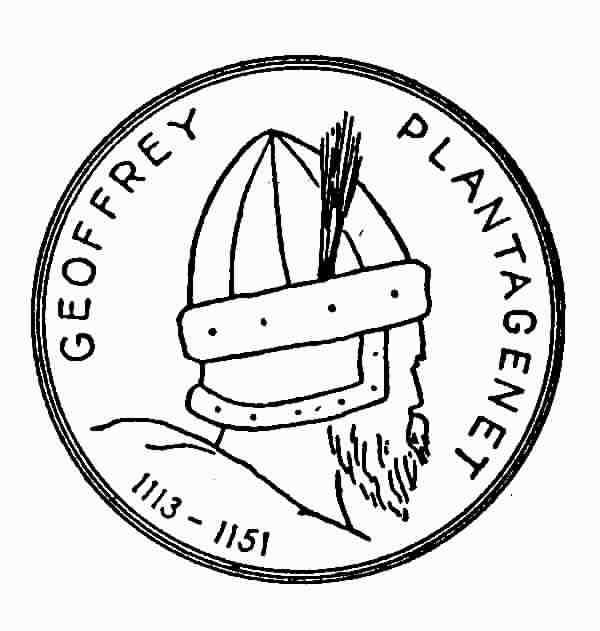 Geoffrey
V "le Bon" PLANTAGENET Count d'Anjou46,131,543,544,994,1122 was born on 24 Aug 1113 in
, , Anjou, France.132,766 He died on 7 Sep 1150 in Château-du-Loir, France.547,766
Geoffrey
V "le Bon" PLANTAGENET Count d'Anjou46,131,543,544,994,1122 was born on 24 Aug 1113 in
, , Anjou, France.132,766 He died on 7 Sep 1150 in Château-du-Loir, France.547,766
From Magna Charta / Wurtz FHL British 942 D2wj Pt. 1-2
537. MATILDA of England, called also Maud, born in 1102, died 30 January 1164. In 1114 she became the wife of Henry V, Emperor of Germany, who died without issue 23 May 1125. Her second husband, to whom she was married 3 April 1127, was No. 69 Geoffrey, surnamed Plantagenet, Count d'Anjou, born 1113, died 1151. The friends of Geoffrey were unaware that their playful nickname for him of Plantagenet would live through the years. The story is told that while disguised in battle, and to make himself known to his followers, he leaned from his horse and grasped a sprig of ‘plante de genet, the common broom corn which grew thickly on the heath, and thrust it in his helmet. Thus he derived his popular title.
A noble person was Geoffrey, one of the most powerful princes of France, with "elegant and courtly manners and a reputation for gallantry in the field." His alliance with England came about in consequence of the great tragedy of the sinking of the famous White Ship. When it struck the hidden rocks off the coast of France, young William, Duke of Normandy, the heir apparent to the English throne, and three hundred others, were drowned in the freezing November waters, the Butcher of Rouen alone being saved.
King Henry I of England, in despair over the loss of his only son, sought the aid of Geoffrey Plantagenet and personally invested him with the order of Knighthood. Approving the marriage of his daughter Matilda with Geoffrey, King Henry expressed the hope that all Englishmen would give them full allegiance. The Barons took the oath to uphold the succession of Matilda and Geoffrey and their children after them. When, therefore, the sons Henry, Geoffrey and William were born, their grandfather thought the succession to the throne secure. However, "King Henry was no sooner dead than all the plans he had labored at so long crumbled away like a hollow heap of sand." Yet eventually, on 19 December 1154, Geoffrey's eldest son was crowned as King Henry II. and thus Geoffrey heads the line of English Kings which bear his Plantagenet name.
As eldest son of Fulk V. King of Jerusalem, and his wife, Ermengarde, daughter of Helias, Count of Maine, Geoffrey was of the House of Angevin Kings which had been prominent for three centuries. His noble character adds prestige to this illustrious background and merits the recognition given it by the formation of The Plantagenet Society, early instituted to commemorate these important historic events.
Parents: Fulk V PLANTAGENET King of Jerusalem and Ermengarde (Ermentrude) Du MAINE.
Spouse: Concubine PLANTAGENT. Geoffrey V "le Bon" PLANTAGENET Count d'Anjou and Concubine PLANTAGENT were married. Children were: Hamelin PLANTAGENET 5th Earl of Surrey, Emma PLANTAGENET Princess of Wales, Mary PLANTAGENET.
Spouse: Matilda (Maud) Empress of GERMANY Lady of the English. Geoffrey V "le Bon" PLANTAGENET Count d'Anjou and Matilda (Maud) Empress of GERMANY Lady of the English were married on 3 Apr 1127 in Le Mans Cathedral, Anjou, France.547,550 Children were: Agnes PLANTAGENET, Henry II PLANTAGENET King of England, Geoffrey VI "Mantell" PLANTAGENET Count of Nantes, Guillaume PLANTAGENET Count of Poitou.
Geoffrey VI "Mantell" PLANTAGENET Count of Nantes6,46 was born on 3 Jun 1134 in , Rouen, Seine-Maritime, France. He died on 27 Jul 1157 in , Nantes, Loire-Atlantique, France. He was buried in , Nantes, Loire-Atlantique, France. GEOFFREY, Knt., Count of Anjou and Nantes, held the castles of Chinon (Indre-et-Loire), Loudon (Vienne), and Mirebeau (Vienne) in France as his appanage, 2nd son, born at Rouen, Normandy about 1 June 1134. He died without issue 26 July 1158. Parents: Geoffrey V "le Bon" PLANTAGENET Count d'Anjou and Matilda (Maud) Empress of GERMANY Lady of the English.
Guillaume PLANTAGENET Count of Poitou46 was born on 21 Jul 1136 in , Argentan, Orne, France. He died on 30 Jan 1163/64 in , Rouen, Seine-Maritime, France. He was buried in Notre Dame, Rouen, Seine-Maritime, Normandy, France. WILLIAM LONGESPÉE (otherwise WILLIAM FITZ EMPRESS), Vicomte of Dieppexe “Dieppe”, of Throwley, Kent, North Luffenham, Rutland, and Acton and Oulton, Suffolk, 3rd son, born at Argentan 21 July 1136. In the period, 1159-63, he sought to marry Isabel de Warennexe “Warenne, Isabel de”, Countess of Surreyxe “Surrey” [see WARENNE 2], widow of his cousin, William, Count of Boulognexe “Boulogne, William, Count of” and Mortainxe “Mortain” (son of King Stephen of Englandxe “England”). The marriage was opposed by Archbishop Becket XE “Becket” on grounds of affinity (he and her former husband being related in the 3rd degree of kindred). WILLIAM LONGESPÉExe “Longespée” died at Rouen, Normandy 30 Jan. 1163/4, and was buried there in the Cathedral. Parents: Geoffrey V "le Bon" PLANTAGENET Count d'Anjou and Matilda (Maud) Empress of GERMANY Lady of the English.
 Hamelin PLANTAGENET
5th Earl of Surrey1123
was born in 1130 in Normandy, France. He died on 7 May 1202 in ,
, , England.1123,1124
Hamelin PLANTAGENET
5th Earl of Surrey1123
was born in 1130 in Normandy, France. He died on 7 May 1202 in ,
, , England.1123,1124
Hamelin - seems to have spent more time at his Yorkshire castle than any of the previous earls; he held the earldom for close on forty years, from 1163 until his death in 1202. It was this period that saw the construction of the great stone keep of the castle and its development as a place suitable for royalty - King John, nephew of Hamelin, did actually stay here in 1201. The cylindrical keep probably dates from around 1180, Hamelin seems to have ordered its construction to his own design, there being no other example of this type of keep anywhere in the country. Parents: Geoffrey V "le Bon" PLANTAGENET Count d'Anjou and Concubine PLANTAGENT.
Spouse: Isabel de WARENNE Countess of Surrey. Hamelin PLANTAGENET 5th Earl of Surrey and Isabel de WARENNE Countess of Surrey were married in Apr 1164 in , , E. Surrey, England. Children were: Maud de WARENNE, Ida (Bigod) PLANTAGENET Countess of Norfolk.
 Henry II
PLANTAGENET King of England46,130,131,543,544,983 was born on 5 Mar 1133 in Le
Mans, Anjou, France.132,133,134,135 He was Crowned on 19 Dec 1154 at Westminster Abbey,
London, England133,134 He died on 6 Jul 1189 in Chinon Castle, France.134,135
He was buried on 8 Jul 1189 in Fontevrault Abbey, Fontevrault, Maine-Et-Loire,
France.
Henry II
PLANTAGENET King of England46,130,131,543,544,983 was born on 5 Mar 1133 in Le
Mans, Anjou, France.132,133,134,135 He was Crowned on 19 Dec 1154 at Westminster Abbey,
London, England133,134 He died on 6 Jul 1189 in Chinon Castle, France.134,135
He was buried on 8 Jul 1189 in Fontevrault Abbey, Fontevrault, Maine-Et-Loire,
France.
Henry II, King of England, was born at Le Mans, Normandy in 1133. As the son of Count Geoffrey Plantagenet of Anjou and Matilda, daughter of King Henry I, Henry became Duke of Normandy in 1150, and after his father's death in 1151, was named Count of Anjou.
In 1152 he married Eleanor of Aquitaine, thereby acquiring the Duchy of Aquitaine. When Henry became King of England, after Stephen's death in 1154, he reigned over one of the most extensive realms in western Europe.
Henry II's first objective as King was to regain the royal powers of his grandfather King Henry I. He did this by reclaiming royal lands and castles, by recovering northern English counties from the Scots, and by revamping the systems of finance, administration, and justice.
His early success, however, did not aid Henry in his attempts to re-establish the acceptance of the Church customs of his grandfather's time. Henry met with strong opposition from Thomas a Becket, Archbishop of Canterbury, who resisted Henry's wishes for regal authority in punishing convicted clergy of crimes. Becket felt that this power should be reserved for the Church courts, not the throne. In turn, Henry exiled Becket, and in 1170, Becket was murdered by four of Henry's knights who hoped that the killing would please Henry. On the contrary, Becket's death left Henry with a feeling of great distress, and he prudently escaped to Ireland while matters settled down. In 1171, while on temporary leave, he was accepted as Lord of Ireland.
King Henry II reconciled with the Church in 1172, but other problems were on the horizon. In 1173 family matters boiled to the point of rebellion. After years of being constantly unfaithful to his wife, Eleanor, and of denying his sons the power their titles should have secured, Henry was plotted against by his family who allied themselves with King Louis VII of France, the Count of Flanders, King William of Scotland, and other dissatisfied nobles. Henry, being sufficiently warned and protected by loyal, capable officers, managed to defeat the rebels and to capture his wife in 1174.
During his later years, Henry II was successful in making constructive changes in England. His greatest achievements include drawing up laws and organizing the courts to administer them properly and professionalizing the entire administration in general to allow his country more justice than it had ever known.
Despite Henry's great accomplishments, the quarrels and jealousies of his sons persisted. In 1189 Henry was forced to make humiliating peace, and, broken by the attacks of his sons, he died two days later on July 6, 1189 at Chinon, France.
Major Events
1150 - Named Duke of Normandy.
1151 - Named Count of Anjou.
1152 - Married Eleanor of Aquitaine.
1170 - Murder of Archbishop of Canterbury; Henry left for Ireland.
1171 - Became Lord of Ireland.
1172 - Reconciled with the Church.
1173 - Family rebeled against him.
1174 - Defeated the rebels.
1189 - Family humiliated Henry; he died.
Did you know?
King Henry II's reconstruction of the justice system in England led to great progress in his time. By using the Roman legal concept of a distinction between the possession of property and the absolute right to property, Henry made it possible for those who had been physically dispossessed of their land to get a fair trial in court, instead of having to duel for the land.
Copyright © 1994 Bureau of Electronic Publishing
HENRY II CURTMANTLE (r. 1154-1189)
Henry II ruled over an empire which stretched from the Scottish border to the Pyrenees. One of the strongest, most energetic and imaginative rulers, Henry was the inheritor of three dynasties who had acquired Aquitaine by marriage; his charters listed them: 'King of the English, Duke of the Normans and Aquitanians and Count of the Angevins'. The King spent only 13 years of his reign in England; the other 21 years were spent on the continent in his territories in what is now France. Henry's rapid movements in carrying out his dynastic responsibilities astonished the French king, who noted 'now in England, now in Normandy, he must fly rather than travel by horse or ship'.
By 1158, Henry had restored to the Crown some of the lands and royal power lost by Stephen; Malcom IV of Scotland was compelled to return the northern counties. Locally chosen sheriffs were changed into royally appointed agents charged with enforcing the law and collecting taxes in the counties. Personally interested in government and law, Henry made use of juries and re-introduced the sending of justices (judges) on regular tours of the country to try cases for the Crown. His legal reforms have led him to be seen as the founder of English Common Law.
Henry's disagreements with the Archbishop of Canterbury (the king's former chief adviser), Thomas à Becket, over Church-State relations ended in Becket's murder in 1170 and a papal interdict on England. Family disputes over territorial ambitions almost wrecked the king's achievements. Henry died in France in 1189, at war with his son Richard, who had joined forces with King Philip of France to attack Normandy. Parents: Geoffrey V "le Bon" PLANTAGENET Count d'Anjou and Matilda (Maud) Empress of GERMANY Lady of the English.
Spouse: Ida (Bigod) PLANTAGENET Countess of Norfolk. Children were: William LONGESPEE Earl of Salisbury.
Spouse: Elbeonore Princess of AQUITAINE. Henry II PLANTAGENET King of England and Elbeonore Princess of AQUITAINE were married on 18 May 1151 in Bordeaux Cathedral, Bordeaux, France.132,133,134,135 Children were: William Prince of ENGLAND, Henry Prince of ENGLAND, Matilda Princess of ENGLAND, Richard "Cæur de Lion" King of ENGLAND, Geoffrey Prince of ENGLAND, Philip Prince of ENGLAND, Eleanor Princess of ENGLAND, Joanna Princess of ENGLAND, John Lackland PLANTAGENET King of England.
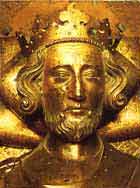 Henry III
PLANTAGENET King of England6,46,131,140,544,1125 was born on 1 Oct 1207 in
Winchester Castle, Hampshire, England.132,133,538
He was Crowned on 28 Oct 1216 at Gloucester Cathedral1126 He died on 15 Jun 1272 in Westminster Abbey, London,
England.132 He was buried
on 20 Nov 1272 in Westminster Abbey, Westminster, Middlesex, England.
Henry III
PLANTAGENET King of England6,46,131,140,544,1125 was born on 1 Oct 1207 in
Winchester Castle, Hampshire, England.132,133,538
He was Crowned on 28 Oct 1216 at Gloucester Cathedral1126 He died on 15 Jun 1272 in Westminster Abbey, London,
England.132 He was buried
on 20 Nov 1272 in Westminster Abbey, Westminster, Middlesex, England.
The reign of Henry III, King of England from 1216 to 1272, featured the rise of English nationalism and the development of a strong baronial claim in governmental participation. Henry was born in Winchester on October 1, 1207, the eldest son of King John and Isabella of Angouleme. When his father died in 1216, Henry inherited the throne and was entrusted to William Marshal, Earl of Pembroke, who promptly knighted the young sovereign.
At the time of Henry III's reign, a large portion of southwest England and other areas belonged to the French Prince, Louis (later Louis VIII) who justified his claim through his wife Blanche of Castile. Unfortunately for Henry, Louis had many English Barons on his side. To remedy the situation, Pembroke set up a sharing power with the Papal Legate and Peter des Roches, Bishop of Winchester, who was also the King's tutor. They brought the civil war to an end in November of 1216 and revised the Magna Carta Charter which Henry's father had signed and which specifically outlined the duties and privileges of the Barons and King, breaking up the original division.
Henry III was formally crowned in 1220, though he was given limited power until 1223 when the Charter was confirmed. As King, he repeatedly tried to recover lands in France, and though his army was decisively defeated in 1242, Henry continued intermittent war with France for the next seventeen years.
In 1255, King Henry III accepted the crown of Sicily, which would have been a costly venture. The Barons forced its abandonment. By 1264, discontent among the Barons and the people soared, and they captured Henry along with his eldest son Edward. In 1265, Edward escaped and managed to defeat his enemies. Edward then became the practicing ruler of England until Henry III's death on November 16, 1272. Despite Henry's evident failings, the reformers themselves failed to overthrow his principle that the King had the right to choose his own ministers and advisors.
Major Events
1216 - Became unofficial King of England; civil war ended.
1220 - Officially coronated.
1223 - Magna Carta reinstated.
1242 - Defeated by the French.
1255 - Accepted the crown of Sicily.
1264 - Captured by rebels and reformers.
1265 - Edward became the real ruler of England.
1272 - Death of Henry III.
Did you know?
Although Henry III was viewed as a weak and extravagant king whose reign was saved by smarter men than himself, his devotion to architecture and the arts suggests more intellect, though of a nonpolitical variety, than his opponents usually credit him with having.
Copyright © 1994 Bureau of Electronic Publishing
HENRY III (r. 1216-1272)
Henry III, King John's son, was only nine when he became King. By 1227, when he assumed power from his regent, order had been restored, based on his acceptance of Magna Carta. However, the King's failed campaigns in France (1230 and 1242), his choice of friends and advisers, together with the cost of his scheme to make one of his younger sons King of Sicily and help the Pope against the Holy Roman Emperor, led to further disputes with the barons and united opposition in Church and State. Although Henry was extravagant and his tax demands were resented, the King's accounts show a list of many charitable donations and payments for building works (including the rebuilding of Westminster Abbey which began in 1245).
The Provisions of Oxford (1258) and the Provisions of Westminster (1259) were attempts by the nobles to define common law in the spirit of Magna Carta, control appointments and set up an aristocratic council. Henry tried to defeat them by obtaining papal absolution from his oaths, and enlisting King Louis XI's help. Henry renounced the Provisions in 1262 and war broke out. The barons, under their leader, Simon de Montfort, were initially successful and even captured Henry. However, Henry escaped, joined forces with the lords of the Marches (on the Welsh border), and Henry finally defeated and killed de Montfort at the Battle of Evesham in 1265. Royal authority was restored by the Statute of Marlborough (1267), in which the King also promised to uphold Magna Carta and some of the Provisions of Westminster. Parents: John Lackland PLANTAGENET King of England and Queen Isabella de Angoulême TAILLEFER.
Spouse: Elbeonore (Lbeonor) Countess of PROVENCE. Henry III PLANTAGENET King of England and Elbeonore (Lbeonor) Countess of PROVENCE were married on 14 Jan 1236 in Canterbury Cathedral, Canterbury, Kent, England.142,538,1126,1127 Children were: Edward I Longshanks PLANTAGENET King Of England, Margaret Queen of SCOTLAND, Beatrice Princess of ENGLAND, Edmund "Crouchback" Prince of ENGLAND, Richard Prince of ENGLAND, John Prince of ENGLAND, Catherine Princess of ENGLAND, William Prince of ENGLAND, Henry Prince of ENGLAND.
Ida (Bigod) PLANTAGENET Countess of Norfolk107,215,986 was born about 1154 in , Norfolk, Norfolk, England.
Was wife of Roger Bigod at the time she conceived William with King Henry II.
An Assessment of a Crux in Medieval English Genealogy
By Paul C. Reed, FASG
One of the most intriguing and elusive problems in medieval English genealogy is the identity of the mother of William Longespée, favored bastard of Henry II, who was made Earl of Salisbury. It was not until 1611, in Speed's History of Great Britain, that the claim that William Longespée was Henry's son by the fair Rosaniond de Clifford was first published, and since proliferated. No medieval chronicle makes this claim.
The author of the article on Rosamond that appeared in the Dictionary of National Biography [DNB] was able to conclude that she could not have been mother of William Longespée, but documentary evidence of the correct identity of his mother did not surface until publication of the Bradenstoke Cartulary. In two miscellaneous charters granting unimportant lands to the priory, William refers to his mother as “Countess Ida.” These gifts were not part of a foundation charter, but two obscure donations for which there would have been no apparent motive to forge or falsify.
In these two charters William Longespée, Earl of Salisbury, refers to his mother as Comitissa Ida, mater mea and Ida comitissa, mater mea. These entries occur in two different manuscripts and in different topographical sections and seem unlikely to be the result of scribal error. Slight confirmation can be found in the fact that one of William's daughters was christened Ida....
If we cannot determine who Countess Ida was, can we determine where she was when Henry had his way with her? If William was born in January or February 1170, he would have been conceived in the spring of 1169. Henry II left England from Southampton in March 1166 and remained on the continent in France until he returned on 3 March 1170 (landing at Portsmouth, but departing England again on 24 June).”8 Whoever “Countess Ida” was, it is clear that she must have been in France-not England-when William was conceived.
At this point, though a thorough examination has been made of English candidates, the identity of Countess Ida, mother of William Longespee, remains elusive Given the Toeni ties in Normandy, it is still possible that Ida of Hainault may have had a daughter named Ida who was in Normandy in 1169, but it must be emphasized that this is just a theory at this point.”9 A careful examination of continental women named Ida would seem the next course in research.
Note: After this issue went to press, Raymond Phair posted evidence on GEN-MEDIEVAL--L/ soc.genealogy.medieval that William Longespée's mother was indeed the wife of Roger Bigod, Earl of Norfolk.
The above excerpts are from: TAG Vol. 77, pg. 137, 149 .
Below is a copy of the posted evidence on GEN-MEDIEVAL.
CNIDR <http://www.cnidr.org/> Isearch-cgi 1.20.06 (File: 767)
=========================================================================
Date: Wed, 3 Jul 2002 17:06:16 +0000
From: "R Phair" <rwphair@myfastmail.com> <mailto:rwphair@myfastmail.com>
To: GEN-MEDIEVAL-L@rootsweb.com
Message-Id: <20020703170617.C494B6DBC6@www.fastmail.fm>
Subject: Countess Ida, Bigod, Longespee
Content-Disposition: inline
Content-Transfer-Encoding: 8bit
Content-Type: text/plain; charset="ISO-8859-1"
After he was created an earl, William Longespee issued two charters for Bradenstoke priory, Wiltshire, in which countess Ida was described as his mother; as the editor observed, this offers a reason why he named one of his daughters Ida [1].
While there were several countesses named Ida in 12th c. France, the only one known occurring in England at this time was the wife of Roger Bigod, earl of Norfolk, leading to the guess that she was William's mother [2].
As it turns out there is evidence that Ida countess of Norfolk was William's mother. Among the prisoners captured at the battle of Bouvines, Flanders, in 1214 was Ralph Bigod, described as a brother of William (Longespee) earl of Salisbury [3].
Two Ralph Bigods have been found in the records, but the older one was already an adult by 1156-62 and thus unlikely to have fought in a battle over 50 years later [4]. The other Ralph was a younger son of Roger Bigod, earl of Norfolk, whom the editors identify as still living in 1219 [5, 6]. This later Ralph seems very likely to have been the half-brother of earl William.
The French compilers of the prisoners list would probably have had a greater interest in his connection to William earl of Salisbury, one of the commanders in the battle, than to his father who is not known to have participated [7].
It may turn out to be only coincidence, but another Bradenstoke charter of earl William, dated by London as 1198x1199, was witnessed by, among others, Hugh Bigod and William Bigod [1]. These happen to be the names of both earl Roger Bigod's half-brothers and two of his sons. Both of the half-brothers were living at this time; Hugh was the older one [8]. It is not clear if both sons would have been old enough to witness a charter of their half-brother, nor is it certain that earl Roger's son William was still alive. London did not attempt to identify the witnesses.
[1] "The cartulary of Bradenstoke priory", ed. V.C.M. London, 1979, pp.8-9, nos.481, 645, 646.
[2] G.B. Roberts, "The royal descents of 500 immigrants", 1993, pp.vi, 348-364, credits Douglas Richardson with the identification of countess Ida as the wife of earl Roger Bigod, although no proof was provided. The subject of earl William's mother has generated numerous postings. See the archives.
[3] "Les registres de Philippe Augustus", ed. J.W. Baldwin, 1992, miscellanea no.13.
[4] "Recueil des actes de Henri II", ed. L. Delisle & E. Berger, 1:no. 4 (1); see also no.75 (spurious).
[5] "Complete Peerage", 9:586-7n, 589n (1936, repr. 1982), ed. G.H. White & E. Stokes; "Rotuli litterarum clausarum", ed. T.D. Hardy, 5:1 (1). This might refer to his ransom after his capture at Bouvines.
[6] The name Ralph seems to have made its first appearance in the Bigod family with Roger and Ida's son, perhaps introduced from Ida's family. No link has been found, so far, between the older Ralph Bigod and the comital family.
[7] Rolls series no.57, 7v, 1872-83, ed. H.R. Luard, 2:578-9. Cf. J. Bradbury, "Philip Auguste: king of France 1180-1223", 1998, chapter 10; W.L. Warren, "King John", 1978, pp.223-4; G. Duby, "The legend
of Bouvines", transl. C. Tihanyi, 1990. Duby confused earl William Longespee with his father-in-law.
[8] Earl William Longespee witnessed many charters of king John; one of these was a confirmation of the marriage of William Bigod, earl Roger's half-brother [Pipe Roll Society 55:no.234 (1939)].
Ray Phair
Copyright 2002 by R. W. Phair
______________________________
------------------------------ Parents: Hamelin PLANTAGENET 5th Earl of Surrey and Isabel de WARENNE Countess of Surrey.
Spouse: Henry II PLANTAGENET King of England. Children were: William LONGESPEE Earl of Salisbury.
 Joan PLANTAGENET
Princess of Wales6,1125,1128 was
born before 1200.425,1128 She legitimatized by Pope Honorus III in Apr 1226.424 She died on 30 May 1236 in
Court of Aber, Gwynedd, Wales.424,425,427
Joan PLANTAGENET
Princess of Wales6,1125,1128 was
born before 1200.425,1128 She legitimatized by Pope Honorus III in Apr 1226.424 She died on 30 May 1236 in
Court of Aber, Gwynedd, Wales.424,425,427
JOAN, PRINCESS OF WALES, DAUGHTER OP KING JOHN:
ANCESTRESS TO BULKELEY, JAMES, MELLOWES, WELBY,
WITTINGHAM, HAUGH, AND ST.JOHN WHITING FAMILIES
By Walter Lee Sheppard, Jr., M.S., Havertown, Penna.
In the Bulkeley Genealogy (pages 2-12) Mr. Donald Lines Jacobus included a painstaking study of the English ancestry of the Rev. Peter Bulkeley and his sisters, several of whom had American descendants. This included a descent from William Longespee, Earl of Salisbury, illegitimate son of Henry II, through the Oharlton family. This descent, brought down through Ingoldsby and James to the Harris family of South Jersey, the present writer put in chart form in the Vineland Historical Magazine, vol. 35, facing p. 88. Subsequent1y the Rev. Frederick Lewis Weia printed this descent in tabular form in his Ancestral Roots of Sixty New England Colonists, line31 (pp. 46-47 of second Edtion, 1951).
Unfortunately, Dr. Weis, in his Additions and Corrections (1956), pp. 2-3, states that in this pedigree the wife of William Mainwaring of Ightfield (who was a Warenne) was a descendant of William de Warenne, Earl of Surrey, son of Hameline Plantagenet, and cites Watson's Memoirs of the Earls of Warenne and Surrey as authority. The Watson book is based on Visitation pedigrees and unreliable, but it happens that both Farrer in his Honours and Knights Fees and Clay in his Early Yorkshire Charters have studied this line and shown that any connection of Warenne of Ightfield to Warenne of Surrey is considerably ante the Plantagenet time. There may well be a Carolingian descent here, but none from the house of Anjou.
Through the research of Mr. John G. Hunt of Arlington, VA., a hitherto unnoted royal line has Come to light, stemming from the Charlton family the marrige of Robert Charlton .(b. 1430,d. 1471) to Mary, daughter of Robert Corbet of Moreton Corbet, Shropshire. This line starts with Joan, Princess of Wales, daughter of King John.
Joan, born well before 1200, is probably the most famous of King John's Illegitimate children. The Tewkesbury Annals, written about 1236, identify her mother as "Queen Clemencia." Some have taken this to mean that she was John's daughter by his first Queen, whom he divorced, his cousin Isabel of Gloucester. But against this it should be noted that Joan never inherited any of the Gloucester estates and was never known as the Countess of Gloucester, and her issue never made claim to that title. David Powell, without citing authority, states that her mother was Agatha, daughter of Robert, Lord Ferrers, Earl of Derby. Joan is first seen in 1203 when a charge is recorded for conveying the King's daughter out of England. She was betrothed to Llewellyn ap Iorwerth, Prince of Wales, by 15 Oct. 1204, and part of her dowry, the Castle of Ellesmere (which Henry II had used to dower his half-sister Emma when he gave her to David ap Owain) was given to Llewellyn on 16 Apr. 1205. The marriage took place that year or the following. In April of 1226 she was legitimatized by Pope Honorius III.
Joan was well loved by the Welsh and apparently had her father's ear, being frequent peace-maker between England and Wales, a position she continued to hold after her brother of the half blood, Henry III, ascended the throne. Her reputation always stood high, though one black episode stands on the record when she seems to have acted as her husband s accomplice in the destruction of William de Braose who had plotted against Llewellyn. (William s father Reginald had married Gwladys Dhu, Joan's daughter, as his second wife.) William de Braose was hanged by Llewellyn on 2 May 1230 "having been caught in the chamber of the Prince with the Princess Janet, wife of the Prince."
Joan died either on 30 May 1236 (Tewkesbury Annals) or in February 1237 ( Welsh Chronicles) at the court of Aber and was buried in the cemetery on the south aide of the Strand.., with sore lamentations and great honour." Her husband founded a Franciscan monastery at her burial place Llanvaes in Anglesey. The grave was despoiled at the dissolution of the monastery, but the stone coffin, bearing her effigy, was later recovered and may be seen there. [Dictionary of National Biography; Sir John Edward Lloyd, History of Wales (1954 ed.), II:658, 766.]
Her daughter. Margaret was married about 1219 to Jobn de Braose. (First cousin of the William hung jn 1230 by Llewellyn), by whom she had a son William. John died in 1231-2, and she married second, after 1233, Walter de Clifford of Clifford Castle in Herefordshire, who died in 1263. Walter de Clifford had by Margaret only one child, a daughter and heiress Maud. [Lloyd, op. cit., II:658, 677, 766; New Complete Peerage, I:21; II:302; VI:45l-2, note g.]
Maud, daughter and heiress of Walter de Clifford and Margaret of Wales, married first, William Longespee III, Earl of Salisbury, died 1257, by whom she had a daughter Margaret, heiress of her father. She married second, Sir John Giffard of Brimsfield, 1st Baron Giffard, aged 16 in 1248, summoned as a Baron 1297, died 29 May 1299. Maud died between 1282 and 1285 leaving only daughters, and he married second, Margaret, widow of Sir John de Nevill, by whom he had a son and heir, John, 2nd Baron, who died without issue, the estate being divided between the heirs of his half-sisters. One of these was Aelinor. [New Complete Peerage, XI:384; V:639 et seq.]
Aelinor, daughter of John, 1st Lord Giffard, and Maud Clifford, married Fulk le Strange, born about 1267, summoned as Baron Strange of Blackmere 1309, died on or before 23 Jan. 1324/5. She had predeceased him. Baron Strange was a very important man, a field commander of the forces of Edward I and Edward II in Scotland and France, and Serving four years as seneschal of the Duchy of Aquitaine. Among their children was Elizabeth [Ibid., XII:part II:341.]Elizabeth le strange married Robert Corbet of Moreton Corbet, born 1304 and died 1375. Proof of her parentage and of the marriage is found in the Calendar of Papal Registers, Vol. II, p. 229, where under date Ides March 1323 we find: "To Robert Corbet, lord of the town of Morton in the Diocese of Litchfield and Elizabeth daughter of Fulke le Strange, seneschal of the Duchy of Acquitaine dispensation to remain in marriage which they contracted in ignorance that they were related in the 4th degree, and declaring their present and future offspring legitimate. 1 March, Avignon." The relationship between these two is not known to the writer. Robert and Elizabeth were the parents of Roger. [A. E. Corbett, The Family of Corbet (1917), ped. op. p. 368; Eyton, Antiquities of Shropshire, VII:47, 100- 107; X:18l-l9l; IX:323-325.]
Roger Corbet of Moreton Corbet, son of Robert and Elizabeth, died about 1394, married Margaret (died 1395) daughter of Sir Giles de Erdington [Eardiston in Eyton] of Shrewsbury. They had a son Robert. [Ibid.]
Robert Corbet of Morton Corbet, son of Roger and Margaret, Sheriff of Shropshire 1419, died 1440, mararet daughter of Sir William Malory, knt. They were the parents of Mary. [Ibid.)
Mary Corbet daughter of Robert and Margaret, married Robert Charlton of Apley, from whom the descent has already been published. [Ibid.] For the convenience of the reader, a quick summary of the descent from Robert Charlton and Mary Corbet is appended below; for further details, see the references in the first paragraph of this article.
Robert Charlton, b. by 1430, d. 1471; m. Mary Corbet as above. Their son:
Richard Charlton, b. 1450, d. 1522; m. Anne daughter William Manwaring of Ightfield [though her identity has been questioned]. Richard s daughter was:
Ann Charlton,, b. 1480; m. 1500 Randall Grosvenor, b. 1480, d. l559/60, of Bel1aport, Salop. They had: Elizabeth Grosvenor, b. ca. 1515; m. Thomas Bulkeley, b.ca. 1515, d. 1591, of Woore, Salop. Parents of:Rev. Edward Bulkeley, b. ca. 1540, bur. 5 Jan. 1620/1; m. Olive Irby, b. ca. 1547, bur. 10 Mar. 1614/15.
Of this last marriage, a son, Rev. Peter Bulkeley, came to America. A daughter, Dorcas, married Rev. Anthony Ingoldsby, and their daughter Olive Ingoldsby married Rev. Thomas James and came with him to America. Other daughters were Martha who married Abraham Mellowes; Frances who married Richard Welby (their daughter, Olive Welby married Henry Farwell, and they came to America); Elizabeth who married first, Richard Whittingham, and second, Atherton Haugh; and Sarah who married Oliver St. John (their daughter Elizabeth St. John married Rev. Samuel Whiting and came to America). The issue of all the above marriages lived in New England, and the American descendants are almost numberless. Parents: John Lackland PLANTAGENET King of England and Mistress Clemence.
Spouse: Llewellyn ap IORWERTH Prince of Wales. Llewellyn ap IORWERTH Prince of Wales and Joan PLANTAGENET Princess of Wales were married in 1206.425 Children were: Margaret ap IORWERTH, Gwladus Duu of WALES, Helen Mcdonal of GALLOWAY.
Joan de Acre PLANTAGENET6,46,78,382,389 was born in 1272 in Acre, Palestine.391,392 She died on 23 Apr 1307 in Clare, Suffolk, England.391,392 She was buried on 26 Apr 1307 in Austin Friars' Church, Clare, Suffolk, England.390
King Edward II's sister Countess of Gloucester and Hertford. Her father had arranged for her to be married to Amadeus of Savoy, but she had already secretly married to Ralph, a member of the King's household.
The following bio on Joan is taken from BREWER'S BRITISH ROYALTY
by David Williamson (c)1996 Cassell
Joan of Acre was the 8th child of Edward I and his first wife Eleanor of Castile, and was born at Acre in Palestine in the spring of 1272 when her parents were taking part in the Crusades. She was married at Westminster Abbey on 30 April 1290 to Gilbert de Clare, 3rd Earl of Gloucester and 7th Earl of Hereford, the divorced husband of Alice de Lusignan, a half-sister of Henry III. Joan gave birth to a son and three daughters in quick succession before her husband died at Monmouth Castle on 7 December 1295 and was buried in Tewkesbury Abbey.
A little over a year later, in January 1297, Joan contracted a second marriage in secret to Ralph de Monthermer, who had been her first husband's esquire. When news of this marriage was made known to her father, he was so infuriated that he threw the crown or coronet he was wearing on the fire and ordered Ralph to be imprisioned at Bristol, at the same time confiscating all the lands and castles that Joan had inherited from her first husband. However, the Bishop of Durham acted as a mediator and the king accepted his new son-in-law by August 1297 when he was summoned to Parliament as Earl of Gloucester and Hereford in right of his wife. Joan had two sons and two daughters by her second marriage and died at Clare in Suffolk on 23 April 1307, being buried in the Augustinian priory there.The earldoms of Gloucester and Hereford passed to her son by her first husband, and Ralph de Monthermer was summond to Parliament as Lord Monthermer. He married again and died on 5 April 1325, having had no issue by his second wife. Parents: Edward I Longshanks PLANTAGENET King Of England and Leonor Princess of CASTILE AND LEÓN.
Spouse: Gilbert "the Red Earl" de CLARE. Gilbert "the Red Earl" de CLARE and Joan de Acre PLANTAGENET were married on 30 Apr 1290 in Westminster Abbey, London, England.390,391,392 Children were: Gilbert de CLARE, Margaret de CLARE, Eleanore de CLARE, Elizabeth de CLARE.
 John Lackland
PLANTAGENET King of England6,46,131,543,544,1125 was born on 24 Dec 1166 in
Beaumont Palace, Oxford, Oxfordshire, England.133,134 He was
Crowned on 27 May 1199 at Westminster Abbey, London, England134 He died on 19 Oct 1216 in Newark Castle, Nottinghamshire,
England.133,134 He was buried in Cathedral, Worcester, Worcestershire,
England.
John Lackland
PLANTAGENET King of England6,46,131,543,544,1125 was born on 24 Dec 1166 in
Beaumont Palace, Oxford, Oxfordshire, England.133,134 He was
Crowned on 27 May 1199 at Westminster Abbey, London, England134 He died on 19 Oct 1216 in Newark Castle, Nottinghamshire,
England.133,134 He was buried in Cathedral, Worcester, Worcestershire,
England.
Reigned 1199-1216. Signed Magna Carta in 1215 at Runnymede. His reign saw renewal of war with Phillip II Augustus of France to whom he has lost several continental possesions including Normandy by 1205. He came into conflict with his Barons and was forced to Sign the Magna Carta. His later repudiation of the charter led to the first barons war 1215-17 during which John died. Burke says he was born in 1160. King of Ireland 1177, Count of Mortain 1189, Earl of Gloucester.
JOHN (1199-1216)
John (reigned 1199-1216) was an able administrator interested in law and government but he neither trusted others nor was trusted by them. Heavy taxation, disputes with the Church (John was excommunicated by the Pope in 1209) and unsuccessful attempts to recover his French possessions made him unpopular. Many of his barons rebelled and in June 1215 they forced the King to sign a peace treaty accepting their reforms.
This treaty, later known as Magna Carta, limited royal powers, defined feudal obligations between the King and the barons, and guaranteed a number of rights. The most influential clauses concerned the freedom of the Church; the redress of grievances of owners and tenants of land; the need to consult the Great Council of the Realm so as to prevent unjust taxation; mercantile and trading relationships; regulation of the machinery of justice so that justice be denied to no one; and the requirement to control the behaviour of royal officials. The most important clauses established the basis of habeas corpus ('you have the body'), i.e. that no one shall be imprisoned except by due process of law, and that 'to no one will we sell, to no one will we refuse or delay right or justice'.
The Charter also established a council of barons who were to ensure that the Sovereign observed the Charter, with the right to wage war on him if he did not. Magna Carta was the first formal document insisting that the Sovereign was as much under the rule of law as his people, and that the rights of individuals were to be upheld even against the wishes of the sovereign. As a source of fundamental constitutional principles, Magna Carta came to be seen as an important definition of aspects of English law, and in later centuries as the basis of the liberties of the English people.
As a peace treaty Magna Carta was a failure and the rebels invited Louis of France to become their king. When John died in 1216 England was in the grip of civil war. Parents: Henry II PLANTAGENET King of England and Elbeonore Princess of AQUITAINE.
Spouse: Mistress Clemence. Children were: Joan PLANTAGENET Princess of Wales.
Spouse: Queen Isabella de Angoulême TAILLEFER. John Lackland PLANTAGENET King of England and Queen Isabella de Angoulême TAILLEFER were married on 24 Aug 1200 in Bordeaux, France.133,134 date is from Internet: http://www.dcs.hull.ac.uk/cgi-bin/gedlkup/n=royal?royal01364 Children were: Henry III PLANTAGENET King of England, Richard Prince of ENGLAND, Joane Princess of ENGLAND, Isabel Princess of ENGLAND, Eleanor Princess of ENGLAND.

